
Study finds NGC 6134 is older and more structured than expected
Astronomers using Gaia data report that the Norma open cluster has a core, tidal tail and halo, and is about 1.38 billion years old.
By Tom Brennan · Health & Medicine Correspondent
2 min read
Astronomers have revised the profile of NGC 6134, an open star cluster in the constellation Norma, finding that it is older and more structurally complex than earlier estimates suggested. The work matters because open clusters help researchers trace how stars and the Milky Way evolve over time.
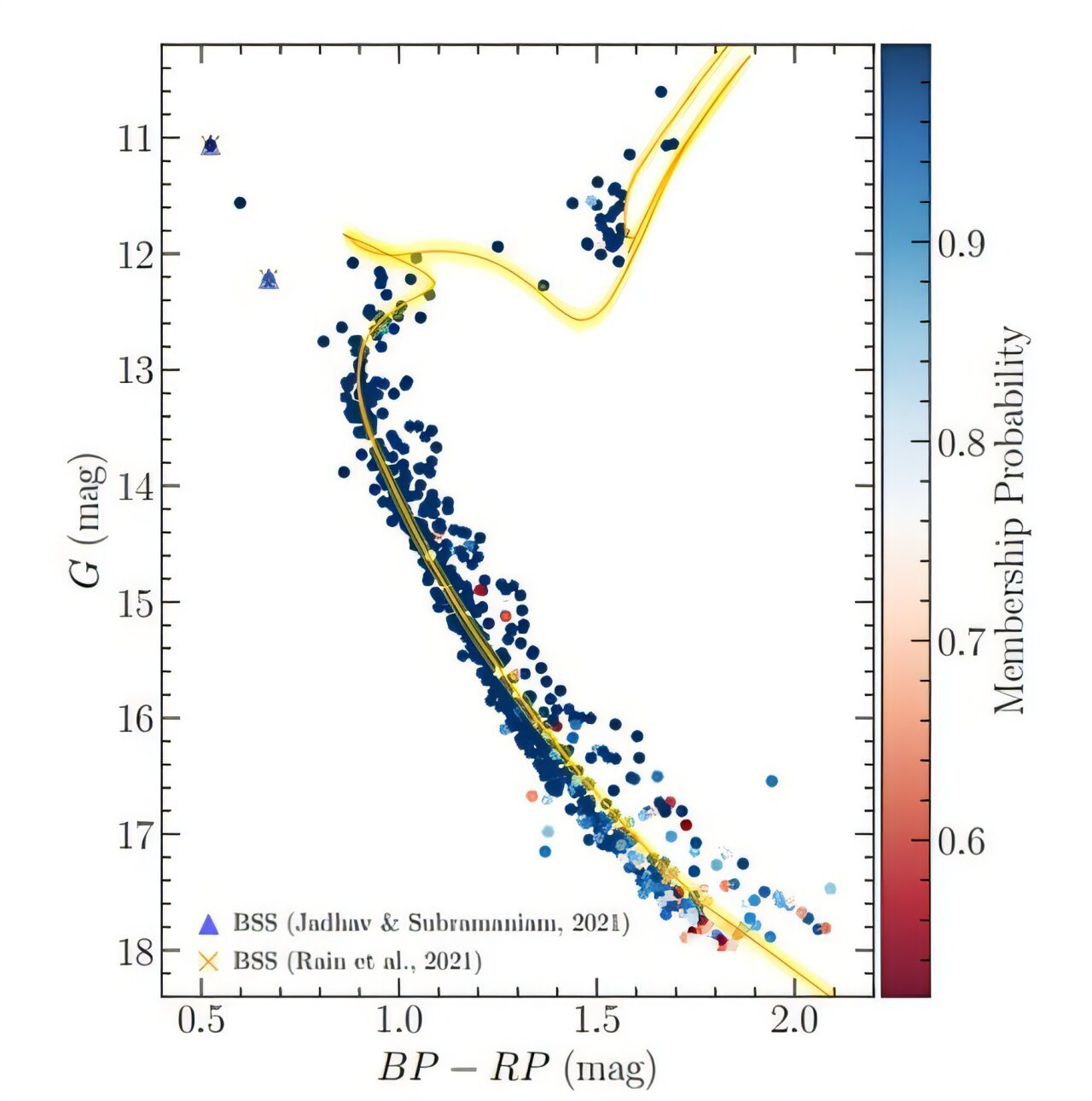
The study, led by Agus Jatmiko of Bosscha Observatory in Indonesia, was posted June 23 on the arXiv preprint server. According to the research team, the cluster is about 1.38 billion years old, compared with earlier estimates of roughly 700 million to 800 million years.
Gaia data sharpen the view
Open clusters are loose groups of stars that formed from the same giant molecular cloud. More than 1,000 have been identified in the Milky Way, and astronomers study them to test models of stellar populations and galactic development.
NGC 6134 was already known as a moderately metal-rich galactic open cluster. Previous observations showed a well-populated main sequence, a clear turnoff point and a giant branch, features that make it useful for studying the ages and properties of its stars.
Jatmiko’s team analyzed data mainly from the European Space Agency’s Gaia satellite, along with a stellar membership catalog produced using Hierarchical Density-Based Spatial Clustering, or HDBSCAN. The researchers used photometric and kinematic information to identify cluster members and assess the system’s structure.
Core, tail and halo
The team reported three components in NGC 6134: a central core, a tidal tail and a more spread-out halo. The researchers said this arrangement is likely tied to the cluster’s dynamical evolution.
The study places NGC 6134 at 3,470 light-years from Earth, a result the authors said is consistent with earlier distance measurements of about 3,400 light-years. The researchers also measured its visual absorption at 1.03 magnitude and its metallicity at 0.08 dex.
A color-magnitude diagram of the cluster showed a clear gap in the main sequence, according to the paper. The authors suggested that the feature may be connected to a high share of binary star systems in the cluster, which they estimated at 42%.
The team also examined mass segregation, a pattern in which stars of different masses are distributed differently within a cluster. The researchers said the results support a dynamical origin for NGC 6134 shaped by long-term two-body relaxation and by the preferential loss of low-mass stars.
The paper, titled “NGC 6134: a comprehensive study through photometric and kinematic analysis using Gaia DR3,” lists Agus T. P. Jatmiko and colleagues as authors. As a preprint, the work is available before formal journal peer review.
This story draws on original reporting from Phys.org.