
New physics model explains one-way interactions in bird flocks
Dresden physicists say artificial variables can make systems such as bird flocks and bacterial swarms easier to model with standard methods.
By Priya Raghavan · Science Reporter
3 min read
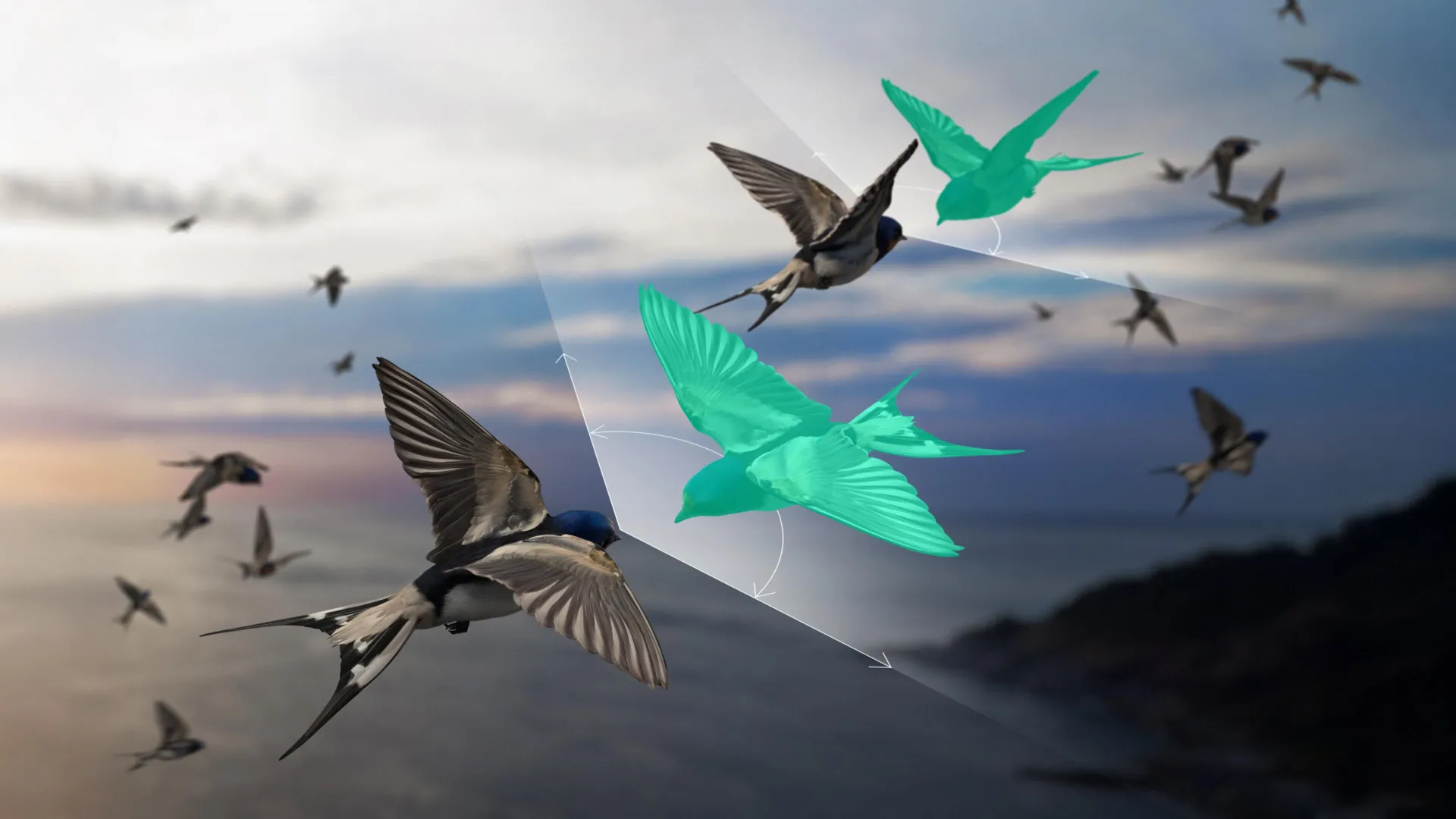
Physicists in Dresden have developed a mathematical way to model collective systems whose parts do not respond equally to one another, including bird flocks, bacterial swarms and cells in tissue. Technische Universität Dresden said the method could let researchers simulate those systems more precisely using tools already common in physics.
The work addresses a problem tied to Newton’s third law, the action-reaction principle that says forces come in equal and opposite pairs. According to the university, flocking birds can create an apparent exception because a bird may adjust to neighbors beside or ahead of it without matching its movement to birds behind it.
Physicists describe such cases as non-reciprocal interactions. In reciprocal systems, two parts affect each other in balanced ways; in non-reciprocal systems, the influence can run more strongly in one direction. Technische Universität Dresden said traditional theories have had difficulty describing those systems exactly because much of classical mechanics is built around reciprocal behavior.
The new theory was developed by researchers connected to the Cluster of Excellence ctd.qmat in Würzburg and Dresden, working with Roderich Moessner, a principal investigator at the cluster and director of the Max Planck Institute for the Physics of Complex Systems in Dresden. The findings were published in Nature Physics by Yu-Bo Shi, Moessner, Ricard Alert and Marin Bukov.
How the model works
The researchers’ approach adds artificial variables, known in physics as auxiliary degrees of freedom, to the description of a system. Technische Universität Dresden said these variables do not correspond to real birds, bacteria or cells, but act as mathematical partners that let one-way interactions be rewritten in a reciprocal form.
In the example of a flock, the model treats each real bird as if it had a fictitious partner placed in front of it and oriented in the opposite direction, according to Ricard Alert, a biophysicist on the research team. That construction lets physicists use established methods for reciprocal systems while still capturing the behavior of a flock that does not actually behave reciprocally.
Marin Bukov, a research group leader, said the result extends parts of standard theoretical mechanics to systems where Newton’s third law does not apply in the usual way. The university said the method can describe these systems exactly and simulate them with much higher accuracy than earlier approaches.
Auxiliary degrees of freedom are not new in physics. The advance, according to Technische Universität Dresden, is their use in a systematic theory for non-reciprocal interactions, allowing researchers to connect these complex systems to the framework of many-body physics.
Why researchers care
Technische Universität Dresden said better models of non-reciprocal behavior could help researchers study several forms of collective motion, from animal groups to bacterial colonies and cell assemblies. The same broad class of behavior can also appear in crowds, where individuals respond only to part of what is around them.
Moessner said the question now is whether exceptions to the usual action-reaction rule can produce new forms of collective quantum behavior. The ctd.qmat cluster studies quantum matter, including systems where particle interactions can produce phenomena such as magnetism or lossless current transport, according to the university.
The journal paper is titled “Hamiltonian description of non-reciprocal interactions” and appears in Nature Physics. Technische Universität Dresden identified the authors as Yu-Bo Shi, Roderich Moessner, Ricard Alert and Marin Bukov.
This story draws on original reporting from ScienceDaily.