
New 3D particle detector uses one scintillator block instead of millions of parts
Researchers say PLATON can reconstruct faint particle tracks with light-field imaging, photon sensors and AI, with possible uses in PET scans.
By Tom Brennan · Health & Medicine Correspondent
3 min read
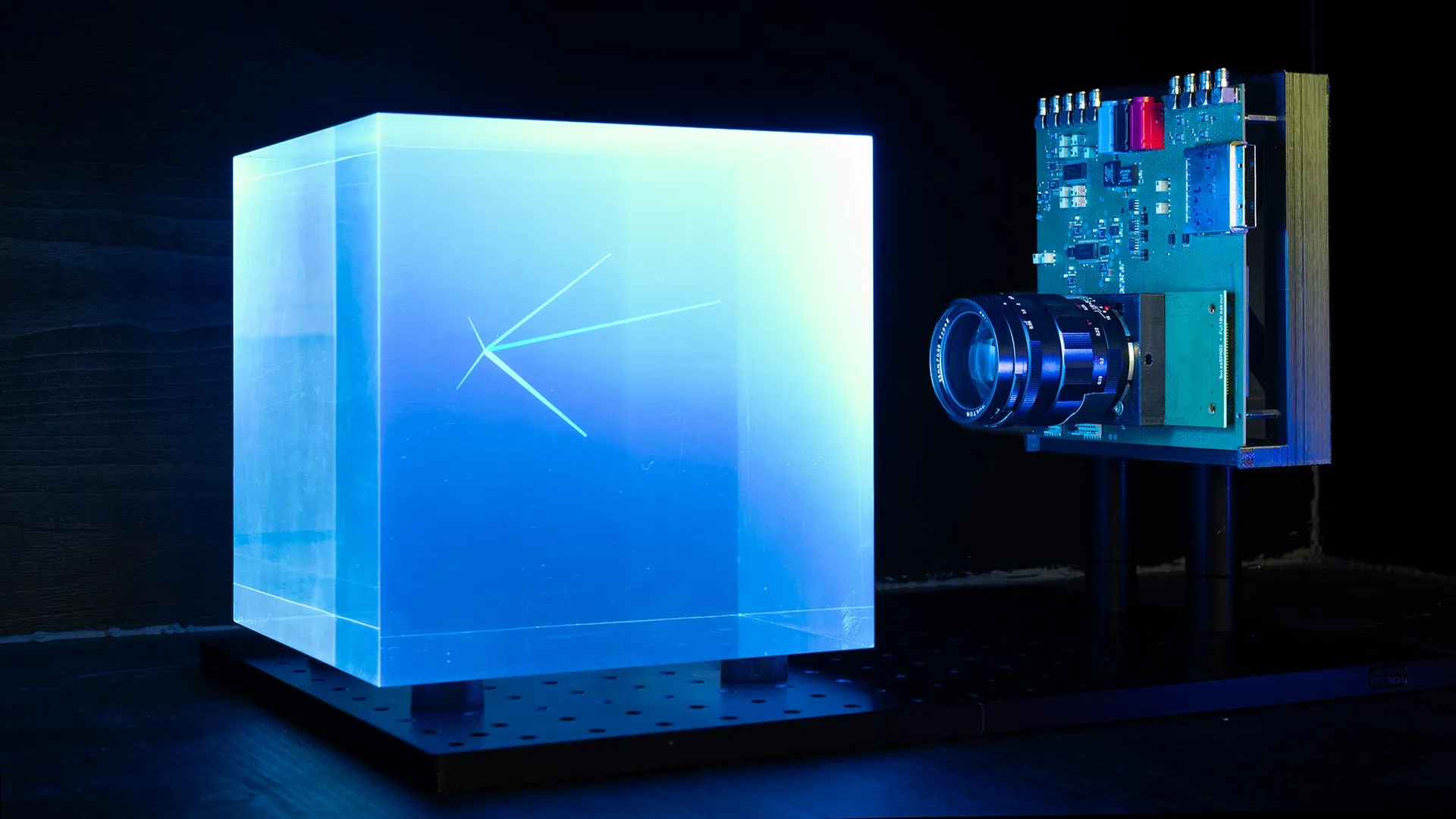
Researchers in Switzerland have built and tested a prototype particle detector that tracks faint particle signals in three dimensions without carving its target material into millions of small pieces. ETH Zurich says the system, called PLATON, could make future detectors easier to scale for neutrino studies, collider experiments and medical imaging.
The work, reported in Nature Communications, was led by researchers at ETH Zurich and EPFL. The team includes PhD student Till Dieminger, senior scientist Saúl Alonso-Monsalve, ETH professor Davide Sgalaberna and members of EPFL professor Edoardo Charbon’s Advanced Quantum Architecture Lab.
Replacing segmentation with imaging
Many particle detectors use scintillators, materials that emit tiny flashes of visible light when charged particles pass through them. Scientists read those flashes to infer where particles traveled and how they interacted with the detector.
According to ETH Zurich, conventional high-resolution systems often split scintillator material into large numbers of small active parts, then use optical fibers and photon sensors to collect the light from each section. That design can work well, but it becomes harder and more expensive to build as detectors grow.
ETH Zurich cited several examples of that complexity. The T2K neutrino-oscillation experiment in Japan uses about two tons of sensitive material made from roughly two million cubes and 60,000 fibers, while the LHCb and Mu3e experiments use millions of thin scintillating optical fibers to reach sub-millimeter precision.
PLATON takes a different approach. Instead of relying on a highly segmented detector, the prototype uses a single, unsegmented block of scintillator and reconstructs the light’s origin with a specialized camera system.
A light-field camera for particle physics
The detector adapts plenoptic, or light-field, camera technology. Unlike a standard camera, a light-field camera records both the intensity of incoming light and directional information, allowing software to infer depth.
In PLATON, a micro-lens array sits with a single-photon avalanche diode imaging sensor. ETH Zurich says the sensor, SwissSPAD2, was developed by the EPFL team, while Raytrix GmbH designed the micro-lens array and mounted it directly on the sensor.
The SwissSPAD2 sensor can record photons in defined time windows. That feature helps the detector concentrate on intervals when scintillation light is expected and reduce random background counts, according to ETH Zurich.
The researchers tested the prototype with light levels ranging from several hundred detected photons down to five. They also used a strontium-90 source to produce electrons and studied whether the detector could reconstruct their positions inside plastic scintillator.
ETH Zurich said the simulations matched the lab measurements closely enough to guide the design of the next version. The team is now working on a new SPAD array with better photon detection efficiency and timing below one nanosecond for individual photons.
AI-assisted reconstruction and possible medical use
The researchers also simulated how an upgraded PLATON detector could perform in neutrino detection. Their image-processing method uses a neural network with a Transformer architecture, adapted to analyze patterns in where and when scintillation photons appear rather than text.
According to the paper, simulations suggest an unsegmented PLATON detector measuring 10 by 10 by 10 centimeters could reach spatial resolution below 1 millimeter. The team also reported that it could identify neutrino interactions producing low-momentum protons with high purity and efficiency.
For a larger one-cubic-meter detector, the researchers did not run full neutrino simulations because of computing limits. Instead, they modeled a simplified point-like photon source, with results suggesting spatial resolution of a few millimeters.
ETH Zurich says the same technology could have uses outside particle physics because it reconstructs weak light signals in three dimensions. Dieminger, Alonso-Monsalve and Sgalaberna have filed three patents related to PLATON technology for positron emission tomography, including scanner designs and neural-network-based image processing.
This story draws on original reporting from ScienceDaily.