
Machine learning screen points to six CO2 conversion solvents
Stony Brook researchers used simulations and machine learning to search 1.3 million molecules for electrolytes that could aid CO2 electroreduction.
By Priya Raghavan · Science Reporter
3 min read
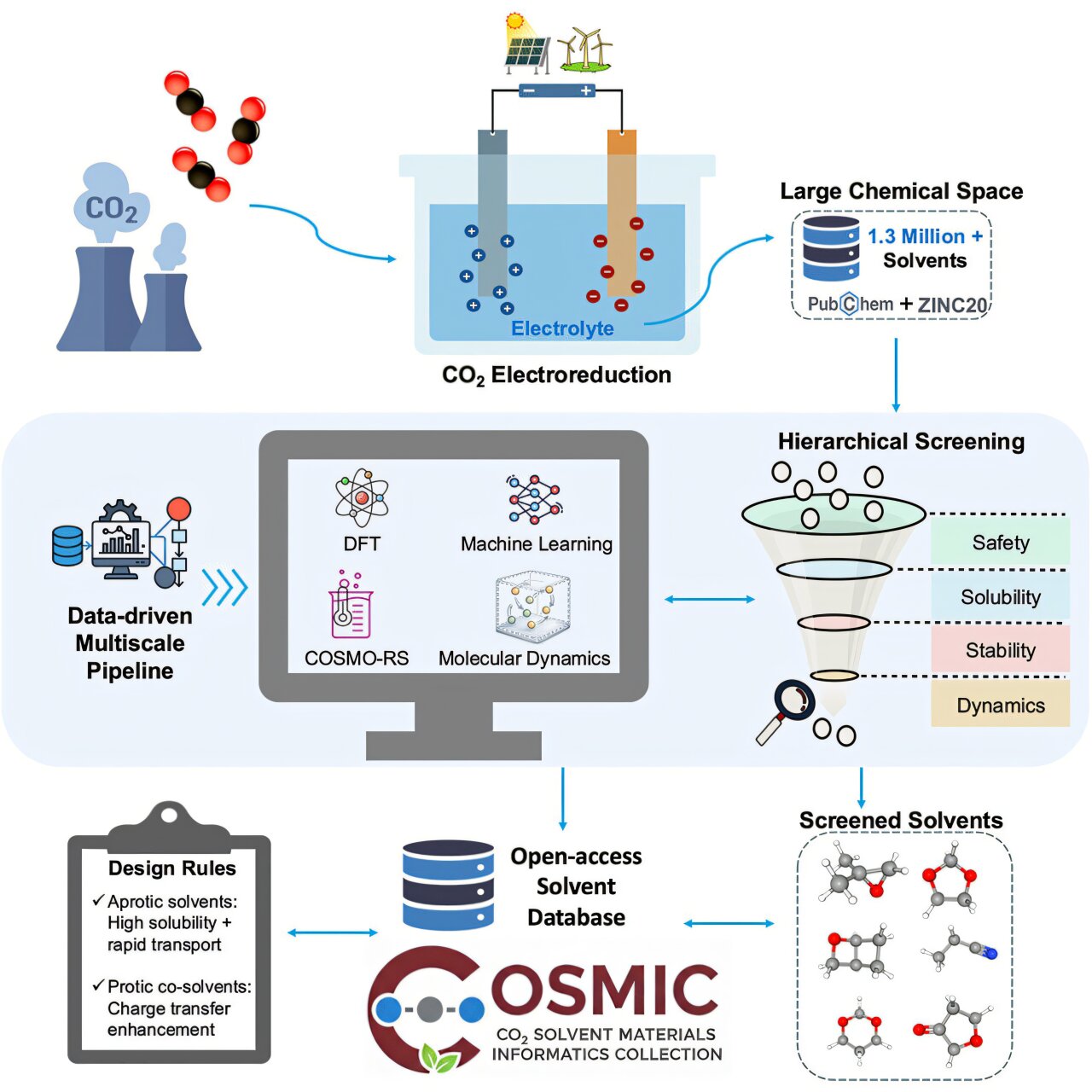
Researchers at Stony Brook University have identified six previously untested solvents that could help turn carbon dioxide into useful chemicals through electroreduction. The work matters because the liquid used in these systems can strongly affect whether CO2 conversion is efficient enough to support clean-energy applications.
The findings were published in Cell Reports Physical Science in a paper titled “Data-Driven Molecular Design Rules for Electrolytes in CO2 Electroreduction,” according to Stony Brook University. The study was led by Ph.D. researcher Kuldeepsinh Raj and principal investigator Nav Nidhi Rajput, a professor in the Department of Materials Science and Chemical Engineering.
CO2 electroreduction uses electricity to chemically convert carbon dioxide into products such as carbon monoxide, ethylene and ethanol, Stony Brook said. The university described the broader goal as using clean electricity to build chemical recipes that can transform emissions into fuels and other products.
Why the solvent search is hard
The Stony Brook team focused on electrolytes, the liquid environments inside electroreduction devices. According to the university, an electrolyte affects how much CO2 dissolves, how quickly it moves through the system, how stable the liquid remains under voltage and which products are made.
That creates a large screening problem. Stony Brook said there are millions of possible liquids, and testing them one by one would take decades.
To shorten that search, the researchers built a computational system that combined physics, chemistry simulations and machine learning. They used it to screen 1.3 million candidate molecules, according to the university.
Six candidates and design rules
From that screen, the team selected six promising solvents: five cyclic ethers and one nitrile. Stony Brook said those solvents had not previously been tested for CO2 electroreduction.
The university said the candidate solvents dissolved large amounts of CO2 and allowed it to move quickly through the system. Those two properties are described by the researchers as key requirements for efficient electroreduction.
The work also produced broader guidance for future electrolyte design. According to Stony Brook, the team examined atomic structure to determine why some molecules performed better than others, producing molecular design rules for building improved electrolytes.
The researchers made the study’s data, models and findings available through an open-access database called COSMIC, short for CO2 Solvent Materials Informatics Collection. Stony Brook said the database is intended to let other researchers use the results in designing future clean-energy devices.
Dilip Gersappe, professor and chair of Stony Brook’s Department of Materials Science and Chemical Engineering, said the project reflects the department’s work combining computational methods with basic science. He said Rajput and Raj had created a faster path for carbon-utilization research and that the COSMIC database gives clean-energy researchers a shared starting point.
The publication is listed as Kuldeepsinh Raj et al., “Data-driven molecular design rules for electrolytes in CO2 electroreduction,” in Cell Reports Physical Science, with DOI 10.1016/j.xcrp.2026.103390.
This story draws on original reporting from Phys.org.