
Little red galaxies emerge as possible source of cosmic neutrinos
A Kyoto University study links JWST’s Little Red Dots to some high-energy neutrinos detected on Earth.
By Lucas Ferreira · Science & Environment Writer
3 min read
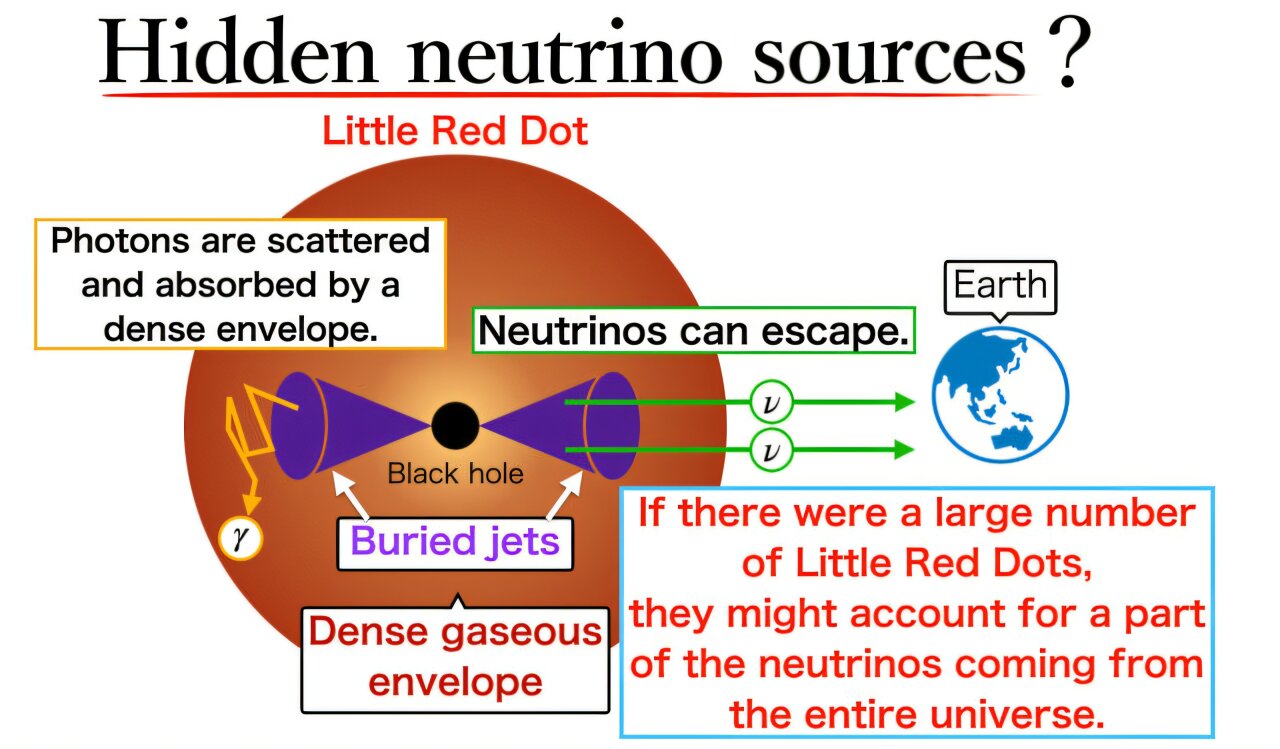
Small red galaxies spotted in the distant universe by the James Webb Space Telescope may help explain part of a long-running particle-physics puzzle, according to Kyoto University. In a study published in Physical Review D, researchers argue that some of these galaxies, called Little Red Dots, could send high-energy neutrinos across space while hiding the gamma rays that usually accompany them.
Kyoto University said astronomers have found many Little Red Dots in the high-redshift universe. Based on observations, researchers suspect that at least some contain growing supermassive black holes wrapped in thick gas near their centers.
That setting matters because high-energy neutrinos are difficult to trace, the university said. Neutrinos are electrically neutral elementary particles with masses close to zero, and detectors on Earth have recorded high-energy neutrinos arriving from across the sky, but their overall origin remains unresolved.
Why hidden sources are needed
The Kyoto University team, led by first author Riku Kuze, focused on the problem of gamma rays. The university said high-energy neutrinos can form when energetic particles, including protons, collide with photons or matter around them.
According to the study, those same environments tend to generate gamma rays. If every neutrino source also let its gamma rays escape freely, the total gamma-ray background would be higher than what astronomers observe, Kyoto University said.
That makes obscured objects strong candidates, the researchers reported. In such systems, dense surrounding material can block or degrade gamma rays, while neutrinos can pass through without much interaction.
Kyoto University said Little Red Dots fit that possibility because many show little radio or X-ray emission associated with jets or outflows. Kuze’s team therefore examined a case in which jets near the central black hole are buried inside a dense gas envelope.
Modeling the neutrino output
The researchers estimated how much Little Red Dots might add to the all-sky high-energy neutrino background using typical luminosity and number density, Kyoto University said. They also ran numerical calculations to model particle acceleration, the secondary particles created in the process, cooling effects and the expected neutrino spectrum.
The study found that, if particle acceleration takes place in the buried black hole environments of Little Red Dots, the galaxies could produce high-energy neutrinos while keeping gamma rays suppressed. Under that condition, Kyoto University said, they could account for a portion of the high-energy neutrino background measured on Earth.
Kuze said, according to Kyoto University, that individual Little Red Dots are difficult to observe directly, but their abundance makes them worth testing as contributors to the observed neutrino signal. The university described the study as the first to show that these galaxies could explain part of the measured high-energy neutrinos under the proposed conditions.
The team’s next questions include estimating the mix of neutrino types, known as flavors, and studying how jets could become buried inside the gas envelopes around the central black holes, Kyoto University said.
The paper, “Little red dots as hidden neutrino sources,” was published in Physical Review D. Kyoto University listed Riku Kuze and colleagues as the authors and provided the DOI 10.1103/vbfz-ncxd, with an arXiv version at 10.48550/arxiv.2601.11203.
This story draws on original reporting from Phys.org.