
Study identifies linked bacterial motors that pull in resistance DNA
Researchers found how two proteins coordinate to retract bacterial pili, a process tied to DNA uptake, biofilms and antibiotic resistance.
By Lucas Ferreira · Science & Environment Writer
3 min read
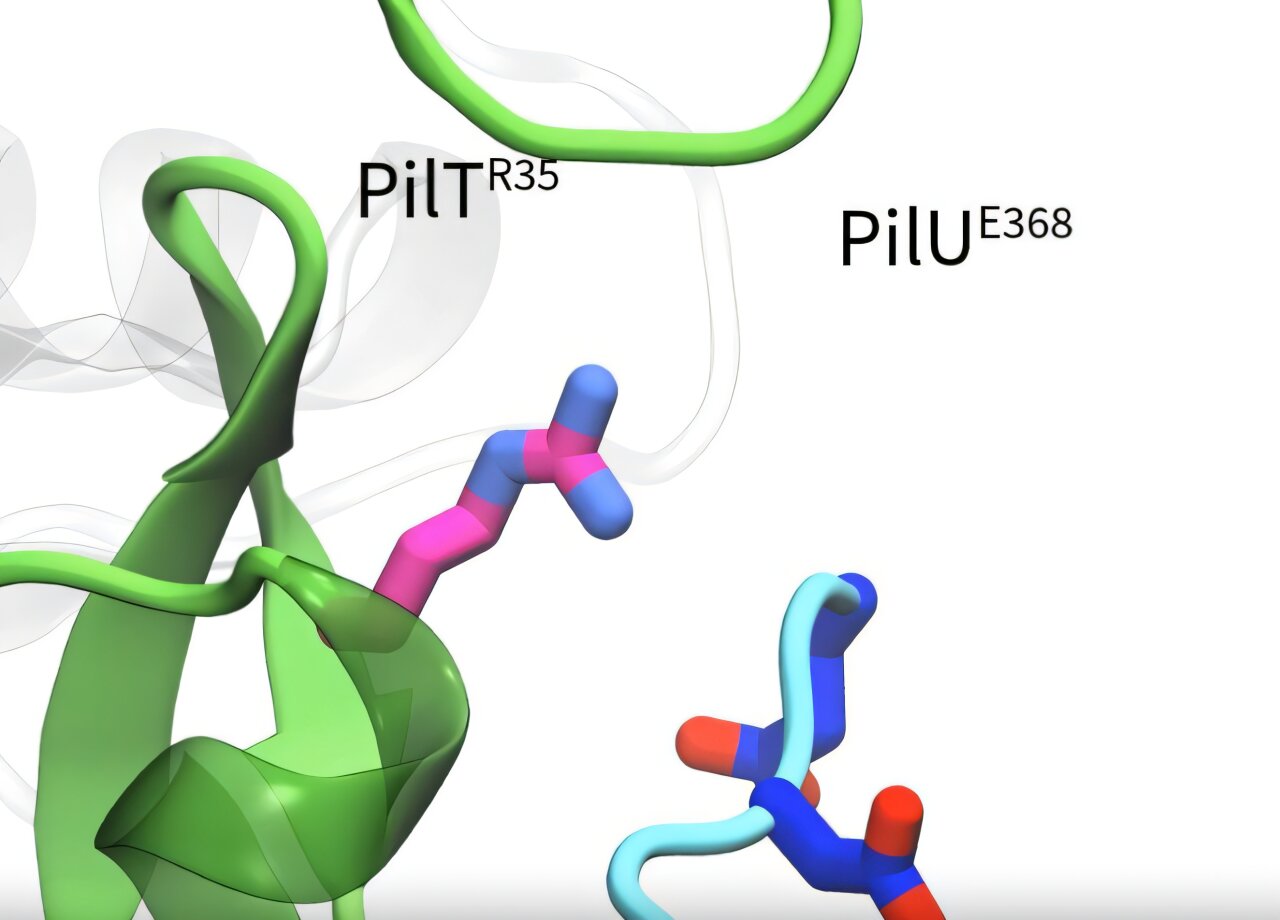
Researchers have identified how bacteria coordinate two molecular motors to reel in surface fibers that can draw in drug-resistance genes. The finding matters because that DNA uptake is one way disease-causing bacteria can acquire traits that make antibiotics fail, according to Indiana University.
The study, led by scientists at Indiana University Bloomington with colleagues at Dartmouth College and the Georgia Institute of Technology, was published in the Proceedings of the National Academy of Sciences. The team focused on type IV pili, thin fibers on bacterial surfaces that extend outward and then retract with high force.
Indiana University said such fibers are found on many bacteria that cause disease. They help bacteria attach to tissue, form biofilms and pull in DNA fragments from their surroundings, including genes linked to antibiotic resistance.
The study examined Vibrio cholerae, the bacterium that causes cholera. Indiana University said related pili functions are also important in pathogens such as Pseudomonas aeruginosa, which can grip the airway lining during lung infections in people with cystic fibrosis, and Neisseria gonorrhoeae, which uses pili as it colonizes the urogenital tract.
Two proteins working as one system
Scientists already knew that pilus retraction depends on two motor proteins, PilT and PilU, inside the bacterial cell, according to the university. The open question was how the two proteins work together and why the system needs both.
The researchers used AlphaFold 3, a protein-modeling tool, to predict interactions among PilT, PilU and PilC, a protein that anchors the motor system to the pilus machinery. Their models indicated that PilT connects the system to the pilus machinery while also positioning PilU.
According to the study, PilU depends on PilT to join the machinery. Once assembled, the two proteins stack together, and a tail on PilU wraps around PilT, a contact the researchers said may allow the motors to coordinate their movement.
The team also used molecular dynamics simulations to observe predicted atomic-scale interactions between the two proteins over hundreds of nanoseconds. Indiana University said the simulations helped identify specific contact points holding PilT and PilU together.
The researchers then tested those predictions in the lab by changing selected molecular contacts and observing bacterial behavior. According to Indiana University, disrupting the PilT-PilU connection did not kill the bacteria, but it prevented normal DNA uptake.
Possible target for resistance spread
Abigail Teipen, the study’s lead author and a graduate student in biology at IU Bloomington, said the work addresses how strong molecular motors coordinate their activity. Ankur Dalia, an IU biology professor and senior author, said interfering with that coordination could offer a route to limiting the spread of antibiotic-resistance genes and bacterial infection.
The researchers calculated that a single motor protein should generate about 50 piconewtons of force. Indiana University said pili in living bacteria have been measured pulling with more than twice that force, supporting the idea that PilT and PilU synchronize their energy cycles.
The study also found evidence that the mechanism extends beyond cholera bacteria. According to Indiana University, the same key molecular contact appears in Acinetobacter baylyi, and sequence analysis suggests similar coordination is conserved across many disease-causing bacteria, including Pseudomonas aeruginosa and Legionella pneumophila, the cause of Legionnaires’ disease.
This story draws on original reporting from Phys.org.