
LARS1 mTORC1 cancer therapy route emerges from growth-switch study
KAIST and Yonsei researchers traced how LARS1 activates mTORC1, suggesting a possible upstream target for future cancer drugs.
By Priya Raghavan · Science Reporter
3 min read
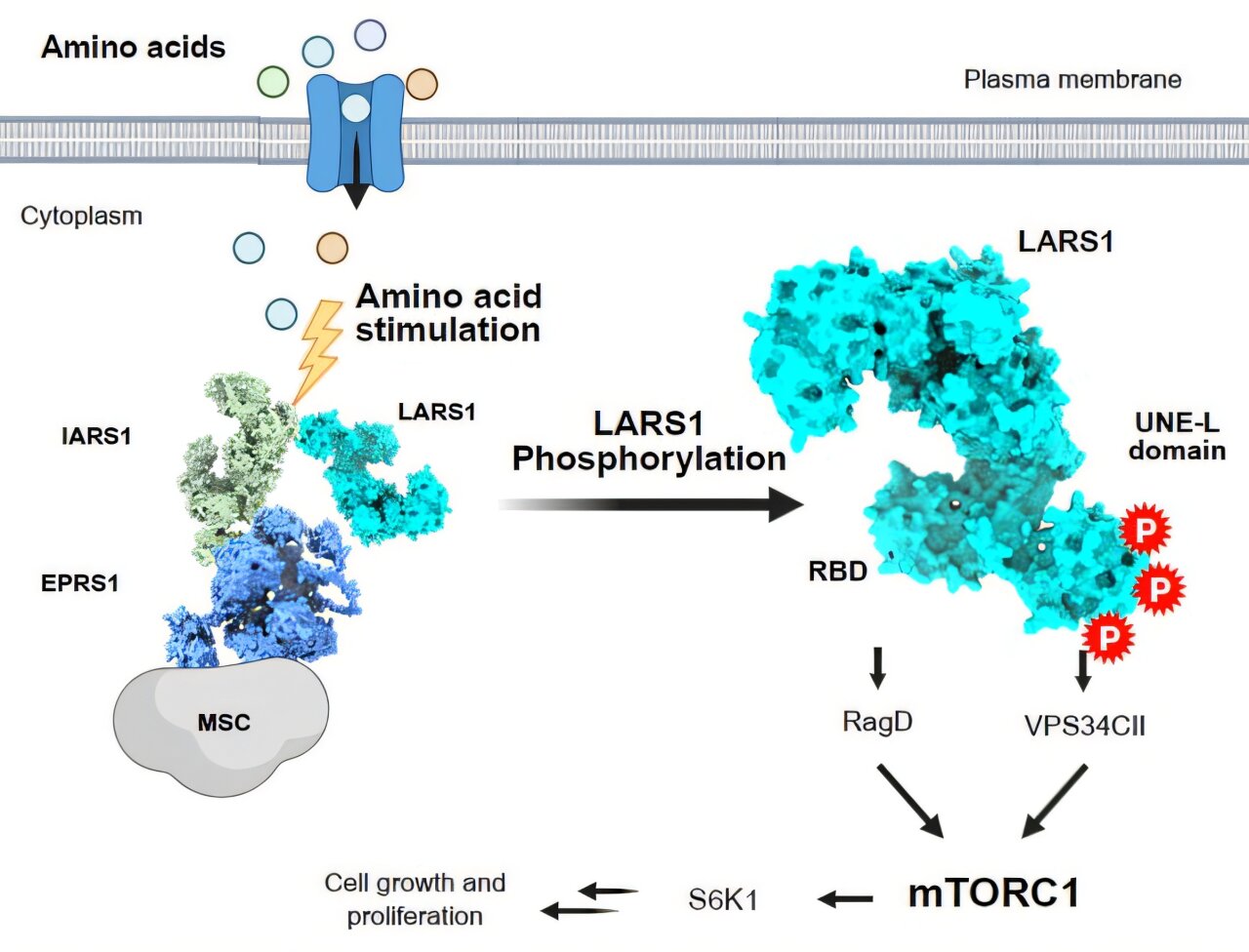
Researchers in South Korea have identified how the protein LARS1 helps turn nutrient availability into a cell-growth signal, a finding that may point toward a LARS1 mTORC1 cancer therapy strategy. KAIST said the work matters because overactive mTORC1 signaling is associated with numerous cancers, while directly blocking mTORC1 can also interfere with normal cell growth and metabolism.
The study was led by professors Hee-Sung Park and Jin Young Kang of KAIST’s Department of Chemistry, working with Professor Sunghoon Kim’s team at Yonsei University. The findings were published in Nature Communications.
How does LARS1 activate mTORC1?
KAIST said the team found that amino acid stimulation causes LARS1, or leucyl-tRNA synthetase 1, to undergo phosphorylation. Phosphorylation is a chemical modification that can change how a protein behaves or which partners it binds.
Under low-nutrient conditions, according to the researchers, LARS1 remains held inside the multi-tRNA synthetase complex, or MSC. When amino acids are sufficient, phosphorylated LARS1 separates from IARS1, the protein that anchors it in that complex, and the released LARS1 activates mTORC1.
mTORC1, short for mammalian target of rapamycin complex 1, is a protein complex that helps control growth, protein production and metabolism when nutrients and energy are available. The researchers describe it as a central growth switch whose excessive activity can support unwanted cell proliferation.
Cryo-EM showed the structural basis
To see how the proteins interact, the team used cryo-electron microscopy, or cryo-EM. The method images protein complexes in three dimensions at near-atomic resolution after samples are rapidly frozen at very low temperatures.
The researchers reported that LARS1 and IARS1 normally bind tightly. Amino acid stimulation led to phosphorylation of LARS1, which weakened that interaction and allowed LARS1 to leave the MSC.
The team also created phosphomimetic LARS1 variants, mutant proteins designed to imitate the phosphorylated form. KAIST said those variants substantially increased mTORC1 activity, supporting the conclusion that LARS1 phosphorylation acts as the switch connecting amino acid signals to growth signaling.
Why the finding could matter for cancer drugs
Some anticancer drugs inhibit mTORC1 directly, according to KAIST. Because mTORC1 also has normal roles in cellular growth and metabolism, that approach can affect healthy cells as well as cancer cells.
The researchers said a more selective strategy could come from identifying the kinase that phosphorylates LARS1 and the mechanism that controls it. A kinase is an enzyme that adds phosphate groups to proteins, and in this case it would sit upstream of mTORC1 in the signaling chain.
KAIST said targeting that upstream step could, in principle, interrupt abnormal growth signaling before it reaches mTORC1. The study does not report a cancer drug or clinical test; it defines a molecular mechanism that future drug research could examine.
The paper is titled “Cryo-EM structure of the LARS1:IARS1 complex reveals a nutrient-responsive switch controlling mTORC1 signaling.” The listed first author is Youjin Kim, and the DOI is 10.1038/s41467-026-74085-x.
This story draws on original reporting from Phys.org.