
Study finds languages reuse word parts to balance brevity and clarity
Research across more than 1,900 languages suggests partial word reuse helps languages link related meanings without making them too easy to confuse.
By Lucas Ferreira · Science & Environment Writer
3 min read
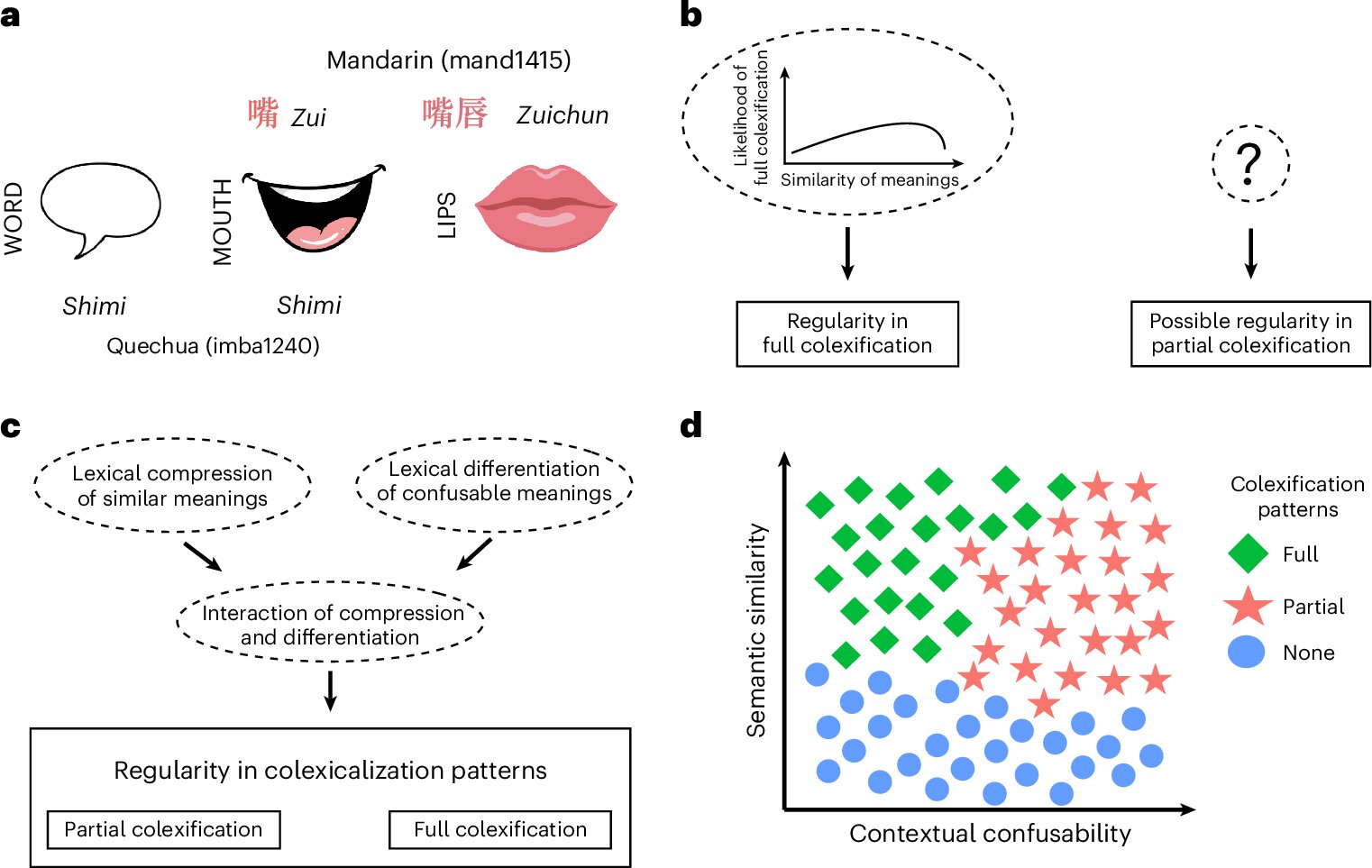
Languages often reuse pieces of words in a patterned way, according to a study published in Nature Human Behaviour. The finding matters because it points to a broad pressure in language: speakers favor compact forms, but they also need words to stay distinct enough to avoid confusion.
The study, by Thomas Brochhagen and colleagues, examined what linguists call colexification, the use of the same form for more than one meaning. English offers a familiar case: “run” can describe fast movement or managing an organization. Spanish uses “lengua” for both tongue and language, as Phys.org reported.
The new work focused on a related but less studied pattern: partial colexification. In those cases, languages reuse only part of a word, as English does with “grand” in “grandfather” and “grandmother.”
Testing a pressure in word forms
The researchers set out to test how languages manage two competing tendencies, according to the study. One is lexical compression, in which forms are reused to keep vocabularies efficient. The other is lexical differentiation, in which different forms help speakers separate meanings.
To study the pattern at scale, the team used Lexibank, a large database of word lists from many languages. The study covered more than 1,900 languages across 192 language families, according to Phys.org.
The researchers also needed a way to measure how close two meanings are to each other. For that, they used data from a word-association game in which thousands of participants were shown a word and asked to give the first word that came to mind.
They then used artificial intelligence models to compare how words appear across millions of sentences. That analysis helped estimate whether two meanings tend to occur in similar contexts, which would raise the chance of confusion if they shared the same form.
A middle position between sameness and difference
The study found that partial word reuse appears across many language families and does not occur at random, according to the researchers. Full colexification is more likely when meanings are closely related but easy to distinguish in use, such as “mouth” for a body part and for the opening of a river.
Partial colexification, by contrast, tends to appear when meanings are related but also used in overlapping contexts. In those cases, the researchers found, languages can preserve a visible link between meanings while keeping the forms separate enough to reduce ambiguity.
One example discussed by the researchers’ model is the relationship between “fourteen” and “ten.” The meanings are closely connected, but because number words are used in similar situations, giving them identical forms would risk misunderstanding. Related but distinct forms can reduce that risk.
Barend Beekhuizen, of the Department of Language Studies at the University of Toronto Mississauga, discussed the research in a News & Views article in the same journal. The study authors said future research could test whether the same balance between efficiency and clarity also shapes other parts of language, including grammar.
This story draws on original reporting from Phys.org.