
Lab device mimics black hole energy extraction
CUNY researchers reported wave amplification in a stationary radio-frequency system designed to simulate extreme rotation.
By Priya Raghavan · Science Reporter
3 min read
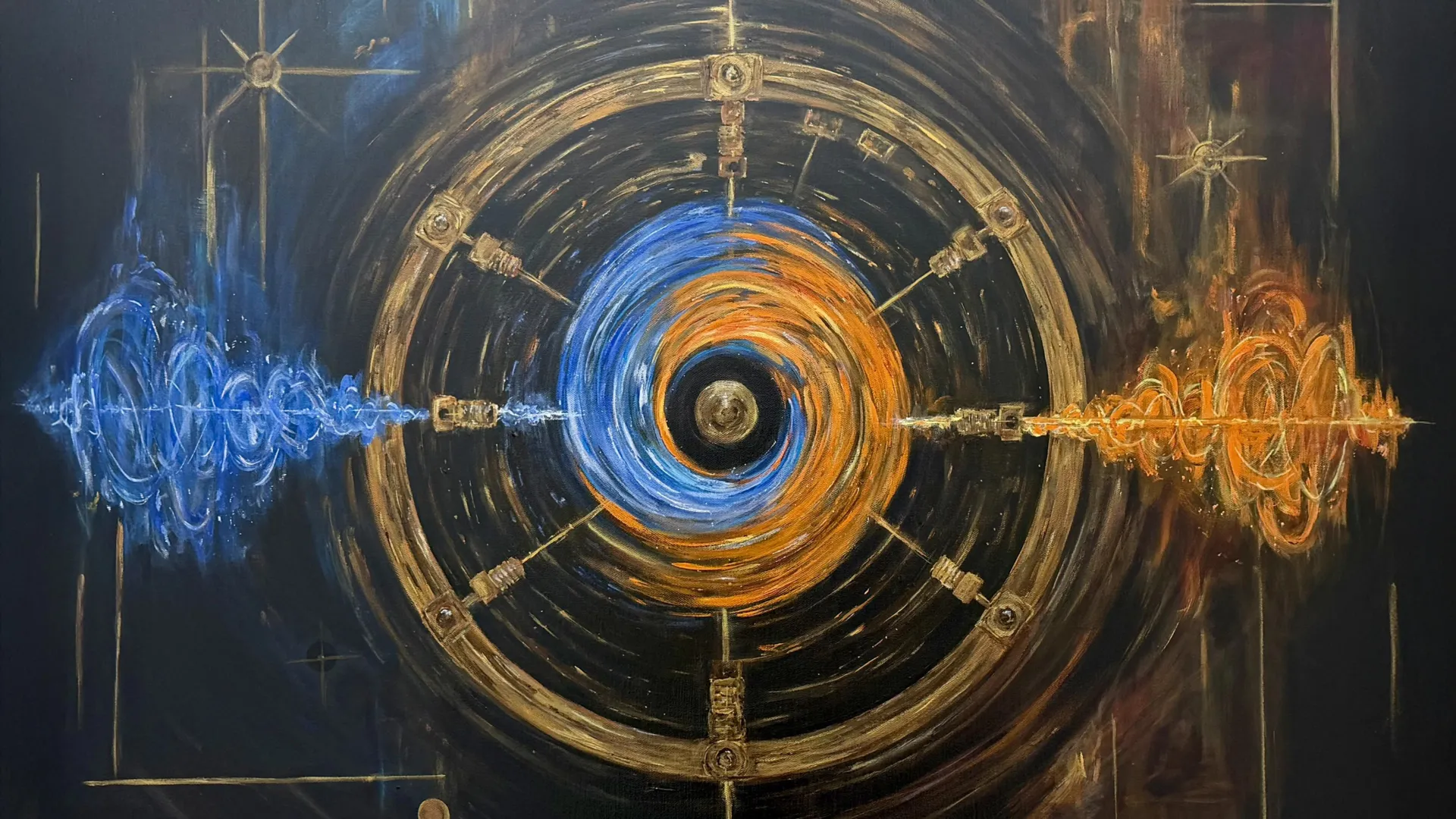
Physicists at the Advanced Science Research Center at the CUNY Graduate Center have recreated a key feature of black hole energy extraction in a laboratory device, according to research published in Nature. The experiment matters because it turns a decades-old idea about spinning black holes into a controllable system for studying wave physics.
The CUNY ASRC team reported that electromagnetic waves gained energy when they interacted with a stationary radio-frequency device engineered to act as if it were rotating at extreme speed. The work was described by the center as an experimental version of physics inspired by ideas from Roger Penrose and Yakov Zel'dovich.
A theory brought into the lab
Penrose proposed more than 50 years ago that energy could be drawn from a rapidly rotating black hole under certain conditions, according to the CUNY ASRC account of the work. In that picture, a particle entering the ergosphere, where spacetime is dragged by the black hole's spin, could divide so that one piece falls inward while another escapes with extra energy.
Zel'dovich later extended the idea to waves, predicting that waves could be amplified after interacting with a sufficiently fast rotating object, according to the research summary. The CUNY ASRC team said its experiment reproduced the central wave-amplification effect without using a physically spinning object.
How the device worked
The researchers built a ring of electronic resonators and rapidly varied their properties in a timed pattern, according to the CUNY ASRC. The hardware stayed still, while the changing pattern moved around the ring and made incoming electromagnetic waves experience the system as if it were rotating very fast.
The team said this synthetic rotation reached effective speeds beyond what ordinary mechanical rotation could produce. According to the researchers, waves with the right rotational properties drew energy from the engineered system and became amplified.
The Nature paper, titled “Observation of Floquet rotational super-radiance,” lists Hadiseh Nasari, Hady Moussa, Yoshiaki Kasahara, Arno Thielens and Andrea Alù as authors. The journal reference identifies the result as an observation of rotational super-radiance in a time-engineered system.
Possible uses and limits
Andrea Alù, a Distinguished Professor and Einstein Professor of Physics at the CUNY Graduate Center and founding director of the CUNY ASRC Photonics Initiative, said the approach offers a way to make selected rotating wave modes extract energy from synthetic rotation. The center said the result produces broadband selective amplification.
Nasari, a postdoctoral researcher at the CUNY ASRC Photonics Initiative, said the experiment provides a platform for studying phenomena that connect astrophysics, wave physics and quantum science. Moussa, identified by the center as a former Ph.D. student in the initiative, said the method uses engineered metamaterials to control wave propagation.
The researchers said the same principles could inform future work in optics, photonics, wireless communications and quantum technologies. The CUNY ASRC also said more research will be required before the ideas can be used in practical devices.
The research was supported by the U.S. Department of Defense, the U.S. National Science Foundation and the Simons Foundation, according to the CUNY ASRC.
This story draws on original reporting from ScienceDaily.