
Ion transport membrane design gains a water-level guide
Researchers found polymer backbone flexibility can improve ion conductivity while limiting water uptake in energy-device membranes.
By Tom Brennan · Health & Medicine Correspondent
3 min read
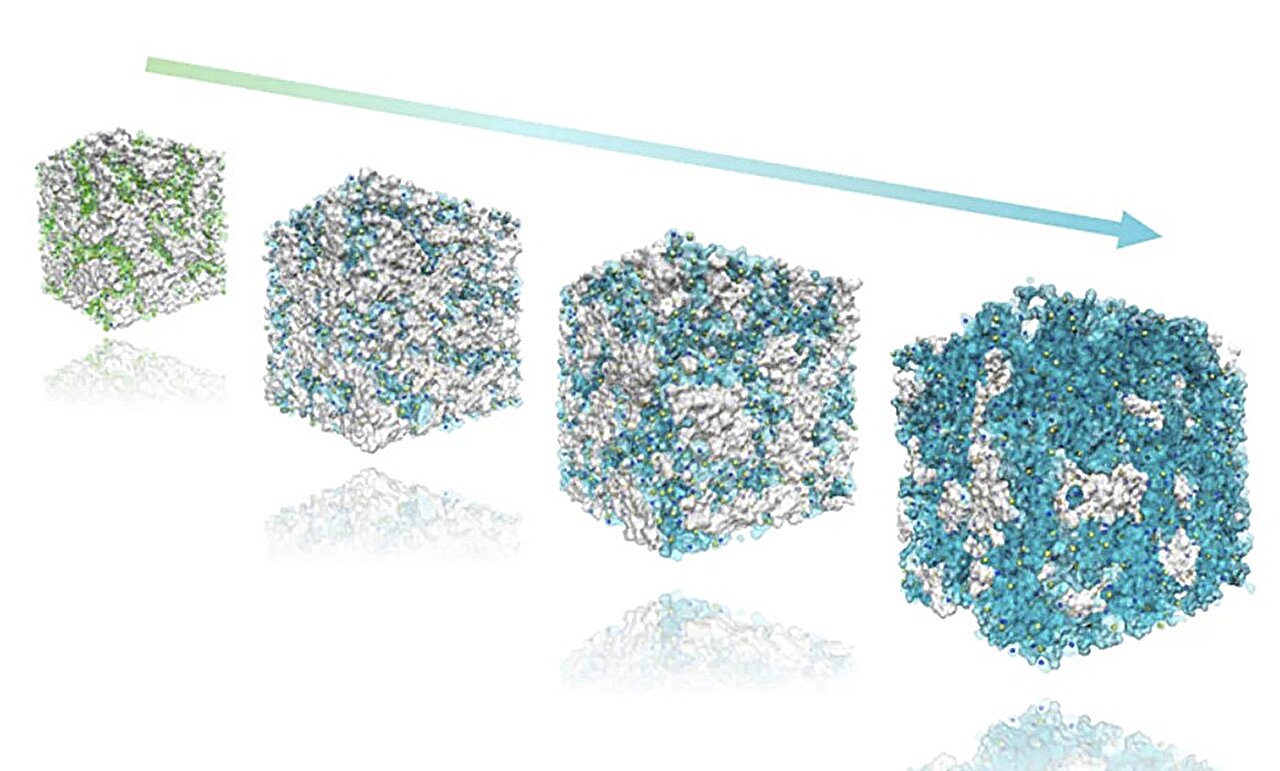
Ion transport membrane design could get a clearer set of rules from new research showing that tiny structures inside some membranes change as water moves through them. The finding matters for fuel cells and water electrolyzers, which rely on membranes that let selected ions and water pass while blocking other material.
Researchers at the University of Chicago Pritzker School of Molecular Engineering worked with scientists at New York University to study how polymer backbone chemistry affects ion-exchange membranes, the University of Chicago reported. Their results were published in the Journal of the American Chemical Society.
The team found that the membranes’ internal nanostructures do not stay fixed when water is introduced. According to the researchers, the stiffness or flexibility of the polymer backbone helps determine what ionic structures form, how water spreads inside the membrane and how easily ions move.
How do ion-exchange membranes move ions?
Ion-exchange membranes are materials designed to allow certain ions to pass through while restricting others. In energy devices, better ion movement can raise performance, but taking in too much water can weaken mechanical stability, according to the University of Chicago.
The study focused on anion-conducting polyelectrolytes, or ACPs. These positively charged polymers support the movement of negatively charged ions along polymer chains inside a membrane, the university said.
The researchers synthesized and tested three ACPs with different backbone structures. One material came from the Kohl group at the Georgia Institute of Technology, according to the University of Chicago.
The work centered on hydrocarbon-based polymers rather than the fluoropolymers often used in this class of membrane. University of Chicago graduate student Mincheol Kim, who led the work, said the hydrocarbon materials are promising from both environmental and stability perspectives, while adding that researchers still need more basic understanding of how they function.
What did the simulations show?
The team combined laboratory experiments with molecular dynamics simulations. Professor Paul Nealey, a co-author, said the pairing of experimental work and molecular simulation was important for connecting molecular-level behavior to the performance of the materials.
The simulations were led by Ge Sun, a co-first author now at NYU’s Courant Institute School of Mathematics, Computing, and Data Science, and Juan de Pablo, now executive dean of the NYU Tandon School of Engineering. According to the University of Chicago, those simulations gave the researchers atomic-scale detail that experiments alone could not provide.
The study found that more defined nanostructures can create additional pathways for ions without requiring excessive water uptake. Flexible polymer backbones achieved higher ion conductivity with less water absorption, addressing a long-running design trade-off for these membranes, the university said.
Kim said the study does not identify one best backbone. Instead, he said, it shows that different backbone chemistries produce different ionic nanostructures, and those structures determine how much water a membrane needs to transport ions efficiently.
The researchers plan to study how counterions affect water dynamics and membrane morphology. Associate professor Shrayesh Patel, a co-author, said the work provides molecular-level design guidance for next-generation ACPs and could support more environmentally friendly membranes for energy conversion, separations and critical minerals recovery.
This story draws on original reporting from Phys.org.