
Farm labor shortages could limit future food supplies, study finds
A KAIST-led study says shrinking rural workforces may curb usable cropland in many regions, even where land and climate remain suitable.
By Priya Raghavan · Science Reporter
3 min read
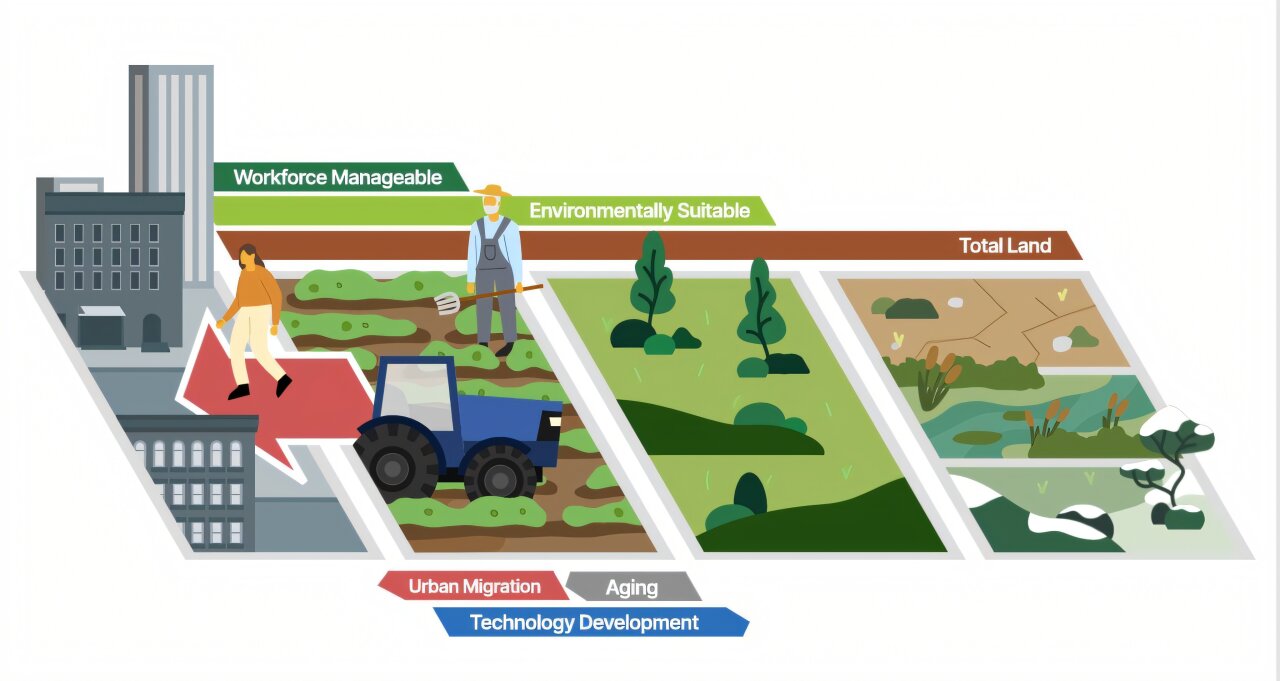
A shortage of farm workers could become a major constraint on future food production, according to research led by the Korea Advanced Institute of Science and Technology. The study matters because food security projections often focus on land, climate and demand, while labor may determine whether available farmland can be used.
The findings were published in Nature Sustainability by a team led by Professor Hyungjun Kim of KAIST’s Department of AI Future, with researchers including Professor Haewon Chon of KAIST, Professor Nicklas Forsell and Professor Taikan Oki of the University of Tokyo, and first author Hongtak Lee.
KAIST said the researchers built a data-driven model that adds agricultural workforce decline to projections of future cropland availability. The work examined whether land that appears suitable for farming could still be left underused if too few people are available to cultivate it.
Labor added to climate and land projections
According to KAIST, many earlier assessments of food security and climate risk have centered on how much farmland can be secured, whether local climate and soils can support production, and how food demand may rise. The new study adds a social constraint: the number of people likely to remain in agriculture.
The researchers used five future scenarios combining Shared Socioeconomic Pathways and Representative Concentration Pathways, KAIST said. SSP scenarios describe possible changes in population, economic growth and technological development, while RCP scenarios describe climate outcomes under different greenhouse gas emissions paths.
By including farm labor in those scenarios, the team found that the amount of cropland that can actually be worked may shrink in most world regions, KAIST reported. In some places, labor availability emerged as a stronger limit than environmental suitability.
The study links the risk to demographic and economic trends. KAIST said low birth rates, the decline of rural communities and movement toward cities are reducing rural populations in many countries. As economies grow, workers also tend to shift from agriculture into manufacturing and service jobs.
Technology may not erase the constraint
The research team said technological progress can raise the amount of land each agricultural worker can cultivate. KAIST said the model still found that rapid development may not fully solve the problem, because industrial growth can also draw more people away from farming and further reduce the rural workforce.
Regional outcomes differed under the scenarios. KAIST said North Africa, Southern Europe and Eastern Europe face projected chronic cropland supply deficits even under a high-growth, high-emissions pathway, identified as SSP5–RCP8.5. Western Europe and Russia were projected to face temporary shortages, with technological progress expected to help them adapt over time.
KAIST said the study also examined migration. If international migration is restricted, developed countries could face agricultural labor shortages, while some low-income countries could see agricultural populations increase excessively, according to the research team.
Kim said the study looks at future food problems by considering changes in people as well as climate and land. He said social issues such as low birth rates and avoidance of rural areas can affect food security and responses to climate change.
The paper, “Agricultural workforce as a potential bottleneck of future cropland availability,” was published in Nature Sustainability. KAIST said the journal also carried a separate commentary on the study titled “Farming needs more hands.”
This story draws on original reporting from Phys.org.