
Distant galaxy candidate offers clue to how early universe cleared its fog
Astronomers report a rare high-redshift galaxy candidate leaking ionizing radiation, a process tied to cosmic reionization.
By Lucas Ferreira · Science & Environment Writer
3 min read
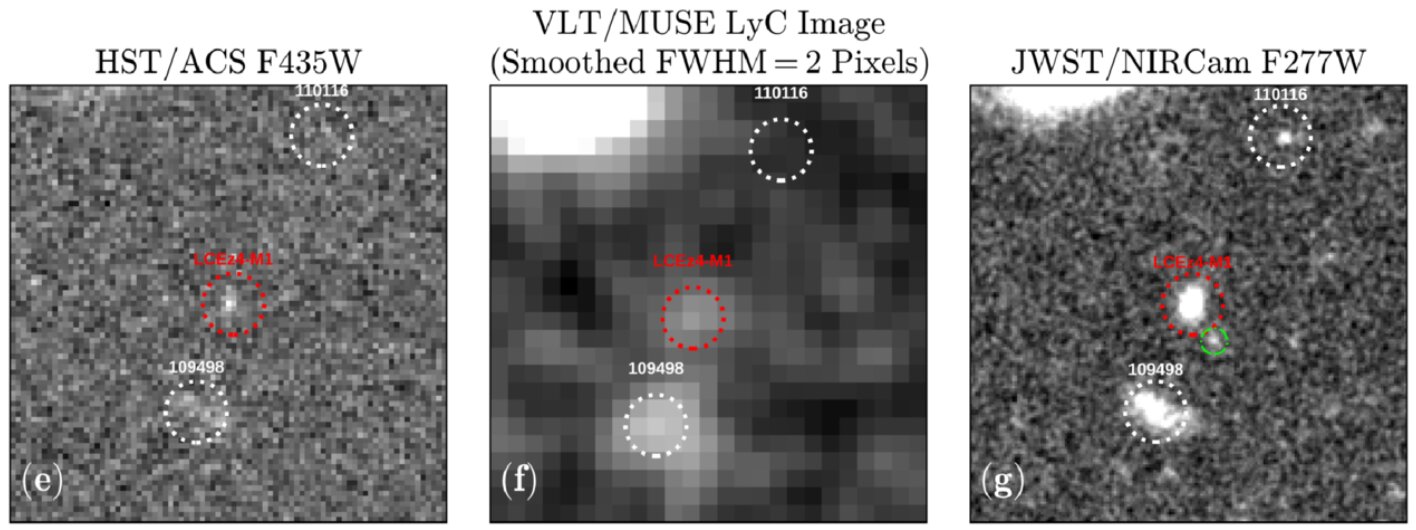
Astronomers have reported a rare candidate galaxy that appears to let ionizing ultraviolet light escape into space, offering a view of a process thought to have reshaped the early universe. The object, called LCEz4-M1, is seen at a time when the universe was about 1.4 billion years old, according to a study published June 22 in The Astrophysical Journal Letters.
The study, led by Shuairu Zhu of Shanghai Astronomical Observatory, identifies LCEz4-M1 as a Lyman continuum emitter candidate at redshift z = 4.444. Phys.org reported that this makes it one of the highest-redshift candidates known for leaking this type of radiation.
Lyman continuum photons are ultraviolet photons with wavelengths shorter than 912 angstroms. Astronomers study them because they can ionize hydrogen, and the escape of such radiation from early galaxies is central to explanations for cosmic reionization.
Why escaping light matters
Cosmic reionization refers to the period when ultraviolet radiation from early stars and galaxies changed neutral hydrogen gas across the universe into the ionized state observed today. Phys.org reported that cosmic microwave background and quasar data place that transition around redshift 6 to 8, roughly 600 million to 1 billion years after the Big Bang.
Star-forming galaxies are thought to have been a main driver of that change, according to the report. Producing ionizing photons is only part of the problem: for the photons to affect intergalactic gas, they must first escape their home galaxies rather than be absorbed by internal gas and dust.
LCEz4-M1 appears somewhat later than the main reionization period. Even so, the research team said its proximity in cosmic time to that era makes it useful for studying how ionizing radiation could escape from young galaxies.
Three telescopes, one candidate
The researchers used observations from the Very Large Telescope, the Hubble Space Telescope and the James Webb Space Telescope to test the detection, according to Phys.org. They used a hydrogen emission line with an asymmetric profile to determine the galaxy’s distance.
The team also examined nearby imaging to check whether the ultraviolet signal might come from an unrelated foreground or neighboring object in the same line of sight. According to the report, the escaping ultraviolet signal appeared independently in two data sets: Hubble imaging and VLT spectroscopy.
Images from Hubble, VLT and JWST show the same source, and JWST also shows a faint possible companion galaxy nearby, according to the study materials. The researchers identified about 15 other galaxies in the surrounding region, but cautioned that the current data do not prove LCEz4-M1 sits in a protocluster.
A quieter kind of leaker
Many nearby galaxies known to leak Lyman continuum radiation are compact systems experiencing intense star formation, Phys.org reported. LCEz4-M1 is compact, but the study found its star-formation surface density is lower than that of local leakers.
The authors wrote that this could point to a postburst phase or a geometry-driven escape process rather than the more familiar pattern of an extreme compact starburst. In that scenario, earlier star formation may have opened channels through gas via stellar winds and supernovae, leaving routes for ionizing light to leave the galaxy.
The faint companion may also suggest a minor interaction, according to the report, though the main galaxy itself appears compact and not visibly disrupted by a merger. If interactions in the crowded region are confirmed, the team said they could help disturb gas and create escape paths.
The authors concluded that LCEz4-M1 is among the small number of reported Lyman continuum detections at redshifts above 4. They called for deeper spectroscopy to clarify the galaxy’s properties, its surroundings and the reason so much ionizing radiation appears to escape.
This story draws on original reporting from Phys.org.