
China’s JUNO detector posts first precision neutrino results
The underground observatory used 59 days of data to sharpen measurements tied to how neutrinos change as they travel.
By Priya Raghavan · Science Reporter
3 min read
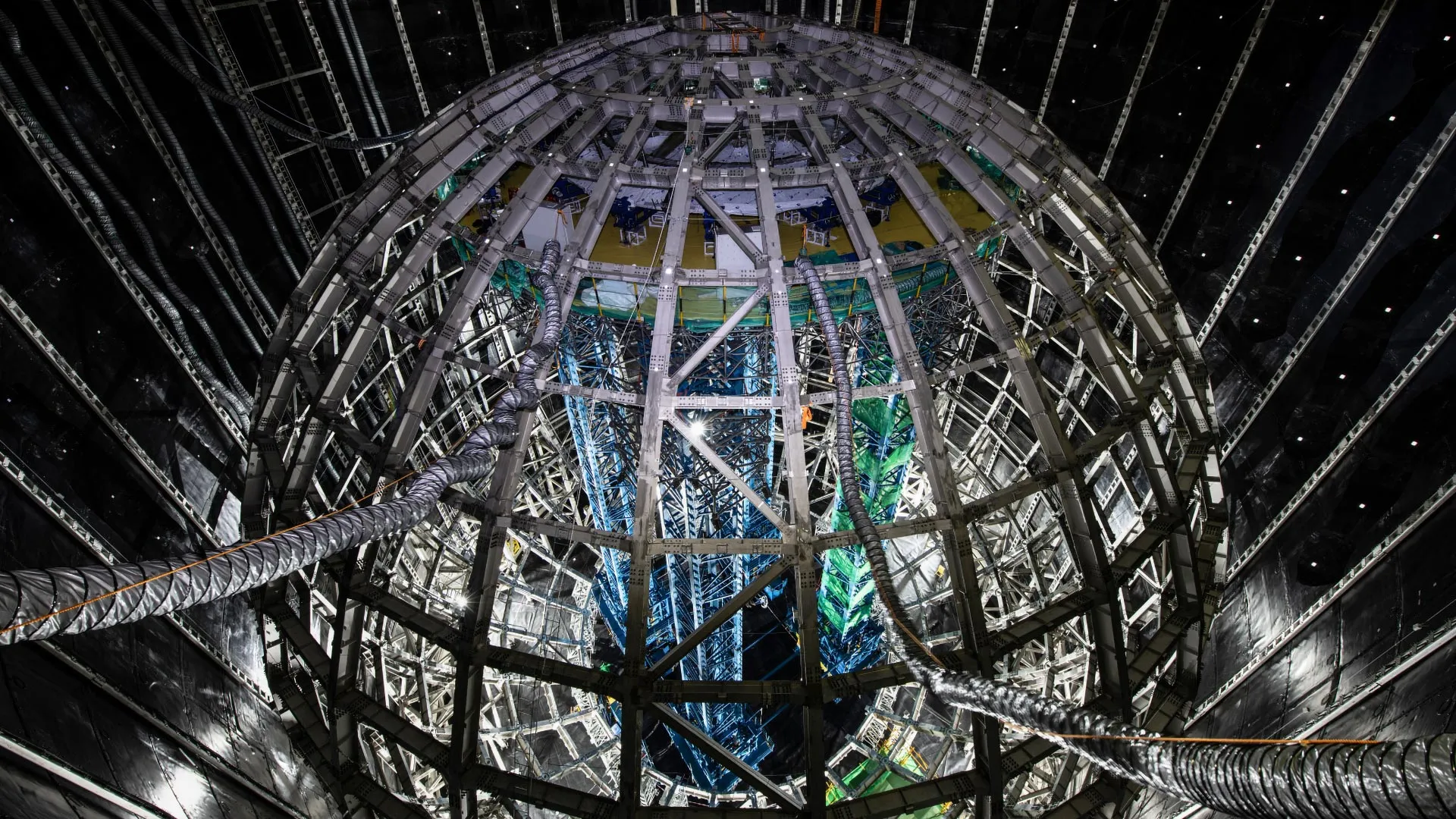
The Jiangmen Underground Neutrino Observatory in China has produced its first major physics result, giving researchers a sharper measurement of how neutrinos shift between forms as they move. The result matters because JUNO is built to address one of particle physics’ open problems: the ordering of neutrino masses.
The international JUNO Collaboration, led by the Institute of High Energy Physics of the Chinese Academy of Sciences, reported the findings in Nature on June 10, according to the Chinese Academy of Sciences. The analysis used 59 days of validated data gathered between Aug. 26 and Nov. 2, 2025.
According to the academy, the collaboration measured two basic neutrino oscillation parameters with high precision. The new analysis cut the uncertainties in those measurements by a factor of 1.6 compared with combined results from earlier experiments carried out over several decades.
Why the measurement counts
Neutrinos are elementary particles with no electric charge, very small masses and weak interactions with matter, according to the Chinese Academy of Sciences. Because they interact so rarely, large numbers pass through Earth and through people without being detected.
That weak interaction also makes neutrinos difficult to study. The academy said neutrinos remain the least understood known elementary particles, and JUNO’s main physics program is aimed at measuring their behavior with greater precision.
JUNO began data-taking in August 2025. The experiment is designed to determine the neutrino mass ordering, measure three of the six neutrino mixing parameters to better than 1% precision, and study neutrinos from supernovae, Earth’s interior, the Sun, the atmosphere and other sources, according to the academy.
How JUNO is built
The observatory sits 700 meters underground and centers on a liquid scintillator detector with an effective mass of 20,000 tons, according to the JUNO Collaboration. The detector is housed inside a 44-meter-deep water pool.
A 41.1-meter stainless steel support structure holds a 35.4-meter acrylic sphere, the liquid scintillator, 20,000 20-inch photomultiplier tubes and 25,600 3-inch photomultiplier tubes. The system also includes front-end electronics, cabling, anti-magnetic compensation coils and optical panels, according to the collaboration.
The photomultiplier tubes record faint flashes of light created when neutrinos interact in the detector. Researchers convert those light signals into electrical signals and use the measured energy from the interactions to calculate oscillation parameters, according to the Chinese Academy of Sciences.
Next steps
Nature published the debut JUNO physics paper as a cover article, according to the academy. Nature also carried a News & Views article saying the first analysis supports confidence that the detector can determine the mass ordering.
Arthur McDonald, who shared the 2015 Nobel Prize in Physics for work on solar neutrino oscillation, said JUNO had met its design goals for radiopurity, energy resolution and stability, according to the academy. He said the experiment is operating and ready to pursue goals including mass ordering, oscillation studies, neutrino detection from multiple sources and searches beyond the Standard Model.
The academy said JUNO has operated smoothly for nine months. Researchers expect additional scientific results from the experiment beginning this summer.
This story draws on original reporting from ScienceDaily.