
Cerebellum study challenges a common marker for movement disorders
Virginia Tech researchers found Purkinje cell activity may not reliably reflect deeper cerebellar signals tied to dystonia, ataxia and tremor.
By Tom Brennan · Health & Medicine Correspondent
3 min read
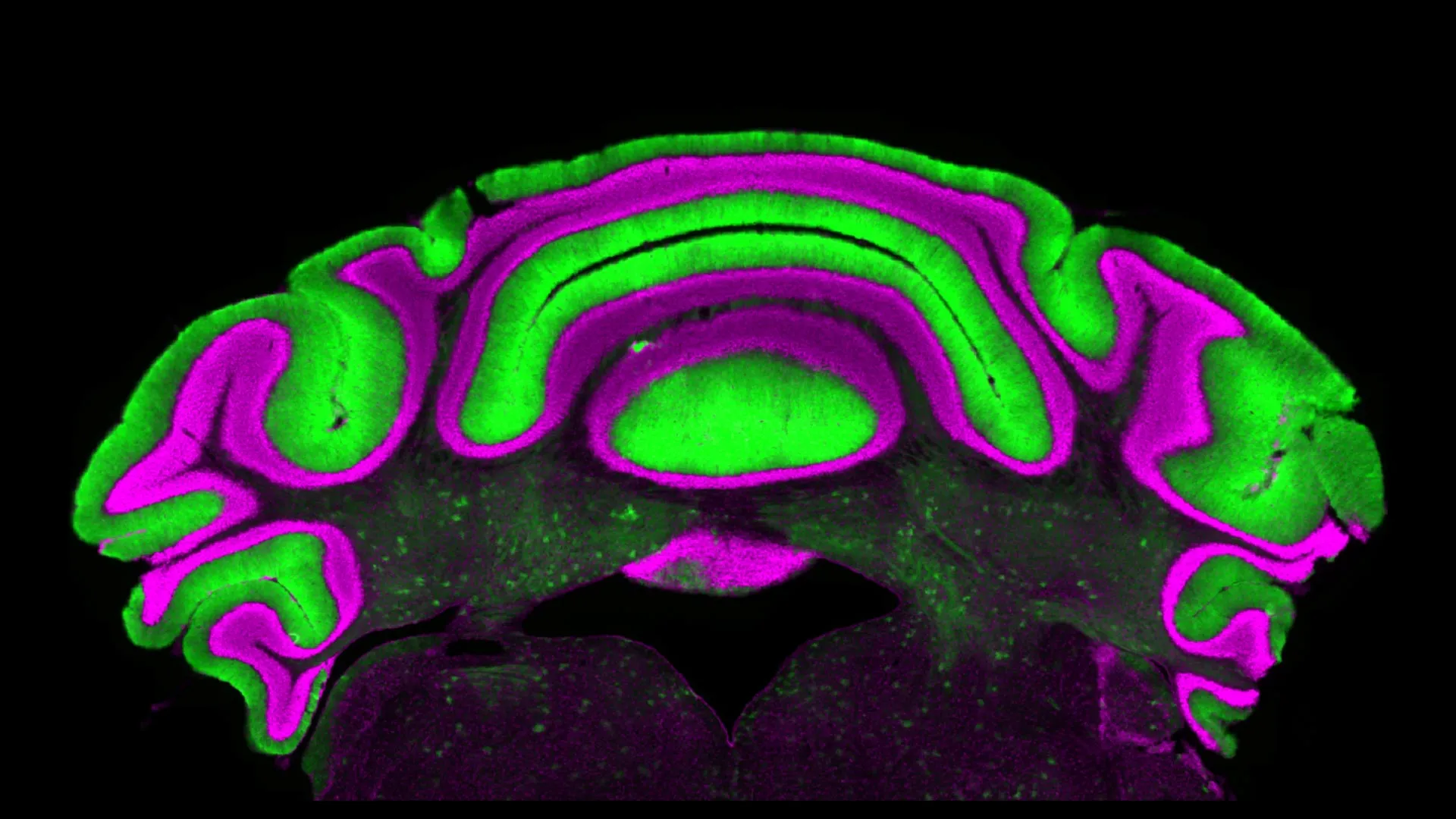
Virginia Tech researchers say a common way of reading brain activity in movement disorders may be less reliable than scientists have assumed. The finding matters because studies of dystonia, ataxia and tremor often use signals from one accessible cerebellar cell type to infer what is happening in a deeper set of cells involved in movement control.
The work, led by Meike van der Heijden at the Fralin Biomedical Research Institute at VTC, was published in The Journal of Physiology. According to Virginia Tech, the study found that activity in Purkinje cells had limited power to predict activity in deep cerebellar nuclei cells, even though the two are directly connected.
The cerebellum helps coordinate movement. Virginia Tech said disruptions in that brain region are linked to symptoms such as painful muscle contractions, abnormal posture and involuntary shaking in disorders including dystonia, ataxia and tremor.
A tested assumption
Purkinje cells and deep cerebellar nuclei cells have been central to research on cerebellar disease. Purkinje cells inhibit the deeper nuclei cells, and researchers have often treated Purkinje activity as a stand-in for cerebellar output, Virginia Tech said.
That approach has practical roots. Purkinje cells sit in the outer layer of the cerebellum and are easier to study, according to the university. Deep nuclei cells are farther below the surface and harder to measure directly.
Van der Heijden’s team tested whether the expected relationship held up in disease models. The researchers analyzed a database of electrophysiology recordings from preclinical models of cerebellar disease, according to Virginia Tech.
The analysis did not show a significant correlation between activity in the two cell populations. Van der Heijden, an assistant professor at the Fralin Biomedical Research Institute and in Virginia Tech’s School of Neuroscience, said the team saw “not a clear linear relationship” between Purkinje cells and deep nuclei cells, leaving “very limited predictive power” in using one to understand the other.
Possible effects on treatment research
The finding may affect how scientists design experiments and treatments aimed at cerebellar movement disorders. If Purkinje activity does not reliably indicate the state of deeper output cells, studies that rely on it alone could miss important disease signals.
Alyssa Lyon, a doctoral candidate in Virginia Tech’s Translational Biology, Medicine, and Health Graduate Program and the paper’s first author, said better knowledge of how the two neuron types relate could help improve treatments for dystonia, ataxia and tremor. Virginia Tech identified the paper’s authors as Lyon, Viviana Hernandez-Castanon and Van der Heijden.
Van der Heijden said researchers seeking to understand cerebellar behavior in disease should examine deep nuclei neurons directly, rather than relying only on Purkinje cells. She also cautioned against assuming that treatments designed to change Purkinje cell activity will produce predictable effects in deep nuclei cells.
The study does not report a new therapy. It points instead to a measurement problem in a field where accessible signals have carried weight because deeper brain activity is harder to capture.
This story draws on original reporting from ScienceDaily.