
Biomolecular condensates can act as catalysts, study finds
Washington University researchers report condensates can drive hydrolysis and esterolysis, adding a new mechanism for cell chemistry.
By Tom Brennan · Health & Medicine Correspondent
3 min read
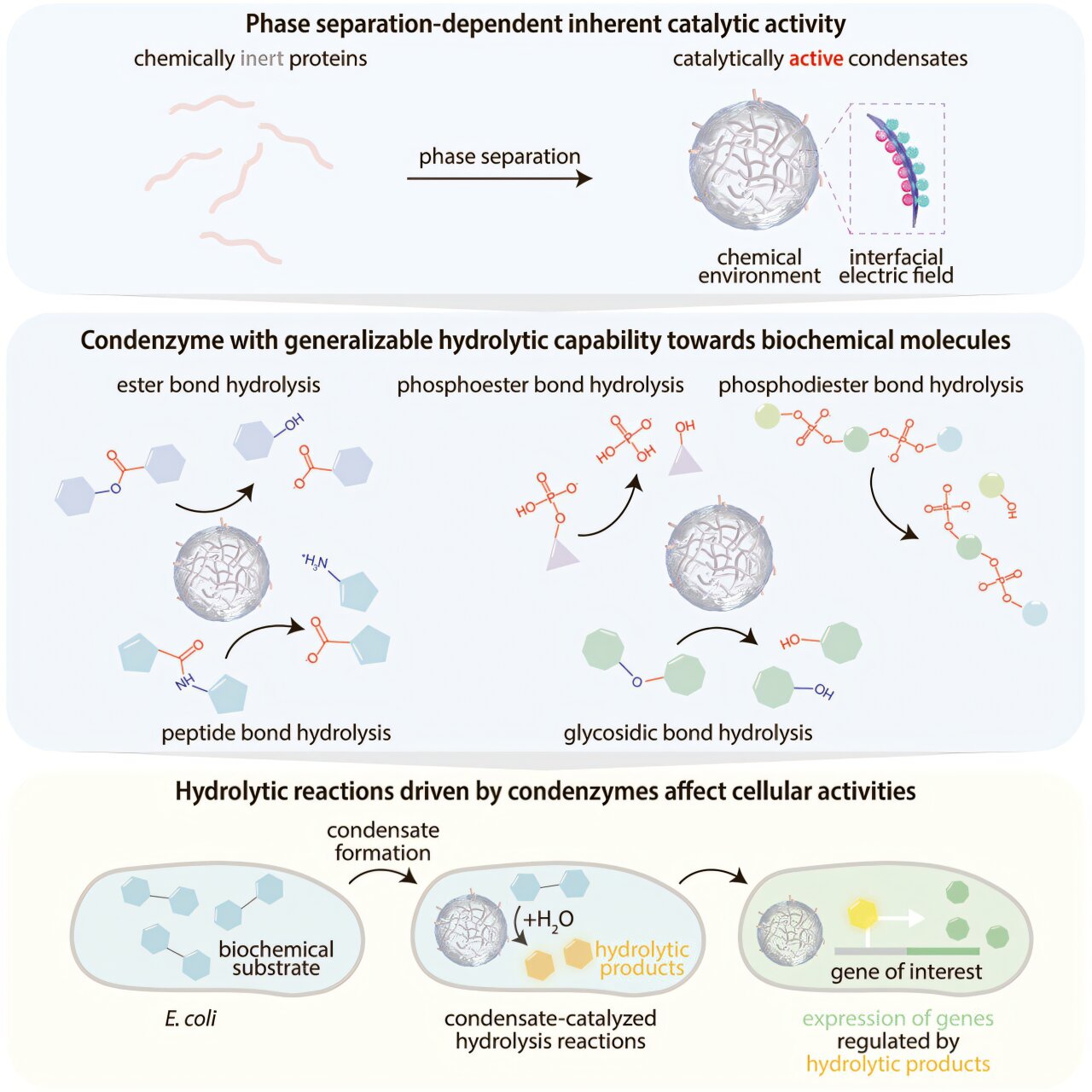
A research team led by Washington University in St. Louis reports that biomolecular condensates can act as catalysts, a finding that could change how scientists study chemical reactions inside cells. The work, published in Molecular Cell, describes catalytic activity arising from condensates even when they lack conventional catalyst components.
The study was led by Yifan Dai, an assistant professor, and Rohit V. Pappu, the Gene K. Beare Distinguished Professor, both in the Department of Biomedical Engineering and the Center for Biomolecular Condensates at Washington University’s McKelvey School of Engineering. Washington University said the team calls the activity “condenzymes,” a term for catalytic functions that emerge from condensates formed through phase separation.
What are biomolecular condensates?
Biomolecular condensates are membraneless structures found in living cells, including bacteria, viruses, plants and mammalian systems, according to Washington University. They are made from molecular groupings that can include DNA, RNA and proteins, and they help bring cellular molecules together for biochemical reactions.
Researchers have studied how proteins and nucleic acids help condensates form because those molecules store, pass along and express genetic information. The new study focuses on another property: whether the condensate structure itself can promote chemical reactions.
How do condensates act as catalysts?
Dai, Pappu and their collaborators found that condensates made by intrinsically disordered proteins can create electric fields at their surfaces. According to Washington University, those surface fields can catalyze reactions including esterolysis, which breaks esters into an acid and an alcohol, and hydrolysis, which uses water to break chemical bonds.
The team worked with scientists at Columbia, Stanford and Harvard universities. Washington University said their results show that both the surface electric field and changes in the behavior of water molecules at condensate interfaces help explain the catalytic activity.
The researchers also reported that the condensates could catalyze hydrolysis across a range of compounds. Washington University said the activity included reactions that allow nucleic acids to break down and reactions involving adenosine triphosphate, or ATP, the molecule that carries energy through cells.
Dai said the team demonstrated this catalytic ability in bacterial cells and that it changes how researchers think about biochemical organization in living cells.
Why the finding changes the condensate debate
Pappu said the functions of condensates have been debated, with some researchers suggesting they may be bystanders inside cells. He said the new findings challenge that view because cells may have evolved ways either to use condenzyme activity or to reduce it.
Washington University said the collaboration combined electrochemistry from Dai’s lab with computational modeling and biochemistry from Pappu’s lab. The work builds on earlier findings from Dai’s group that condensate interfaces have electric potential and can drive redox reactions, as well as research from Pappu’s group showing that natural condensates such as nucleoli are shaped by pH gradients and membrane-like potentials.
The paper lists Michael W. Chen, Xiao Guo, Mina Farag and Naixin Qian as co-first authors. Chen is a doctoral student in Dai’s lab; Guo formerly worked as a research technician there; Farag earned a biomedical engineering doctorate in Pappu’s lab and a medical degree from Washington University in 2025; and Qian is a doctoral student in the Columbia University lab of chemistry professor Wei Min, a co-author.
The study, “Biomolecular condensates can function as inherent catalysts,” appeared in Molecular Cell with DOI 10.1016/j.molcel.2026.07.008.
This story draws on original reporting from Phys.org.