
Asteroid defense prize goes to plan for protecting space infrastructure
University of Edinburgh researchers won the Schweickart Prize for a proposal to track meteoroid risks to satellites, lunar bases and other off-Earth assets.
By Tom Brennan · Health & Medicine Correspondent
3 min read
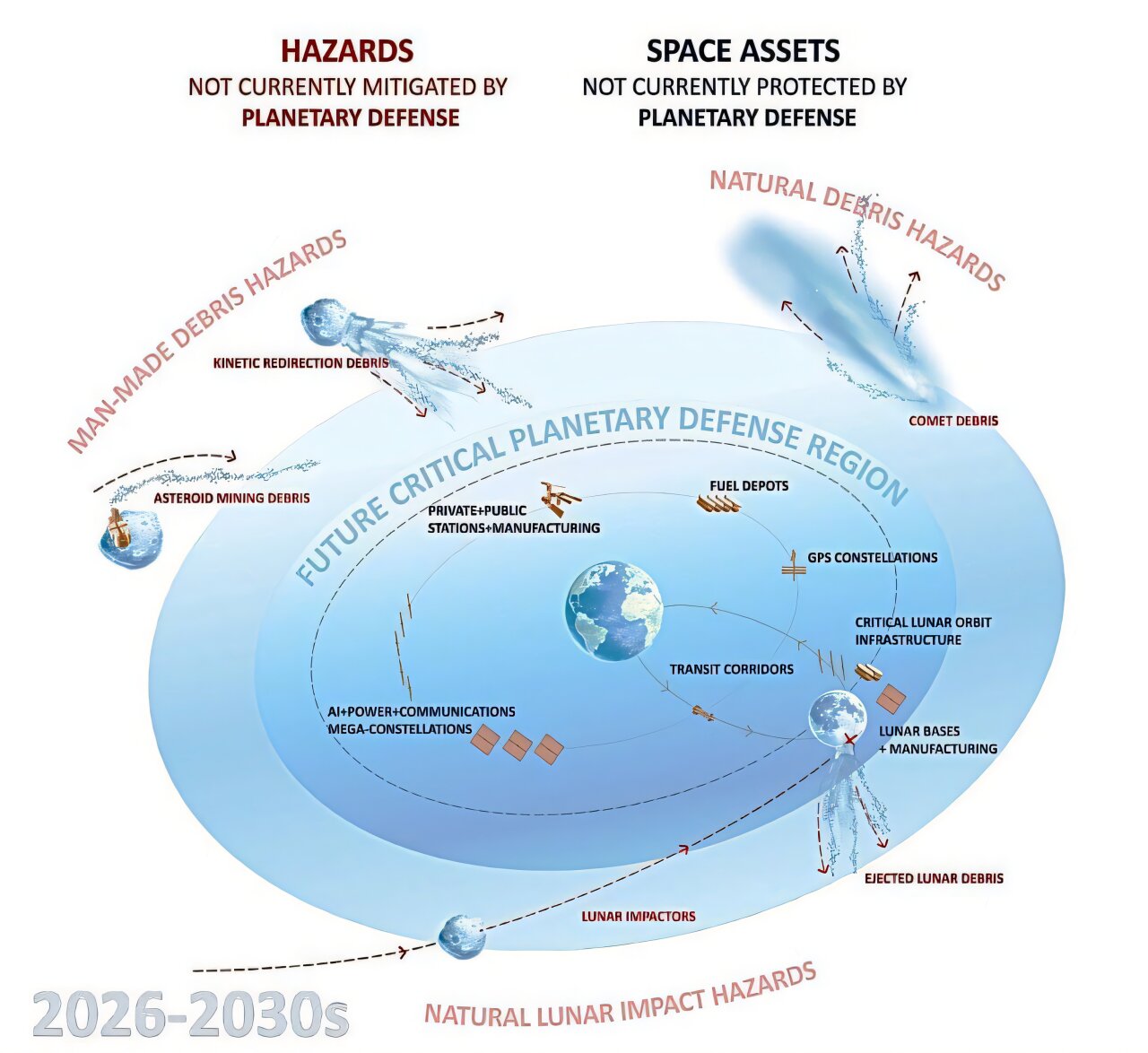
Two University of Edinburgh researchers have won this year’s Schweickart Prize for proposing a system to protect satellites and future space facilities from meteoroids, asteroid fragments and other small-object hazards. The idea reflects a growing concern in planetary defense: space infrastructure is expanding faster than the systems meant to protect it.
The B612 Foundation, which runs the prize, said Brian Murphy and Richard Cannon will receive the award June 27 at Lowell Observatory in Arizona. The prize, named for Apollo 9 astronaut and planetary defense advocate Rusty Schweickart, includes $10,000 and a trophy topped with a meteorite.
According to Universe Today, Murphy and Cannon’s proposal calls for an international commission to assess risks to infrastructure in Earth orbit and beyond. Their plan would then create a coordinating body called WARDEN, short for Warning Network for Asset Resilience From Dusts, Ejecta and NEOs.
Schweickart said in a B612 Foundation release that human activity is moving beyond the atmosphere’s protection, increasing the number of objects that could damage life and critical systems in space. He said the winning proposal calls for a broad review of that emerging risk.
The threat is different from the classic planetary-defense problem of a large asteroid striking Earth. Universe Today reported that Murphy and Cannon focused on smaller objects and streams of space dust that would usually burn up in Earth’s atmosphere but can hit exposed spacecraft at high speed.
Satellite operators already account for meteoroid storms through shielding and by changing spacecraft orientation during predicted events, according to Universe Today. Those measures have limits. Meteoroids from the Perseid shower are thought to have contributed to the loss of the European Space Agency’s Olympus 1 satellite in 1993, and scientists have suspected a Perseid meteoroid damaged NASA and USGS’s Landsat 5 in 2009.
The number of active satellites has climbed sharply since then. Universe Today cited figures showing fewer than 1,000 satellites in orbit in 2009 and more than 17,000 now, with SpaceX’s Starlink constellation driving much of the growth. Murphy and Cannon estimate that exposure to meteoroids has risen by a factor of 10 to 100 and could keep rising as commercial constellations expand.
Murphy told Universe Today that damaging meteoroid storms are expected to return in 2028, 2033 and 2034. The 2028 event is associated with the Perseids, while the later possible storms are linked to the Leonids.
Some companies are already preparing for impact risks. Universe Today reported that SpaceX uses extra shielding on Starlink satellites and can reduce exposure by flattening solar panels. Philip Johnston, co-founder and CEO of Starcloud, told Universe Today by email that his company is aware of the issue and expects to spend more time on it as its planned data-center satellite constellation grows.
Murphy and Cannon also want WARDEN to look beyond Earth orbit. Universe Today reported that their proposed system would cover infrastructure as far away as the moon, where future bases could face hazards from asteroids, comet debris or material kicked up by asteroid mining.
The researchers argue that existing international bodies, including the International Asteroid Warning Network and the Space Mission Planning Advisory Group, are aimed at threats to Earth rather than off-Earth assets. Murphy told Universe Today the new group would add another layer to planetary defense rather than replace those systems.
Murphy and Cannon plan to use the prize money to support meetings for a proposed International Commission on Space Infrastructure Resilience, known as ICSIR. Murphy said the first meeting would be held at the University of Edinburgh, with follow-up meetings roughly every six months.
This story draws on original reporting from Phys.org.