
Asteroid breakup may explain ancient impact surge on Earth and moon
Southwest Research Institute researchers link an 800-million-year-old impact shower to the breakup of the Eulalia asteroid family.
By Lucas Ferreira · Science & Environment Writer
3 min read
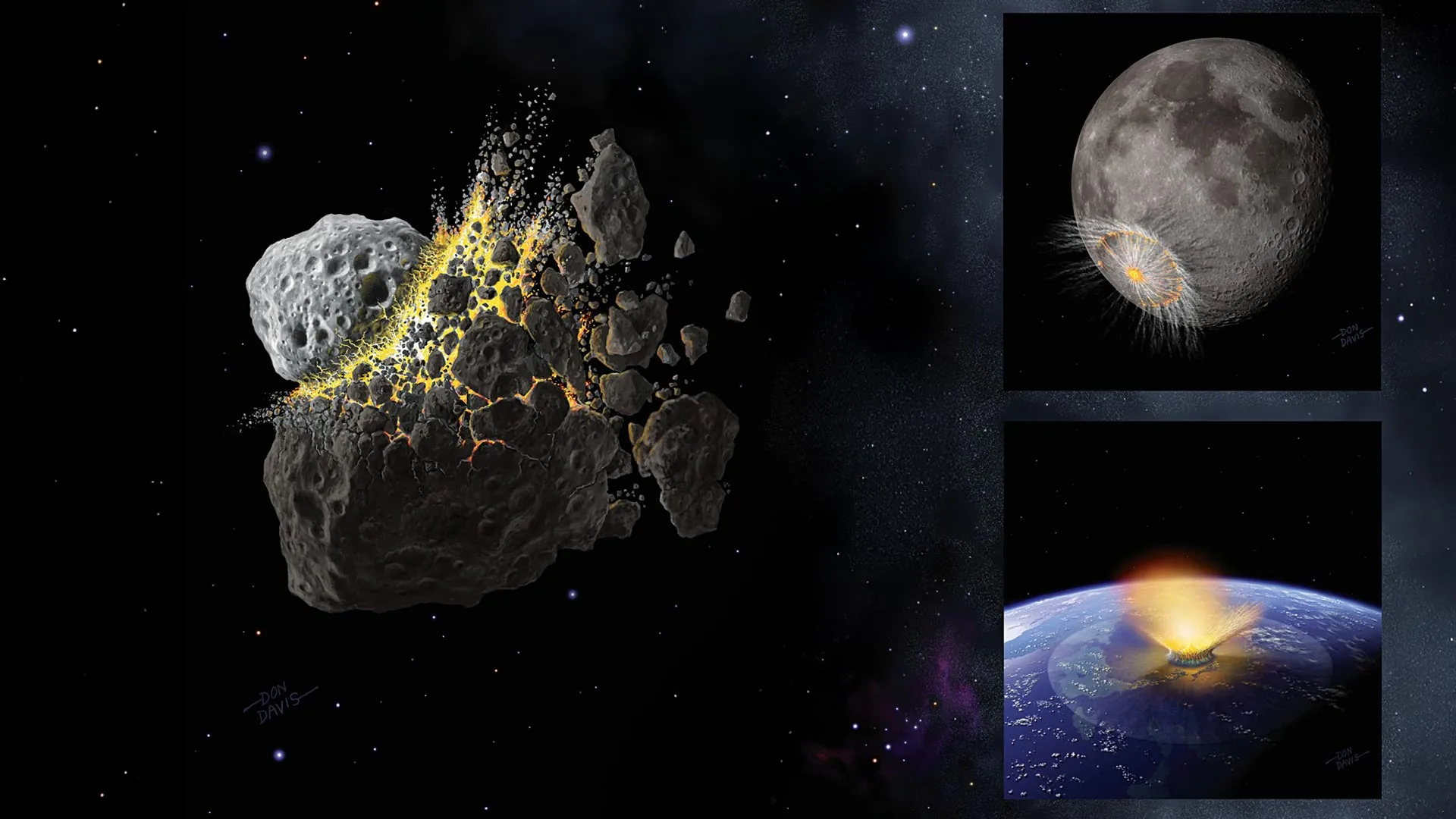
A Southwest Research Institute-led team says a breakup in the main asteroid belt may have sent a long wave of debris into Earth, the Moon and Mars about 800 million years ago. If the model is correct, the event could help explain ancient lunar craters and may have overlapped with major climate and biological changes on Earth.
The study, published in The Planetary Science Journal, connects the impact surge to the destruction of the parent body that formed the Eulalia asteroid family. Southwest Research Institute said the work used collisional and dynamical models to trace how fragments from that breakup could have reached the inner solar system.
Moon records point to an old bombardment
Earth’s record of very old impacts is difficult to read because plate tectonics, volcanism, weathering and other processes alter or erase craters over time, according to the researchers. The Moon preserves older evidence more readily because it lacks active plate tectonics, flowing water and a thick atmosphere.
Earlier lunar research has pointed to an increase in large impacts around 800 million years ago, Southwest Research Institute said. That evidence includes age estimates for major lunar craters and impact glass returned by Apollo missions.
Impact glass forms when collisions melt rock and the material later cools, leaving clues that scientists can date. The new study sought to identify an asteroid-belt event capable of producing the lunar pattern.
Jupiter’s gravity provided a route inward
William Bottke, lead author of the paper and an executive director in SwRI’s Solar System Science and Exploration Division, said the team linked the lunar evidence to the breakup of the Eulalia parent body. According to Bottke, the object was a primitive carbonaceous chondrite-like body and broke apart near a key gravitational region tied to Jupiter.
That region is known as the 3:1 mean motion resonance with Jupiter, or J3:1. In that orbital setup, an asteroid circles the Sun three times for each orbit of Jupiter, allowing repeated gravitational pulls from the planet to disturb asteroid paths.
Southwest Research Institute said the resonance can act as an exit from the main asteroid belt, sending objects onto stretched orbits that cross the paths of rocky planets. The researchers said many near-Earth asteroids are thought to have come through this region.
In the team’s simulations, about half of the Eulalia fragments entered the J3:1 resonance quickly after the breakup. Another 25% moved into the resonance over the next 100 million to 150 million years through the Yarkovsky effect, a small orbital push caused when asteroids absorb sunlight and later radiate heat unevenly.
Possible effects on Earth and Mars
The modeling suggests the Eulalia breakup could account for the rise in lunar impacts dated to roughly 800 million years ago, according to Southwest Research Institute. Because Earth is larger than the Moon and has stronger gravity, the study estimates Earth would have been hit by about 20 objects of similar or larger size for every large object that struck the Moon.
The researchers did not say the bombardment caused Earth’s environmental changes. They said its peak coincides with widespread cooling and major shifts in the biosphere, making the possible link a subject for further research.
Southwest Research Institute also said Mars may have experienced substantial seismic shaking from the impacts. The team linked the timing of those strikes with a surge in volcanic activity on Mars, though the study frames the broader planetary effects as a consequence to be investigated rather than a settled chain of cause and effect.
This story draws on original reporting from ScienceDaily.