
Aminocyclopropane synthesis offers a milder route for drug discovery
Vienna researchers report a room-temperature way to make drug-design building blocks, with early assay results but no clinical evidence.
By Tom Brennan · Health & Medicine Correspondent
3 min read
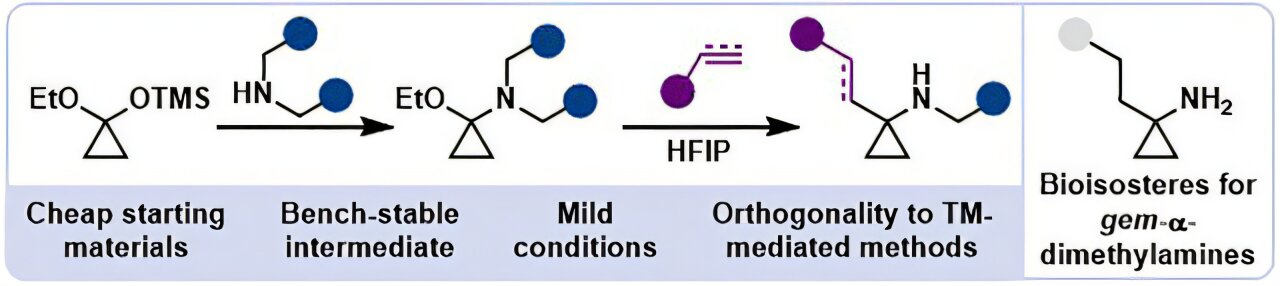
Researchers in Vienna have reported an aminocyclopropane synthesis for drug discovery that could make it easier to test small structural changes in prospective medicines. The method works under mild conditions and with chemical groups that have posed problems for older approaches, according to the University of Vienna, CeMM and the Austrian Academy of Sciences.
The study, published Sept. 4 in Angewandte Chemie International Edition, was led by Nuno Maulide’s group and involved researchers at the University of Vienna, CeMM Research Center for Molecular Medicine and the Medical University of Vienna, the Austrian Academy of Sciences said.
What are aminocyclopropanes and why do they matter for drug discovery?
Cyclopropanes are three-carbon rings shaped as triangles. Adding an amine, a nitrogen-containing chemical group, produces an aminocyclopropane.
Researchers use such structures as bioisosteres: substitutes designed to occupy a similar part of a molecule while potentially changing features such as its biological activity or metabolic stability. The team said aminocyclopropanes can stand in for a drug-molecule feature called an α,α-gem-dimethylamine, giving medicinal chemists another structural option to test.
A broader 2022 analysis in the Journal of Medicinal Chemistry found that ring systems are widely used in clinical-stage compounds and approved drugs, while only a small share of the available ring-system pool has appeared in clinical-trial molecules. That finding provides context for why methods that broaden access to ring-containing compounds can be useful; it does not validate the new Vienna chemistry or establish medical benefit.
A room-temperature reaction with broader chemical tolerance
Established routes to aminocyclopropanes can rely on highly reactive reagents, metals, several reaction steps or difficult-to-make inputs, and often require conditions that exclude air and moisture, CeMM said. Those constraints can make it harder to alter complex molecules without affecting other parts of their structures.
The new process is a hydroaminoalkylation that begins with a bench-stable material known as a hemiaminal. For many of the tested substrates, dissolving that starting material in the appropriate solvent triggered the reaction at room temperature without rigorous removal of air or water, the institutions reported.
The group made products that retained unprotected alcohols, carbonyls and phthalimides. It also applied the reaction to a complex molecule derived from estrone, extended it to alkynes, and developed a one-pot, three-component version using commercially available inputs, according to CeMM.
In one run, the researchers produced more than one gram of product with an 84% yield. That result shows the reaction beyond a very small demonstration scale, but the reported work does not establish industrial manufacturing performance.
What the phentermine-related experiment showed
As a proof of concept, the team prepared a molecular relative of phentermine, an amphetamine-like stimulant that interacts with neurotransmitter transporters. The researchers reported that replacing the α,α-gem-dimethylamine feature with a triangular cyclopropylamine retained activity at two transporters while suppressing dopamine release through the dopamine transporter.
The researchers linked that laboratory property to a potentially lower risk of dependence. The available evidence does not report animal studies, human trials, safety results, treatment efficacy or any plan to develop the compound as a medicine.
This story draws on original reporting from Phys.org.