
ALMA data reveal nine young stars forming in one system
A preprint reports a rare look at a developing stellar group in NGC 6334-43, where nine objects appear linked along a gas filament.
By Lucas Ferreira · Science & Environment Writer
3 min read
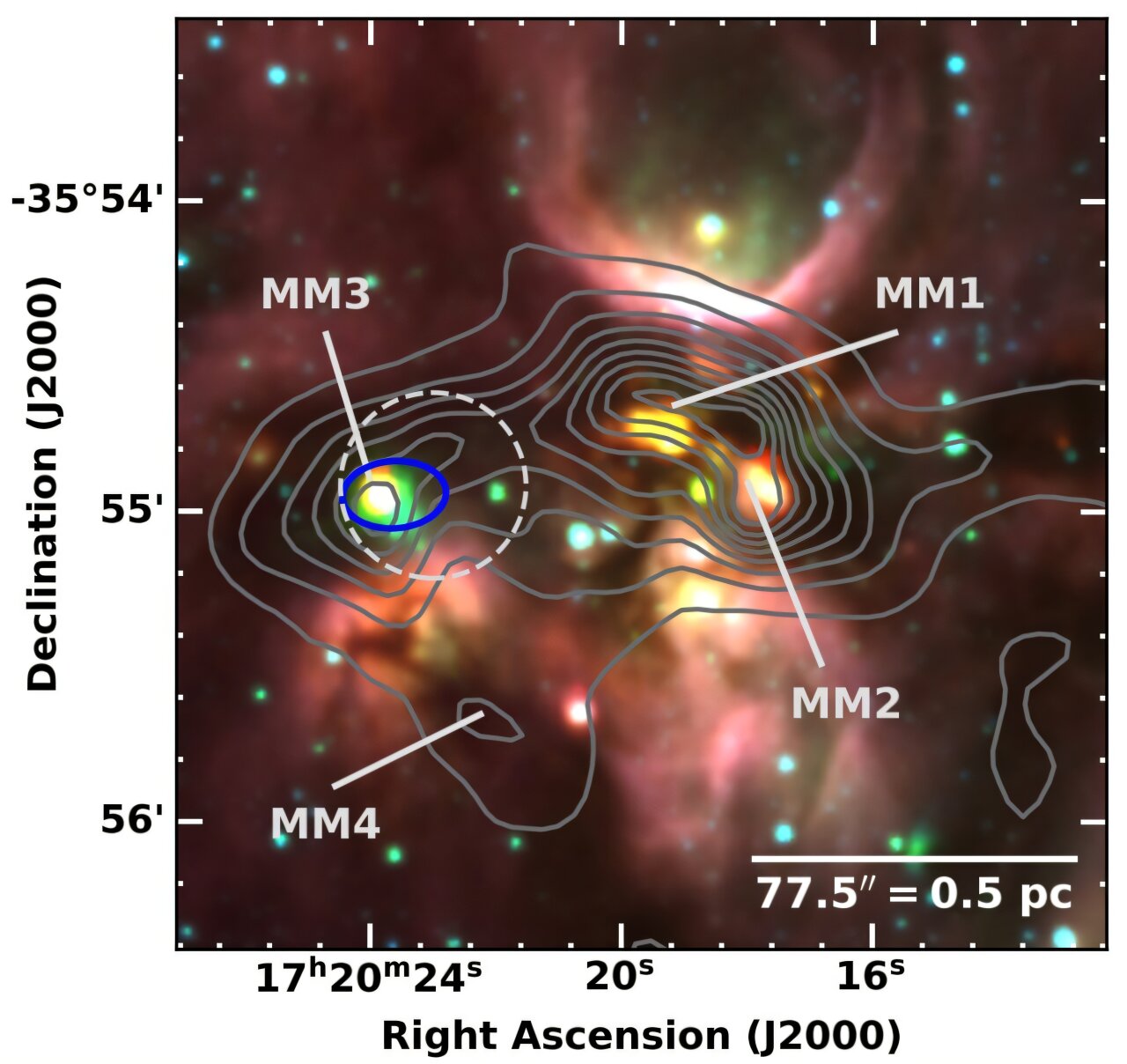
Astronomers using ALMA data have identified nine young stellar objects forming together in NGC 6334-43, a hot core in a larger star-forming region about 4,340 light-years away. The finding, reported by D. J. Taylor and colleagues in a June 2 arXiv preprint, offers a rare view of how multiple massive stars may assemble while still embedded in gas and dust.
The team was studying data from the CoCCoA survey, which was designed to examine complex organic molecules around 25 hot cores in massive star-forming regions, according to the preprint. NGC 6334-43 was one of those targets, and the multiple system emerged during analysis of high-resolution dust and gas emission.
A filament points to a shared origin
The researchers detected 12 compact sources in the field and focused on nine that sit close together along a long gas structure, according to the study. The authors report that the arrangement is unlikely to be a random grouping and that the nine sources appear to form a gravitationally bound system.
Taylor and colleagues tested that conclusion by comparing gravitational and kinetic energy in the system, according to the preprint. They found an average separation of about 7,930 astronomical units between pairs of sources; one astronomical unit is about 150 million kilometers.
The nine objects also lie along a larger filamentary structure about 24,700 astronomical units long, the researchers report. That layout supports the idea that the broader system formed through filament fragmentation, in which a long cloud of gas breaks into star-forming clumps along its length.
Smaller groups show another process
The study also points to a second formation process at smaller scales. The authors report that the ALMA2 triple system, made up of the hot-core pair ALMA2a and ALMA2b plus the younger ALMA2c, does not show evidence for a shared disk.
That pattern is more consistent with core fragmentation, according to the preprint. In that scenario, a dense gas core splits into separate star-forming condensations before or during the formation of individual stars.
The ALMA6 binary also appears to fit core fragmentation, Taylor and colleagues report. Its two components are separated by 1,530 astronomical units, and the system includes an unusually long spiral-arm-like structure; the study identifies ALMA6a as more developed than ALMA6b, which the authors describe as likely still in a pre-stellar stage.
Other members of the nine-object system span different masses and stages of development, according to the researchers. Some show outflows, a sign associated with very young stars, though the authors say the available archival data do not resolve whether an outflow near the ALMA2a/b hot-core pair comes from ALMA2a, ALMA2b or the pair together.
Age spread does not rule out filament breakup
The range of evolutionary stages initially complicates the filament-fragmentation explanation, according to the study. Taylor and colleagues note that this mechanism allows sibling objects to differ in age by up to about half a million years.
The authors argue that such a spread is comparable to the time needed to form a single massive star, so the observed differences do not exclude a shared filament origin. Their interpretation is that filament fragmentation produced the overall nine-member system, while core fragmentation shaped closer subgroups inside it.
The result adds an early-stage example to a difficult area of star-formation research, according to the preprint. Massive young systems are hard to observe because they are distant, dust-obscured and develop quickly inside dense clouds.
This story draws on original reporting from Phys.org.