
KRAS G12D antibody design targets hidden cancer mutation in KAIST study
KAIST researchers report a TCR-like antibody that recognizes KRAS G12D fragments on cancer cells, pointing to a new route for precision therapy.
By Tom Brennan · Health & Medicine Correspondent
3 min read
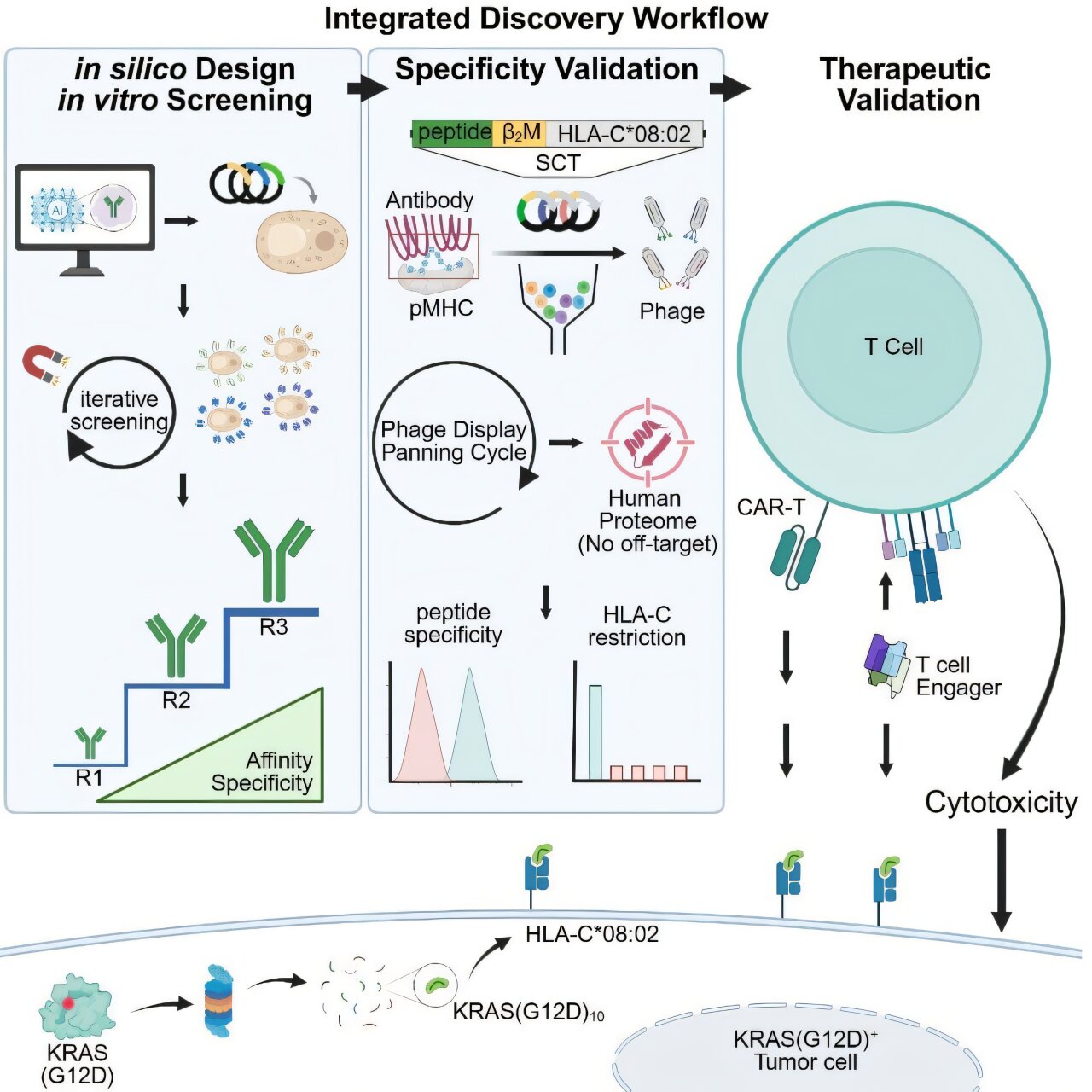
KAIST researchers have designed a KRAS G12D antibody that can identify a cancer-driving mutation normally hidden inside cells, the institute said. The work matters because standard antibody drugs mainly bind targets on cell surfaces, leaving many intracellular cancer proteins hard to reach.
The study, published in Molecular Therapy, describes a TCR-like antibody built through computational protein design and cell-based testing. The team was led by Professor Byung-Ha Oh of KAIST’s Department of Biological Sciences, with researchers from Therazyne, a KAIST faculty startup focused on protein design and headed by Oh.
What is a KRAS G12D antibody?
KRAS G12D is a mutated version of the KRAS protein, which helps regulate cell growth and proliferation. KAIST said the mutation is a common cancer driver in pancreatic, colorectal and lung cancers.
A KRAS G12D antibody is intended to recognize cells carrying that mutation. In this study, the antibody does not enter the cell to bind the KRAS protein directly; it detects a mutation-derived protein fragment displayed on the cell surface.
How the antibody finds an intracellular mutation
Cells routinely cut old or damaged proteins into short fragments. KAIST said fragments from mutant KRAS G12D can become neoantigens, molecular signs that help immune cells distinguish cancer cells from normal cells.
Some of those fragments are carried to the cell surface, where immune cells can read them. The KAIST-led group used computational design and experimental screening to create a TCR-like antibody aimed at one of these KRAS G12D-derived fragments.
TCR refers to the T cell receptor, the sensor T cells use to inspect protein fragments shown on cell surfaces. KAIST said the antibody developed in the study works on a similar principle, giving an antibody a way to detect evidence of a mutation that sits inside the cell.
What the experiments showed
According to KAIST, experimental results showed that the antibody selectively recognized cancer cells with the KRAS G12D mutation. The institute said it showed little to no reaction with normal cells or unrelated proteins.
KAIST also said that, when used in an immunotherapy setting, the antibody eliminated cancer cells carrying the mutation. The team is now verifying the antibody’s efficacy in animal disease models, according to the institute.
The findings suggest a possible way to broaden antibody therapy beyond surface proteins to intracellular cancer-driving proteins that have been difficult for conventional antibodies to target. KAIST said the approach could become a platform for precision antibody therapies against KRAS and other cancer mutations.
Oh said the work showed that the antibody could distinguish cancer cells with KRAS G12D from other cells, supporting the goal of precision antibody treatment that reduces harm to normal tissue. He also said the computational antibody design method could be applied to KRAS and other cancer mutations.
The paper is titled “Discovery of TCR-like antibodies to the KRAS G12D neoantigen via in silico-in vitro workflow.” Its authors include SangPhil Ahn and colleagues, and the study carries the DOI 10.1016/j.ymthe.2026.05.032.
This story draws on original reporting from Medical Xpress.