
Brain scan-guided TMS shows stronger depression results in small trial
A randomized trial found MRI-guided targeting improved symptoms more than standard scalp measurements in treatment-resistant depression.
By Priya Raghavan · Science Reporter
3 min read
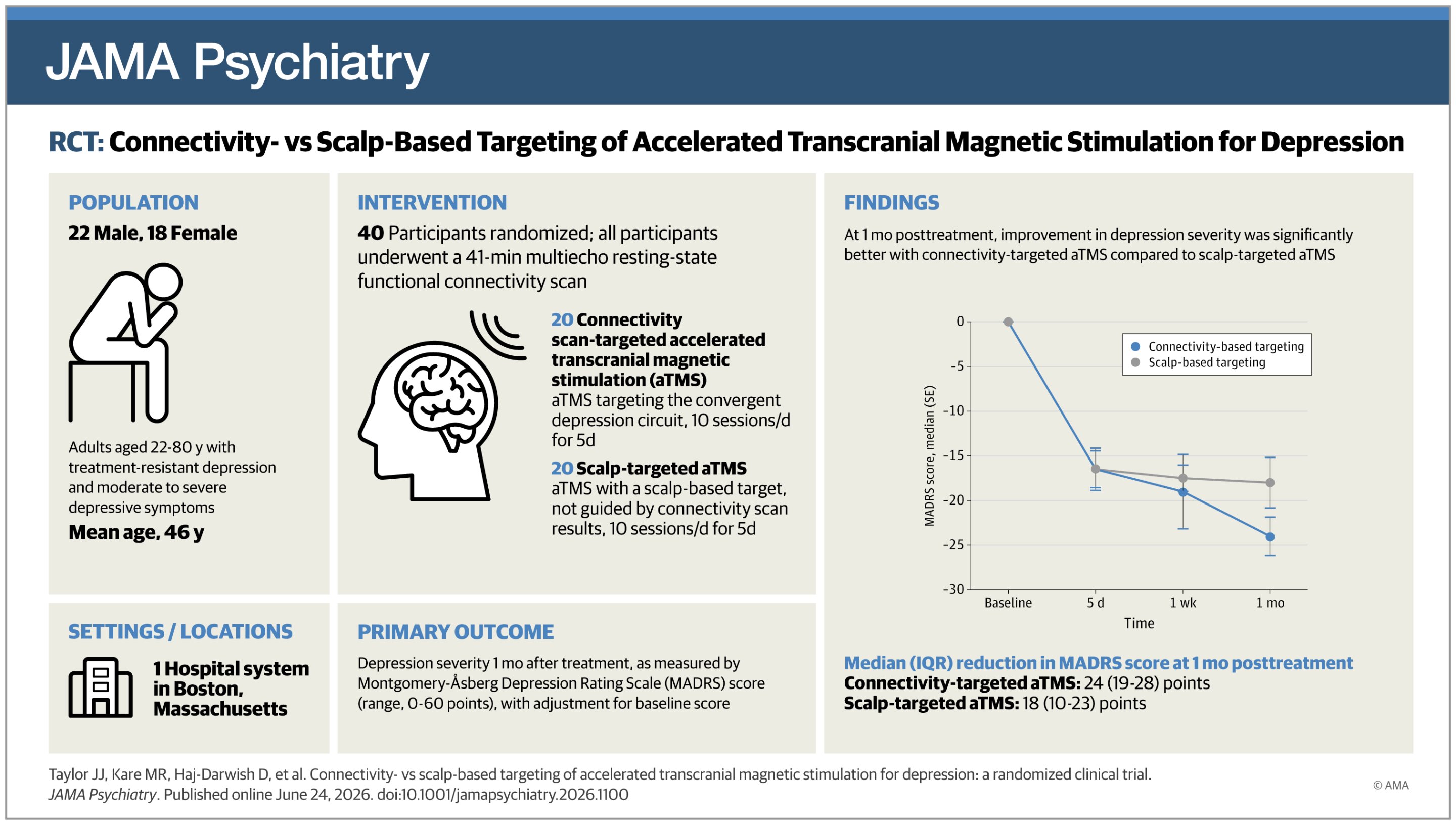
A small randomized clinical trial found that using personalized brain imaging to guide transcranial magnetic stimulation led to better short-term outcomes for adults with treatment-resistant depression. The findings, reported by Mass General Brigham researchers in JAMA Psychiatry, add prospective evidence that brain scans may help clinicians choose more effective stimulation targets.
Transcranial magnetic stimulation, or TMS, uses magnetic pulses to influence brain activity without surgery. The U.S. Food and Drug Administration has cleared TMS for major depressive disorder in adults since 2008, and clinicians often use it when standard depression treatments have not worked, according to the report from Brigham and Women’s Hospital.
Standard TMS targeting relies on measurements taken from the scalp. Mass General Brigham investigators said that method is practical and widely used, but it does not account for differences in the brain circuits tied to depression from one patient to another.
The new trial tested whether functional MRI could improve targeting. Researchers used resting-state functional connectivity, an analysis that measures how brain areas synchronize while a person is at rest, to select a stimulation site for each participant.
The team studied accelerated TMS, or aTMS, which gives multiple treatment sessions per day. That schedule can compress treatment that usually takes several weeks into one week, according to the researchers.
The study enrolled 40 adults ages 22 to 80 with major depressive disorder and moderate to severe treatment resistance. Each participant had an fMRI scan before treatment, then was randomly assigned to receive aTMS guided either by the connectivity-based target or by the conventional scalp-based target.
Participants and the clinicians rating their symptoms did not know which targeting method had been used. One month after treatment, patients in the connectivity-guided group had greater improvement in depressive symptoms than those in the scalp-guided group, the investigators reported.
The researchers measured symptoms with the Montgomery-Åsberg Depression Rating Scale, a clinician-rated depression severity scale. They also found higher response rates in the imaging-guided group: 80% met response criteria, compared with 60% in the group treated with scalp-based targeting.
Dr. Joseph Taylor, corresponding author and a psychiatrist at Mass General Brigham and Harvard Medical School, said the trial was designed to test whether imaging adds value beyond standard targeting, since brain imaging increases the cost and complexity of TMS care. He said prior retrospective work had suggested functional imaging could improve results, while prospective evidence had remained limited.
The findings build on Taylor’s recent work, including a trial in Molecular Psychiatry that examined circuit-targeted treatment of anxiety symptoms in people with major depression, according to Brigham and Women’s Hospital.
The researchers cautioned that the study was limited by its small size and single-site design. They said they plan a larger trial to test connectivity-based aTMS in more diverse patient groups and to examine how long the effects last.
This story draws on original reporting from Medical Xpress.