
Brain iron buildup tied to weaker neuron defenses in Salk study
Salk researchers report that prolonged iron exposure can push neurons into a stress state that may help explain age-related neurodegeneration.
By Priya Raghavan · Science Reporter
3 min read
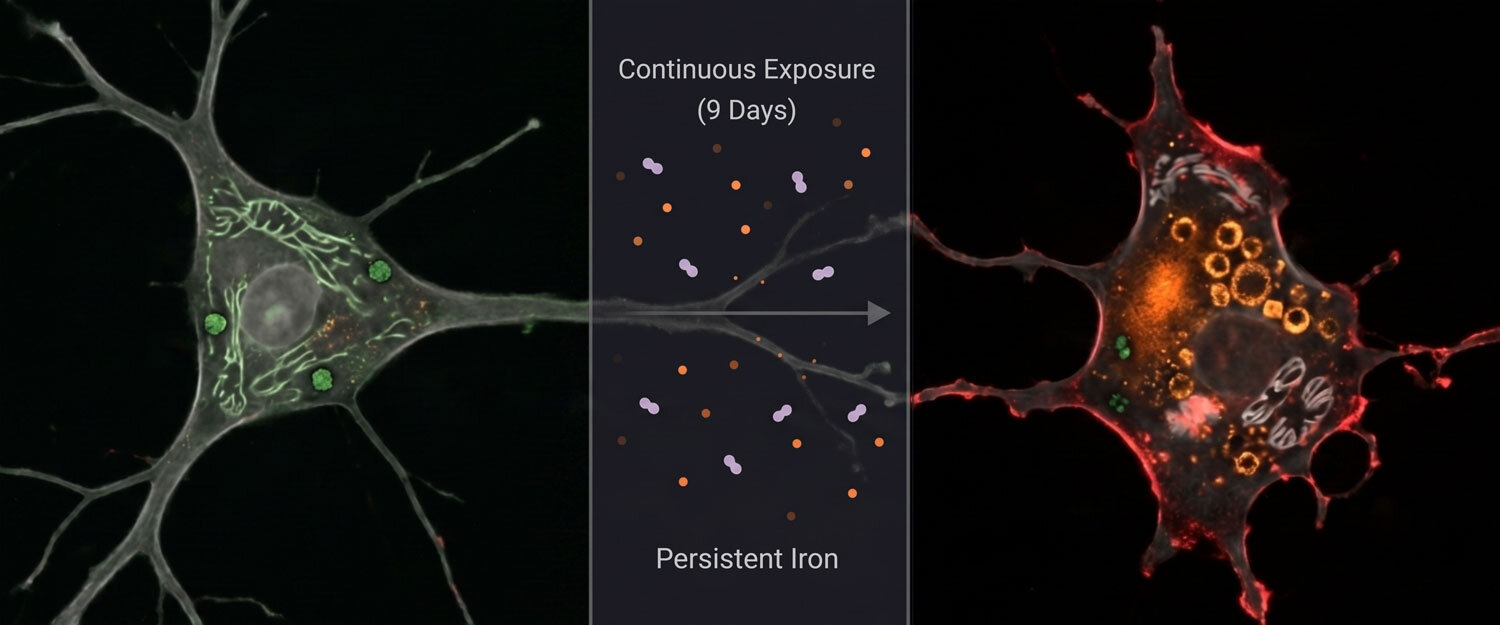
Salk Institute researchers say prolonged iron buildup in neurons can weaken the cells’ ability to withstand stress, offering a possible clue to how neurodegenerative diseases develop with age. The work identifies a previously described stress pathway, which the team named chronoferroptosis, as a potential target for future efforts to predict or treat conditions such as Alzheimer’s and Parkinson’s disease.
The study was published June 18, 2026, in Cell Death Discovery. According to the Salk Institute, the researchers used a human-derived nerve cell line to compare short-term and longer-term iron exposure in neuronal cells.
Neurodegenerative diseases affect tens of millions of people worldwide, according to the Salk Institute. In the United States, the Alzheimer’s Disease Association and the Parkinson’s Foundation report about 7 million people living with Alzheimer’s disease and about 1 million with Parkinson’s disease.
Longer exposure changed the cells
Iron is needed throughout the body, including for red blood cell development, oxygen transport, hormone production, immune function and energy production, according to the Salk Institute. The researchers said the concern is not iron itself, but the gradual buildup of iron inside neurons over time.
The exact cause of that buildup remains unresolved. The Salk team said it suspects a problem with the cells’ iron export system: iron enters neurons, then is not cleared efficiently after use.
To test how time changes the effects of iron exposure, the researchers compared acute exposure lasting six to eight hours with chronic exposure lasting nine days. The Salk Institute said the short exposure produced little biochemical change, while the longer exposure altered many cell processes.
In the chronically exposed neurons, the team reported changes in iron-handling and antioxidant-defense proteins, increases in lipid peroxidation, buildup of harmful chemicals and loss of protective ones. When the researchers added further stress, the acutely exposed cells could withstand it, while the chronically exposed cells were more vulnerable, according to the Salk Institute.
A time-based form of ferroptosis
The pathway described by the researchers builds on ferroptosis, an iron-dependent cell death process linked to lipid peroxidation. Pam Maher, a Salk research professor and senior co-corresponding author, has studied ferroptosis for years, according to the institute.
The team’s findings suggest that prolonged iron stress can place neurons into a persistent state that does not necessarily kill the cells immediately. Instead, the researchers said, chronoferroptosis may reduce neuronal resilience and leave cells more likely to fail when they face added stress later.
Nawab John Dar, a postdoctoral researcher in Maher’s lab and co-corresponding author, said the model was designed to reflect the progressive nature of neurodegenerative disorders, according to the Salk Institute. Earlier experiments in the field often examined iron exposure over much shorter periods, the institute said.
Possible treatment direction
The study does not show that chronoferroptosis causes Alzheimer’s or Parkinson’s disease in patients. It does, however, point to chronic iron imbalance as a biological process that researchers may be able to track or influence.
The Salk Institute said future work could examine whether scientists can detect when neurons begin entering this vulnerable state. The researchers also said interventions that correct iron imbalance or strengthen neuron defenses could one day be explored as ways to delay neurodegeneration.
Maher said her lab has developed several compounds that inhibit the pathway, though those compounds were not tested in this study, according to the Salk Institute. The paper is titled “Sustained dysregulation of iron and glutathione homeostasis induces chronoferroptosis, a persistent ferroptotic adaptation in neuronal cells.”
This story draws on original reporting from Medical Xpress.