
Brain implant controls neuron activity with heating and cooling
Korea University researchers built a deep-brain implant that uses temperature shifts to suppress or boost neural activity while recording brain signals.
By Priya Raghavan · Science Reporter
3 min read
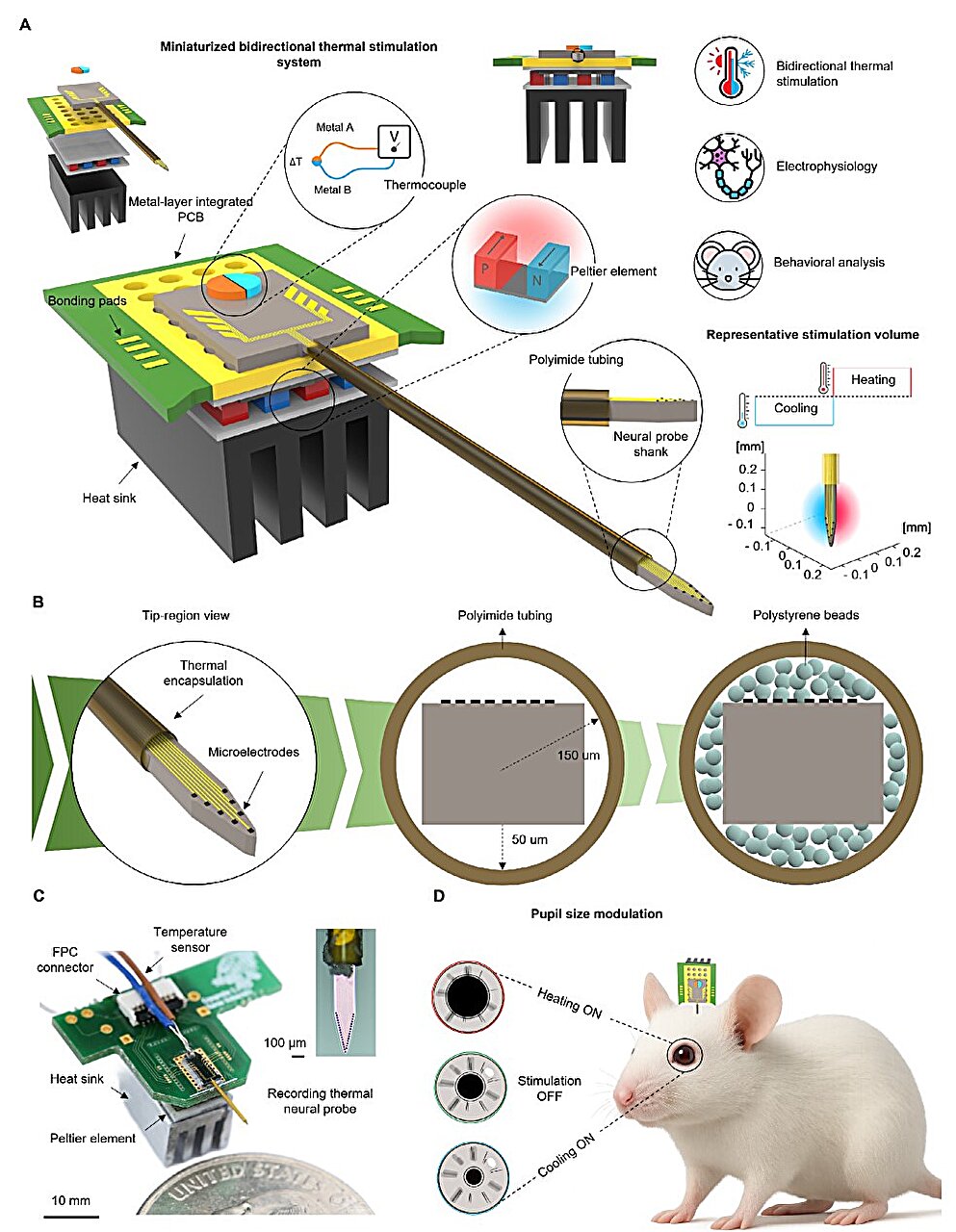
A team at Korea University College of Medicine has developed a miniaturized brain implant that can raise or lower local brain temperature to control neural activity in both directions. The work could help advance brain-computer interfaces and closed-loop neuromodulation systems, according to the researchers.
The device, described in the journal Advanced Science, combines a thermoelectric Peltier element with a silicon-based neural probe. The system is designed for implantation in deep-brain regions, where it can deliver localized heating or cooling to specific neural circuits.
Researchers led by Professor Il-Joo Cho said the implant also includes an electrode array, allowing it to record neural signals while applying temperature-based stimulation. That combination lets researchers observe how brain activity changes as tissue temperature is adjusted.
Using temperature as a control signal
Most neuromodulation tools rely on electrical, magnetic, optical, ultrasonic or chemical stimulation, according to Korea University College of Medicine. Many of those approaches are built mainly to either increase or reduce neural activity, which can limit two-way control of circuits.
Temperature offers a different route because cooling and heating can have opposite effects on neurons. In the experiments reported in Advanced Science, cooling reduced neural activity, while heating increased it, according to the research team.
The technical challenge has been applying temperature changes to targeted deep-brain regions without affecting broad areas. Cho’s team addressed that by integrating the heating and cooling element into a small implant paired with a probe for localized delivery.
Tests in an arousal-related brain region
The researchers tested thermal stimulation in the locus coeruleus, a brain region involved in arousal and attention regulation, according to Korea University College of Medicine. Stimulation there changed neural activity and was linked to changes in pupil size.
The team reported both pupil constriction and dilation during thermal stimulation of the locus coeruleus. Those physiological changes matched the researchers’ aim of showing that the device can influence neural circuits and related bodily responses in more than one direction.
The study, titled “Miniaturized Bidirectional Thermal Stimulation System Integrated With an Electrode Array for Recording Neural Activities,” lists Zoia Naumkina and colleagues as authors. It was published in Advanced Science with the DOI 10.1002/advs.202522077.
Potential role in future interfaces
Korea University College of Medicine said the technology may support future bidirectional brain-computer interfaces. Current BCI systems often focus on reading brain signals to control external devices, while future systems may need to send sensory information, such as tactile feedback, into the brain.
By allowing both activation and suppression of selected circuits, the implant could become part of systems that adjust stimulation based on recorded neural activity. The researchers also said it may be relevant to approaches for neurological and neurodegenerative disorders, though the reported work focused on device development and experimental testing.
“This study introduces a new concept in brain interface technology that enables both activation and suppression of neural activity within a single device,” Cho said. He added that the team expects the technology to contribute to bidirectional BCIs, neural function restoration and new therapeutic approaches for neurological and neurodegenerative disorders that are difficult to address with conventional methods.
This story draws on original reporting from Medical Xpress.