
Young women trail men in entry-level hiring, Stanford-ADP data finds
New Stanford and ADP Research data finds young women have weaker job growth than men, but AI exposure does not explain most of the gap.
By Daniel Okafor · Business Editor
3 min read
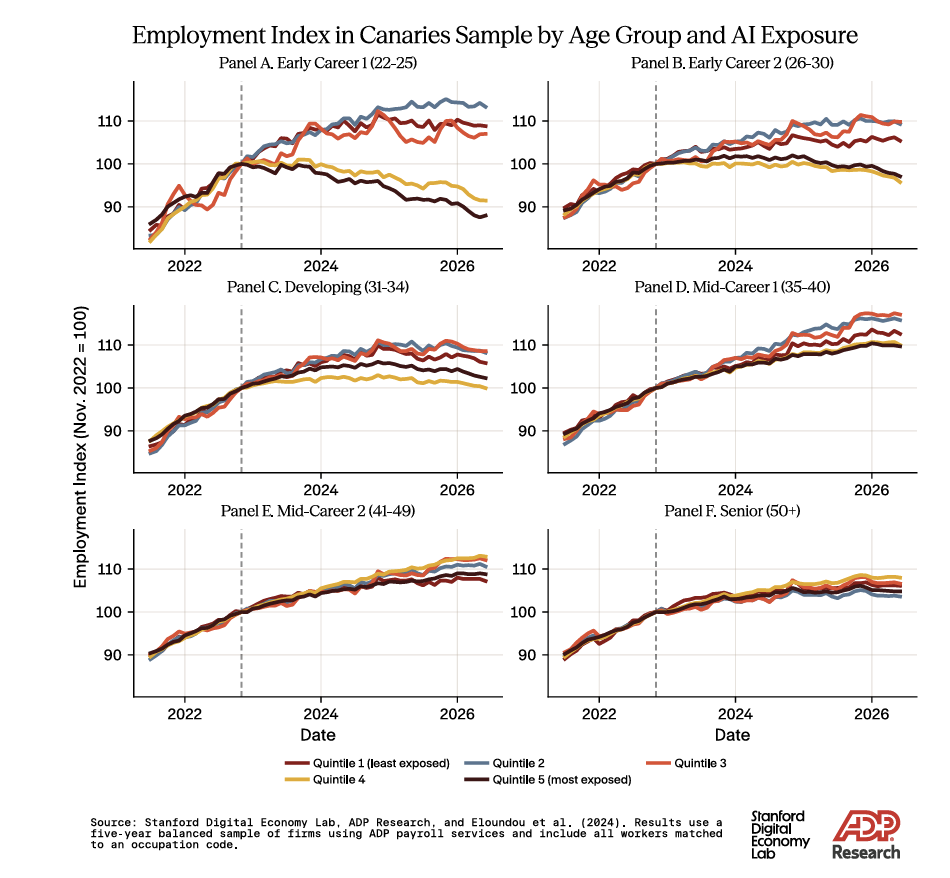
Young women are losing ground to young men in the early-career labor market, according to new data from Stanford researchers and ADP Research reported by Fortune. The data matters because it suggests generative AI is weighing on entry-level work, but does not appear to be the main reason women ages 22 to 25 are seeing weaker employment growth than men.
The findings come from an update to the Canaries Dashboard, a project run by the Stanford Digital Economy Lab and ADP Research. Fortune reported that the project is led by Erik Brynjolfsson and Nela Richardson and tracks how generative AI is affecting entry-level employment.
According to Fortune, the dashboard has shown a widening split since ChatGPT was released in late 2022. Workers ages 22 to 25 in jobs most exposed to AI, including software development and customer service, have seen employment fall while overall U.S. job growth has remained solid, Fortune reported.
The researchers found that the gap has continued to expand, growing by about half a percentage point each month since their earlier paper last year, according to Fortune.
Gender split adds a new layer
The latest dashboard update breaks out the data by gender for the first time, Fortune reported. In the 22-to-25 age group, young women in the sample posted weaker employment growth than young men.
The researchers identified two forces behind the difference, according to Fortune. Women are more likely than men to work in occupations with high exposure to AI, and women also show somewhat slower employment growth than men across every level of AI exposure.
Most of the difference comes from the jobs young women and men hold, Fortune reported. In the Canaries sample, 43.8% of women work in the most AI-exposed group of occupations and 21.2% work in the second-most-exposed group. For men, the comparable shares are 32.4% and 18.1%.
When the researchers looked for a direct link between AI exposure and the gender gap, they did not find one, according to Fortune. Women’s weaker job growth appeared in occupations with low exposure to AI as well as those with high exposure.
In the least-exposed group of occupations, employment for women ages 22 to 25 rose 1.3% annually after late 2022, compared with 2.7% for men, Fortune reported. In the most-exposed group, women’s employment fell 4.5% annually, while men’s fell 2.5%.
“These gaps are a feature of our broader sample; they are not noticeably correlated with AI exposure,” the researchers wrote in materials cited by Fortune. The researchers concluded that gender differences in employment trends tied to AI exposure appear to reflect occupational mix more than different outcomes for women and men within the same kinds of jobs.
AI still weighs on early-career work
The new gender findings do not change the dashboard’s broader reading of the entry-level market, according to Fortune. Brynjolfsson and Richardson have argued that AI is changing tasks before it eliminates whole jobs, with routine work such as summarizing, formatting and scheduling often assigned to the least-experienced employees.
Richardson has pointed to the distinction between AI that supports workers and AI that replaces tasks, Fortune reported. Occupations where AI supports human work have shown stronger employment growth, while occupations where AI automates tasks have contracted, and early-career jobs are more concentrated in the latter group.
Fortune reported that women’s greater presence in AI-exposed occupations leaves them more exposed to that pressure. The researchers’ data, however, points to long-running occupational sorting rather than AI producing a separate gender effect within comparable jobs.
The researchers have not yet identified what explains women’s weaker growth across low- and high-exposure occupations, Fortune reported. Possible areas for future study include education mix, industry concentration, hours worked and return-to-office effects.
This story draws on original reporting from Fortune.