
Trump details his deal-driven economic agenda in Oval Office interview
President Trump told Fortune he is using tariffs, equity stakes and direct CEO outreach to pursue growth while acknowledging limits from war and inflation.
By Daniel Okafor · Business Editor
3 min read
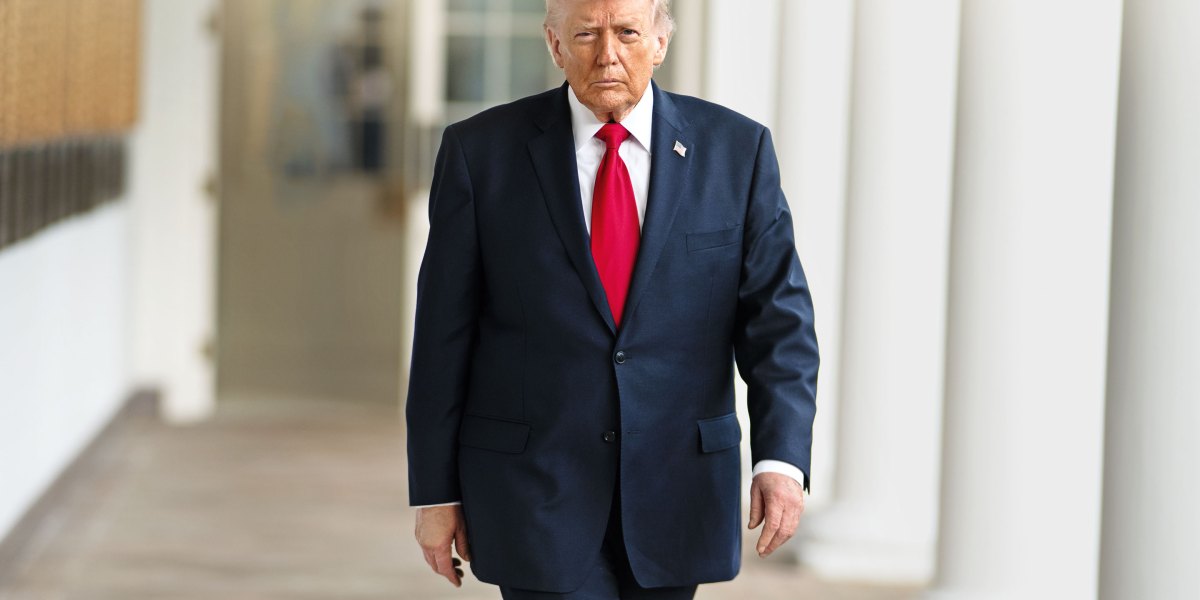
President Trump described an unusually centralized approach to economic policy in an Oval Office interview with Fortune, saying he is personally pushing tariffs, corporate equity deals and CEO-to-CEO diplomacy to strengthen the U.S. economy. The remarks matter because they show how much of the administration’s strategy depends on Trump’s own dealmaking style.
Fortune editor-in-chief Alyson Shontell reported that the hourlong conversation took place shortly before Trump left for a China summit. Fortune said Nvidia cofounder Jensen Huang was added late to the business delegation and traveled on Air Force One with Elon Musk and other executives, while Citigroup CEO Jane Fraser and Boeing CEO Kelly Ortberg were also among the corporate leaders preparing for the trip.
Trump told Fortune he prides himself on quick, personal transactions with business executives and foreign leaders. Fortune reported that he has leaned on Commerce Secretary Howard Lutnick and Treasury Secretary Scott Bessent while pursuing tariffs, foreign investment pledges and government ownership stakes in selected companies.
Tariffs and corporate stakes
Trump told Fortune he was angry about a Supreme Court ruling that found roughly half of his “Liberation Day” tariffs unconstitutional. He said he could use other legal tools to impose tariffs more slowly, but estimated that annual revenue would fall from about $600 billion to roughly half that amount, according to Fortune.
Fortune reported that Trump also objected to the possibility of refunding $149 billion in tariff collections. The outlet noted that research, disputed in part by the White House, has found many tariff costs were borne by U.S. importers or consumers rather than foreign governments.
The president also defended his administration’s use of equity stakes in companies. Trump told Fortune the U.S. received a 9.9% stake in Intel after federal chipmaking grants were converted into equity, and said he regretted not asking Intel CEO Lip-Bu Tan for a larger share.
According to Fortune, Trump said the government’s Intel position had risen from about $10 billion to more than $50 billion in eight months. He said he was not worried about an eventual exit and believed the government could sell shares gradually if it clearly signaled its plans to markets.
Trump also pointed to Boeing as an example of his industrial policy. Fortune reported that he has encouraged U.S. allies to buy more Boeing jets, and that he said Ortberg had jokingly named him “Salesman of the Year.” Fortune said Trump was expected to announce in Beijing that China had agreed to buy 200 Boeing aircraft.
Inflation, Iran and AI
Fortune reported that the interview came the same day the Senate advanced Kevin Warsh’s nomination to lead the Federal Reserve and the Bureau of Labor Statistics said inflation had risen to 3.8% from 3.3% a month earlier. Trump told Fortune that the Iran war and higher oil prices could delay his hopes for lower interest rates.
On Iran, Trump described its leaders as eager to reach an agreement but difficult to pin down, according to Fortune. He framed the conflict partly in the language of negotiation, while Fortune noted that inflation, oil markets and war are less controllable than corporate deals.
Trump also said U.S. strength in artificial intelligence depends on allowing technology companies to build power plants for their computing needs, Fortune reported. He said companies such as Meta need far more electricity than the grid can provide and argued that private power generation is helping the U.S. compete with China.
Asked who could sustain his dealmaking model after his term ends, Trump did not name a successor, according to Fortune. He said the next president would be important and warned that choosing the wrong person would be a “disaster.”
This story draws on original reporting from Fortune.