
On LightSpray shoes use robots to make uppers in three minutes
On says its LightSpray process cuts running-shoe construction to seven parts and removes 200 to 300 hours of human work.
By Daniel Okafor · Business Editor
3 min read
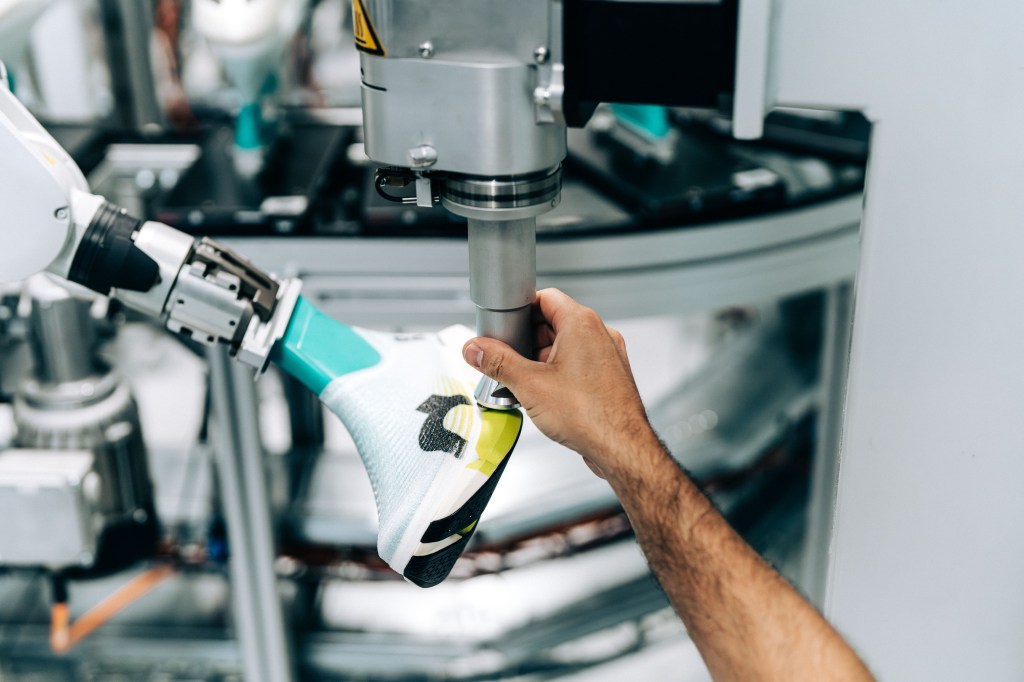
On LightSpray shoes are being built with a robot-led process that can form a running-shoe upper in about three minutes, according to Fortune’s report from the company’s Zurich headquarters. The Swiss sportswear company says the technology reduces a shoe to seven parts and cuts an estimated 200 to 300 hours of human work from the traditional development and production cycle.
The process centers on a robotic arm, a plastic foot-shaped mold and a nozzle that sprays 1.5 kilometers of molten plastic filament. As the arm turns the mold, the material is layered into the upper of the shoe.
On cofounder and co-CEO Caspar Coppetti told Fortune the company did not set out to automate an existing shoe design. He said On built a manufacturing method that depends on robots from the start.
How do On LightSpray shoes get made?
LightSpray makes the shoe upper by spraying molten plastic onto a foot mold rather than assembling many cut, stitched and glued pieces. The company says that marks a sharp break from conventional footwear production, where a shoe can involve as many as 200 components.
One step still uses manual labor: attaching the outsole before the LightSpray process. Coppetti told Fortune that work is still done in Asia, though On is trying to automate it.
On has expanded LightSpray production beyond Zurich to South Korea, where robotic systems are making the shoes as the company works to scale the technology. Coppetti said the economics shift from labor toward capital equipment, and he expects the approach to become more cost-effective over time.
On executives also say the method could change where shoes are made. Coppetti told Fortune he sees smaller factories closer to customers, reducing the distance between design, production and buyers. Cofounder and co-CEO David Allemann said the robot can switch among shoe sizes instead of running large batches of one size at a time.
Why On is investing in shoe automation
Fortune reported that LightSpray reflects On’s broader engineering culture. The company filed about 200 patents last year across footwear, apparel and manufacturing technologies.
That approach traces back to On’s beginnings in 2010. Former professional triathlete Olivier Bernhard, frustrated by running shoes that forced a tradeoff between cushioning and speed, attached pieces of garden hose to an existing shoe. Allemann and Coppetti later joined him as cofounders after seeing the prototype.
On introduced its first shoes in 2010. Fortune reported that the company now has more than 3 billion Swiss francs in annual revenue and a market value of roughly $15 billion after listing on the New York Stock Exchange in 2021.
Footwear remains its main business, accounting for more than 90% of revenue, according to Fortune. The Americas, led by the United States, make up nearly 58% of net sales, while Asia-Pacific accounts for 17% and is On’s fastest-growing region.
The company remains much smaller than Nike and Adidas, which Fortune said generate $46 billion and $29 billion in revenue, respectively. On has also built visibility through investor Roger Federer, collaborations with Loewe and Post Archive Faction, retail expansion and global campaigns featuring Zendaya.
On tests its shoes in labs and with elite athletes. Fortune reported that Olympic marathon champion Helen Obiri helped develop the LightSpray racing shoe with the On Athletics Club in Boulder, while engineers tracked workouts, filmed her stride and gathered feedback on performance.
This story draws on original reporting from Fortune.