
Framers built the Constitution around distrust of unchecked power
A historian says the Federalist Papers defended stronger national authority as a safeguard against ambition, faction and political disorder.
By Daniel Okafor · Business Editor
3 min read
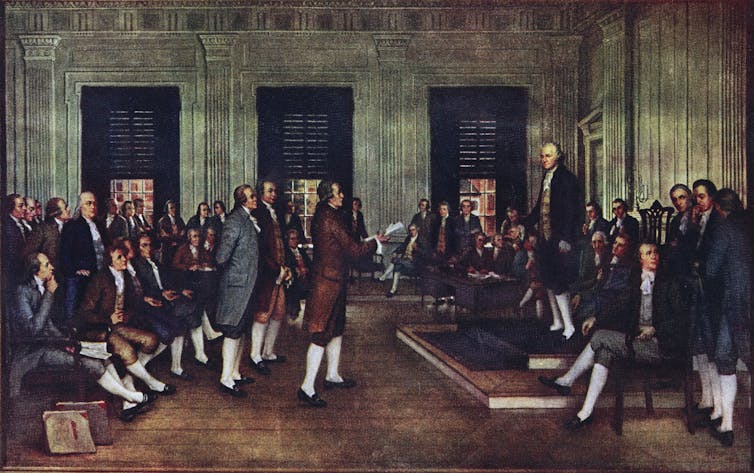
The Constitution emerged from a fight over whether the United States needed a stronger national government after independence. Donovan Fifield, a University of South Carolina history instructor, writes in The Conversation that many founders saw the Declaration of Independence as only the beginning of building a workable union.
Fifield says the question facing the new republic was how to protect liberty while accounting for what its leaders viewed as recurring flaws in human behavior: self-interest, ambition, factional conflict and violence. That concern shaped the case for replacing the Articles of Confederation with the Constitution.
Weaknesses after the Revolution
According to Fifield, the national government after the Revolutionary War was a loose arrangement of state governments. It had helped win independence, but the postwar period exposed sharp disputes over debt, taxes, commerce and local power.
The Articles of Confederation, drafted by the Second Continental Congress in 1777 and ratified by all states in 1781, reflected deep mistrust among the states, Fifield writes. The National Archives describes the Articles as giving limited powers to the central government.
Under that system, Fifield notes, there was no strong executive branch and no national judiciary. Congress had one chamber, each state cast one vote, major legislation required a supermajority, and amendments required unanimous approval.
Many Americans preferred those restraints because memories of British rule remained fresh, Fifield writes. But the 1780s brought events that alarmed national leaders, including the Newburgh Conspiracy, trade disputes among states, an economic depression and Shays’ Rebellion in western Massachusetts.
A stronger union
Fifield identifies Alexander Hamilton, James Madison and John Jay as leading nationalists at the center of the campaign for a more powerful federal structure. They supported a national government that could reduce conflict among states, regulate commerce, manage public finance and enforce federal authority.
The Constitutional Convention met in Philadelphia in 1787 to draft a replacement for the Articles. Fifield writes that the proposed Constitution created a three-branch federal government: a bicameral legislature, an executive branch and a national judiciary.
The proposed system also gave the federal government broader power over commercial regulation, legal tender, foreign policy, courts and the suppression of uprisings, according to Fifield. Those powers drew criticism from Anti-Federalist writers, who argued that the plan concentrated authority in ways that could threaten liberties won in the Revolution.
The Federalist argument
Hamilton, Madison and Jay answered those objections through 85 essays published in New York newspapers under the name Publius, according to the Library of Congress. The essays became known as the Federalist Papers.
Fifield writes that the essays defended stronger federal power by presenting a skeptical view of human nature. In Federalist 51, Madison wrote that “if men were angels, no government would be necessary.”
Madison argued in Federalist 10 that faction was “sown in the nature of man.” Hamilton, in Federalist 6, rejected the idea that republics would naturally remain peaceful, warning that disunited states could fall into “frequent and violent contests with each other.”
Hamilton also argued in Federalist 15 that laws without penalties would amount to “advice or recommendation.” Fifield says that view reflected the Federalist belief that government needed practical authority to restrain both citizens and officials.
The Federalist case did not rest only on distrust, Fifield writes. Madison also argued that human nature contained qualities deserving “esteem and confidence,” while warning of “a degree of depravity in mankind.” The Constitution’s design, in that view, aimed to channel ambition and conflict through institutions rather than deny their existence.
This story draws on original reporting from Fortune.