
Expressive robot mistakes can feel like social violations, study finds
A Science Robotics study finds robot errors cut trust in both cases, while expressive cues changed how participants processed the failures.
By Daniel Okafor · Business Editor
3 min read
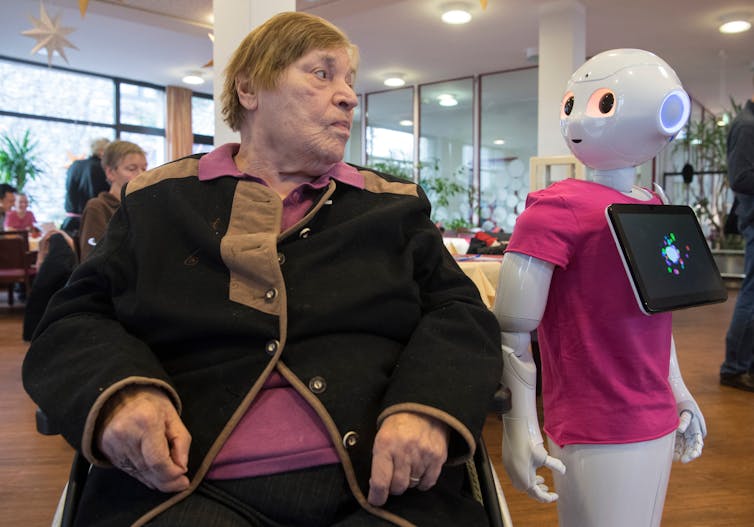
A study of expressive robot mistakes trust found that conversational errors reduced participants’ trust in a humanoid robot and made them less likely to follow its advice. The research, published in Science Robotics, suggests gestures, eye contact and other social cues can make the same failure seem more like a breach by a social partner than a machine error.
Researchers led by Drexel University studied 50 healthy adult men during face-to-face sessions with Pepper, a humanoid robot. The findings matter for robots intended for settings such as homes, health care, education and customer service, where people must judge when to rely on a machine.
Why do expressive robot mistakes affect trust?
The researchers found that errors hurt self-reported trust and the robot’s influence over decisions in both conditions. But when the animated version erred, participants showed stronger activity in prefrontal brain regions involved in monitoring uncertainty and interpreting another party’s intentions, according to the study’s abstract.
The authors interpret that pattern as evidence that expressive cues changed the apparent meaning of the errors. A stationary robot’s failure may be treated more like a discrete glitch; an animated robot that breaks conversational norms may be evaluated as a social partner behaving badly. That is an interpretation of this experiment, rather than a rule that applies to every robot or user.
Expressiveness therefore presents a design trade-off, the researchers said: it can draw people into an interaction, while reliable performance remains the basis for trust. The study describes expressive design as potentially making errors disproportionately damaging to trust, but its results also show that mistakes reduced trust for both versions of Pepper.
What happened in the Pepper robot experiment?
Each participant spent about two and a half hours with a Pepper robot secretly operated by a human who followed a script, Drexel said. One group met a robot that used eye contact, gestures, nods and brief acknowledgments. The other heard the same words from a motionless version without those nonverbal signals.
After two error-free exchanges, the robot began making conversational and cooperative-norm violations. It offered irrelevant comments and illogical reasoning, interrupted participants and asked them to repeat themselves. The study did not test hardware breakdowns or autonomous software failures.
The team measured prefrontal activity with wearable functional near-infrared spectroscopy, or fNIRS, which tracks changes in blood oxygenation while a person can talk and move. It also collected saliva samples to measure oxytocin, surveyed participants about trust and rapport, and recorded whether they changed decisions to match the robot’s suggestions.
Oxytocin rose as robots made errors even as trust dropped, Drexel reported. During expressive-robot errors, higher oxytocin was most strongly associated with lower trust and less influence on decisions. The paper says that pattern is consistent with a context-sensitive vigilance response; it does not show that oxytocin causes distrust.
How far do the findings extend?
The experiment involved one robot design, scripted interactions and young male participants, limiting how broadly the results can be applied. Its brain measurements covered prefrontal areas, not deeper regions involved in social processing.
Researchers plan to test other users, cultures and robot designs, and to examine whether acknowledging an error, apologizing or signaling good intent can help repair trust. Separate University of Michigan research found that, after three robot mistakes, apology, denial, explanation and promises did not fully restore trust in its own experiment.
This story draws on original reporting from Fortune.