
Xi calls for global cooperation on artificial intelligence
China’s president told a Shanghai AI conference that development of the technology should be shared internationally and kept under human control.
By Sofia Marchetti · World Affairs Correspondent
3 min read
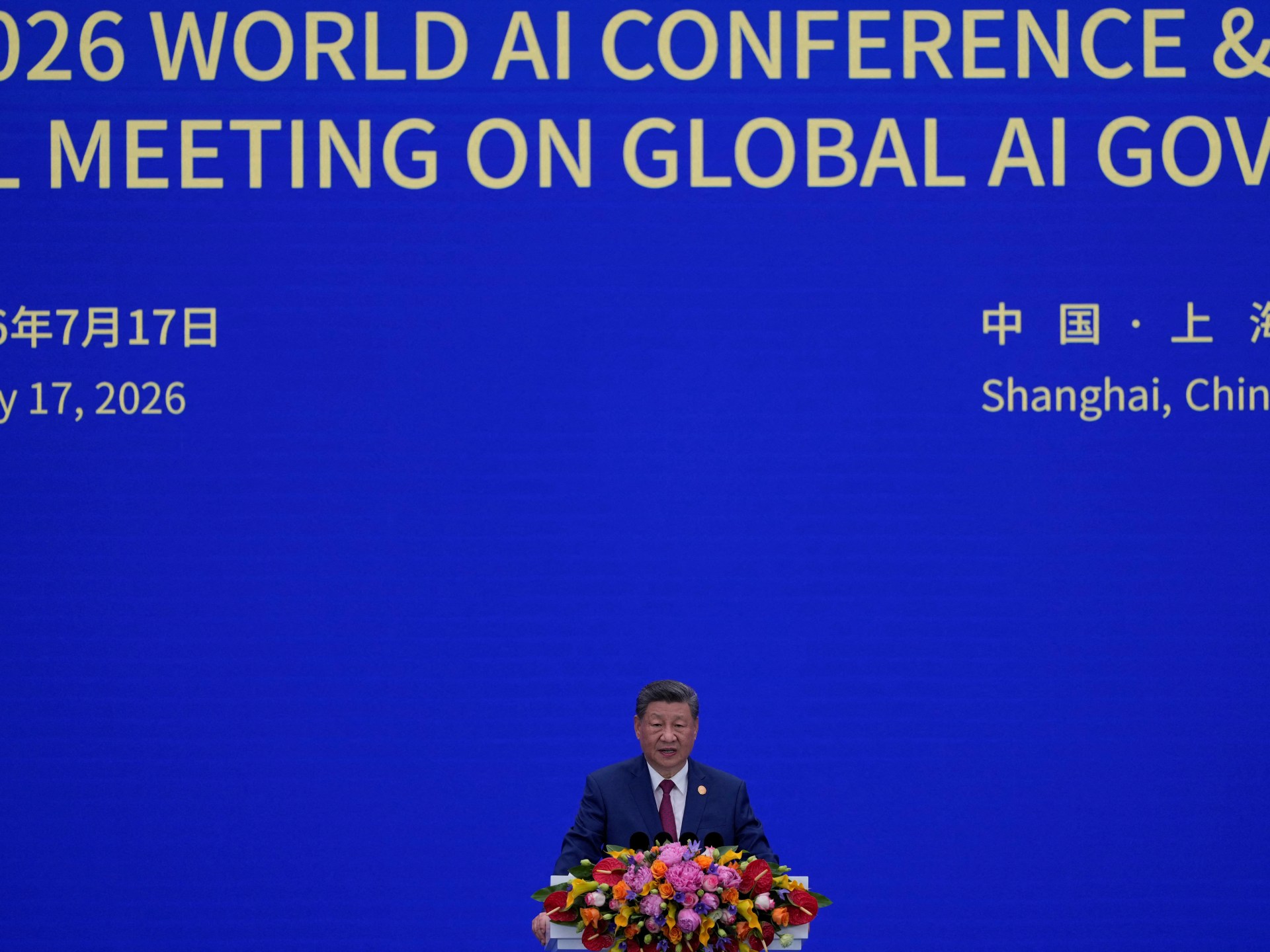
Chinese President Xi Jinping called for wider international cooperation on artificial intelligence on Friday, saying the technology should not be controlled by a single country. Speaking at the opening of the World Artificial Intelligence Conference in Shanghai, Xi also urged a “people-centred” approach that keeps humans in charge of AI systems, according to Al Jazeera, AFP and Reuters.
The Shanghai conference is showcasing advanced AI technology as China seeks to compete more closely with the United States in a field now central to economic and national security policy. Al Jazeera reported that Chinese AI models are narrowing the gap with leading US systems and drawing users abroad in part because they are cheaper.
Xi used his keynote address to frame AI development as a global issue, particularly for developing countries. He said China had a role in helping ensure fair access to AI capacity-building so that the technology does not create what he called “new historical injustices,” according to the report.
“AI development should not be a solo performance by a single country, but a symphony of international cooperation,” Xi said. “We should jointly oppose overstretching the national security concept in the field of AI or placing one country’s security over that of others.”
Xi said China plans to work with international bodies, including groups from Africa, Latin America, Asia and BRICS countries, to expand AI-related opportunities, Al Jazeera reported. He did not, in the report, give detailed terms for those initiatives.
Governance concerns grow
The remarks came as governments debate how to regulate AI amid concerns over its possible use in military operations, cybercrime and other illegal activity. The United States and the European Union have placed restrictions on some Chinese technology imports, citing national security concerns, according to Al Jazeera, AFP and Reuters.
Washington has also tightened rules around advanced semiconductors. In May, the US Commerce Department issued guidance confirming that restrictions on exports of advanced AI chips apply to companies headquartered in China or owned by a Chinese parent, including subsidiaries outside China, according to the report.
Those limits are part of a broader contest over access to the chips needed to train and run powerful AI systems. Al Jazeera reported that recent disputes between Washington and US AI labs have also raised questions about who should control access to the most advanced technology.
Xi said regulation should be built around human oversight. “We should put in place laws and regulations, technological monitoring, early warning, and emergency response systems, in order to … ensure AI is always under human control,” he said.
China’s AI push
AI has become a major part of China’s industrial strategy, supported by state investment in areas ranging from chipmaking to consumer applications, according to Al Jazeera. State media, citing officials, said daily AI “token” consumption in China has risen a thousandfold over the past two years.
Although China trails the US in access to the most advanced semiconductors, Al Jazeera reported that the country has an advantage in powering large data centres because of its supply of low-cost electricity. The International Energy Agency says a typical data centre can use as much electricity as 100,000 households, while next-generation hyperscale sites can consume as much power as two million homes.
China already produces more than twice as much electricity as the United States, according to Al Jazeera, and that lead is expected to grow as Beijing invests heavily in the national power grid. That energy base could help China support the data centres needed for AI expansion, even as chip restrictions remain a constraint.
This story draws on original reporting from Al Jazeera.