
Ten years after Brexit, UK growth, trade and opinion have shifted
A decade after the 2016 referendum, official data and polls point to weaker trade, higher migration than before Brexit and growing public regret.
By Sofia Marchetti · World Affairs Correspondent
4 min read
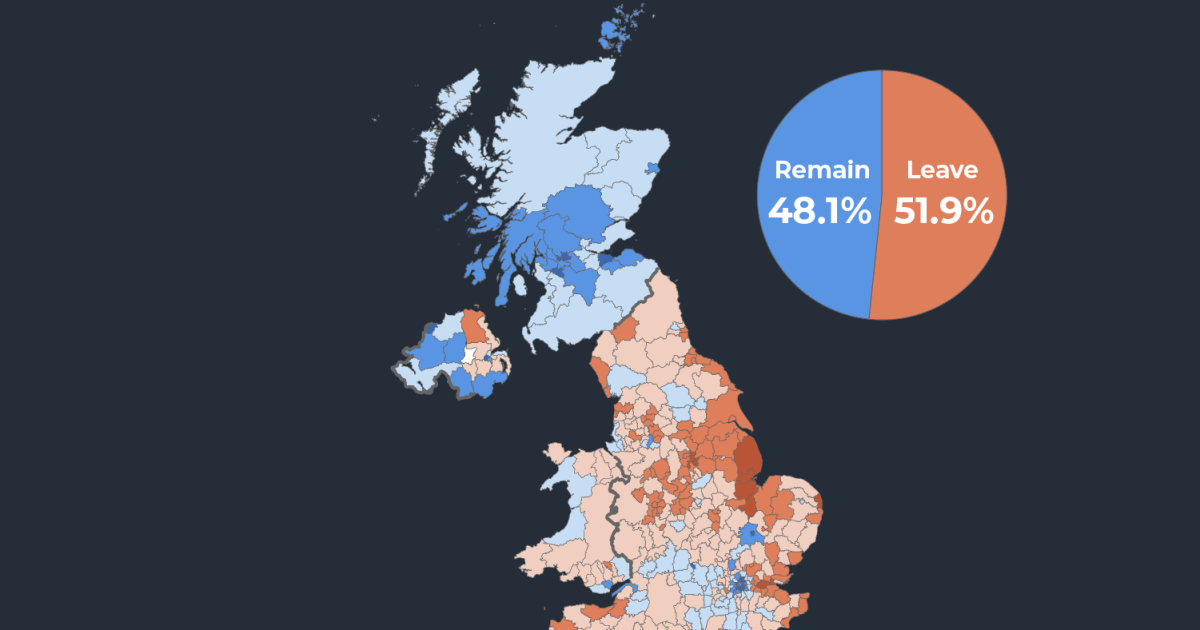
Ten years after the United Kingdom voted to leave the European Union, the economic and political record is mixed at best, with several central promises of the campaign unmet. Data cited by Al Jazeera, along with official forecasts and polling, show weaker trade links with Europe, slower growth than EU peers and a public that has become more negative about the decision.
The referendum on June 23, 2016, delivered a narrow Leave victory: 51.9 percent voted to quit the EU and 48.1 percent voted to remain. England and Wales each voted 53 percent Leave, while Scotland and Northern Ireland backed Remain, with Leave shares of 38 percent and 44 percent respectively, according to the reported results.
The vote followed decades of tension over Britain’s place in Europe. The UK joined the European Economic Community in 1973, after a period in which its relative economic performance had weakened; the Centre for Economic Policy Research says UK GDP per person was nearly 30 percent above EEC countries in 1950 but about 10 percent lower by 1973.
David Cameron, then prime minister, promised the referendum under pressure from Eurosceptic Conservatives and the UK Independence Party. Cameron campaigned for Remain and resigned after the result. Theresa May then tried to secure parliamentary approval for a withdrawal deal, before Boris Johnson became prime minister and took the UK out of the EU on January 31, 2020.
Growth and investment
Since the vote, UK real GDP per person has fallen behind the EU’s 27 members when measured against a 2016 baseline. By 2025, Al Jazeera reported that the UK was five index points behind the bloc.
The National Institute of Economic and Social Research has projected average annual growth of 1.3 percent from 2026 to 2030, citing the effects of trade barriers and structural changes. The Office for Budget Responsibility estimates that Brexit has reduced UK productivity by about 4 percent.
Business investment also weakened after the referendum. Studies cited by Al Jazeera put the investment gap at 12 percent to 18 percent compared with a scenario in which Brexit had not happened, attributing much of the shortfall to political and regulatory uncertainty.
Trade and the pound
The Office for Budget Responsibility says UK trade with Europe is expected to be about 15 percent lower in the long run, and that new trade agreements with non-EU countries have not made a meaningful difference. After leaving the EU single market arrangements, British exporters faced rules of origin checks, certification requirements and additional paperwork under the EU-UK Trade and Cooperation Agreement.
HSBC Global Investment Research estimated that border checks cost the UK £4.7bn, or $5.9bn, through 2024. It also put the annual cost of sanitary controls on food trade at about £54m, or $71.5m.
The pound dropped more than 10 percent against the dollar within hours of the Leave result, falling from $1.48 to as low as $1.32, according to Al Jazeera. It has recovered from its lows but has not returned to its pre-referendum level.
Migration, laws and public opinion
Brexit ended free movement for EU citizens and introduced a points-based immigration system. Office for National Statistics figures cited by Al Jazeera show EU migration turned negative by 2022, but non-EU arrivals rose sharply and total net migration reached a record high in 2023.
Migration has since fallen after tighter rules introduced in 2025, but the Office for National Statistics data show it remains above the pre-Brexit level. Provisional estimates for September 2024 put total net migration at 204,000, including 383,000 from non-EU countries and negative balances for British and EU-plus categories.
Brexit also changed the legal framework. The UK copied 6,800 pieces of EU law into domestic law to prevent gaps after withdrawal, according to the House of Commons Library material cited by Al Jazeera. A decade later, only about one-third had been amended or repealed, while the fast-track mechanism for changes was due to expire on June 23, 2026.
Public opinion has moved against Brexit. A June 2026 YouGov poll found 57 percent of Britons said leaving the EU was the wrong decision, while 30 percent said it was right. Ipsos found 52 percent thought the UK should apply to rejoin the EU, with support for rejoining strongest among younger adults.
This story draws on original reporting from Al Jazeera.