
Seoul museum’s quiet room centers two ancient Buddhist treasures
The National Museum of Korea displays sixth- and seventh-century bodhisattvas in a dim gallery designed for contemplation.
By James Whitfield · Staff Writer
2 min read
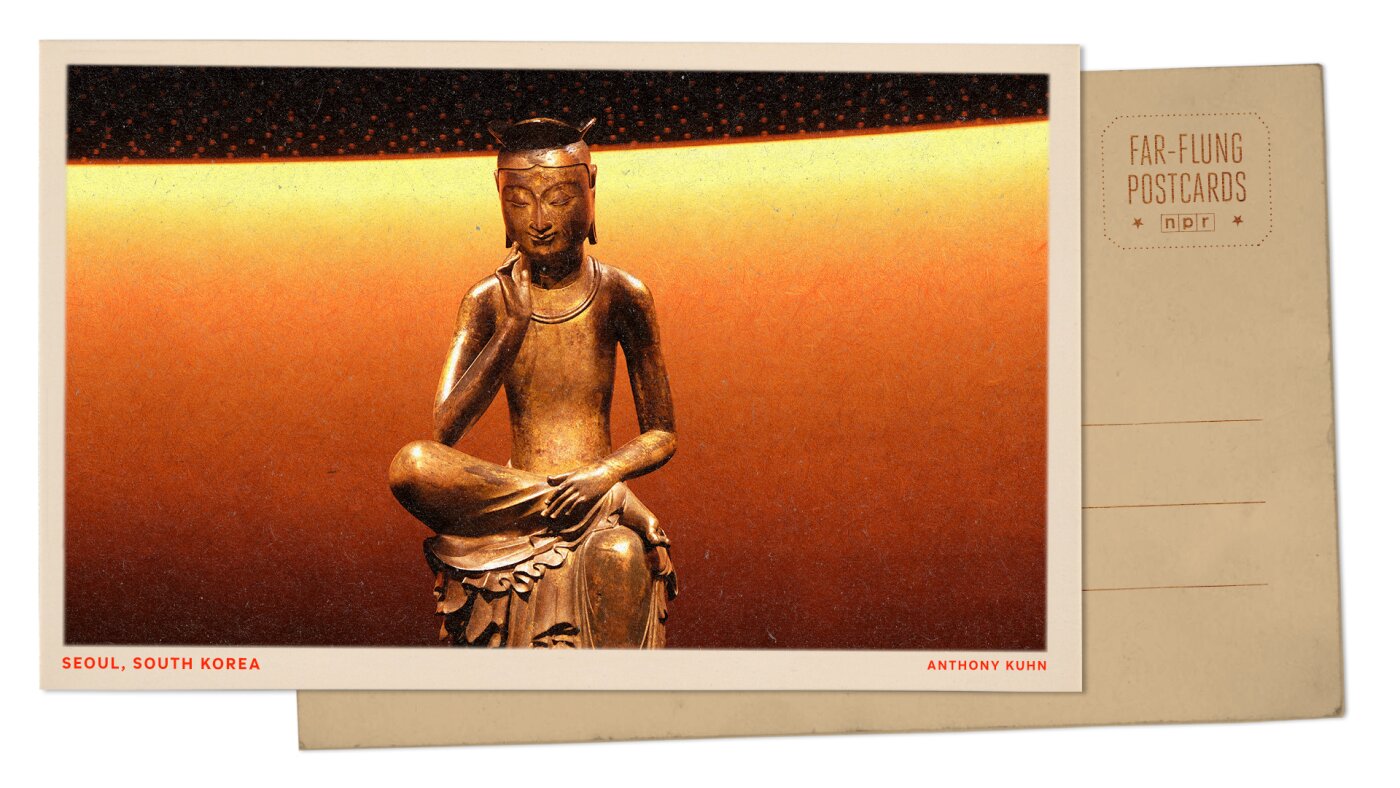
The National Museum of Korea is presenting two of South Korea’s most prized Buddhist artworks in a gallery built around stillness and close looking. NPR reported that the Room of Quiet Contemplation has become a prominent stop inside a museum that ranked among the world’s most visited last year.
The room holds two gilt-bronze bodhisattva statues, one dated to the sixth century and the other to the early seventh century, according to NPR and the museum’s own listing for one of the works. The figures stand on a circular platform in low light while ambient audio plays on a loop.
The National Museum of Korea is in Seoul and is set near bamboo groves and pagodas, NPR’s Anthony Kuhn reported. Inside the quiet room, the museum has narrowed the visitor’s focus to the two sculptures rather than a dense display of objects.
The statues share a similar pose. NPR described them with half-closed eyes, slight smiles, right hands lifted with two fingers touching the cheek, one leg folded and the other lowered toward the floor.
Specialists in Buddhism and Buddhist art interpret those details as more than decoration, according to NPR. The eyes suggest meditation on life’s impermanence, the smiles point to an understanding of truth, and the leg position represents movement toward action in service of freeing sentient beings.
The gallery also uses a contemporary cultural guide. Visitors can scan a code to hear Jisoo, a member of the South Korean pop group Blackpink, explain her reading of the statue, NPR reported.
In that audio, Jisoo says the Buddhist figure reflects the hopes of people seeking salvation through reflection and enlightenment during an unsettled period, according to NPR. She also says the work continues to calm people who view it.
The room is part of a broader strategy that combines historic objects with digital and physical presentation, NPR reported. The museum has also drawn on the reach of South Korean pop culture to connect with visitors.
That approach has coincided with strong attendance. Citing a ranking by The Art Newspaper, NPR reported that the National Museum of Korea was the world’s third-most visited museum last year, trailing only the Louvre in Paris and the Vatican Museums.
The display’s appeal rests on a contrast: centuries-old Buddhist sculpture shown through a restrained, modern museum setting. As NPR reported, the result is a space designed less for speed than for sustained attention to two works regarded as national treasures.
This story draws on original reporting from NPR.