
Failed 2016 coup left Turkiye's military under tighter civilian control
A decade after the coup attempt, reforms, purges and prosecutions continue to define Turkiye’s civil-military balance.
By James Whitfield · Staff Writer
3 min read
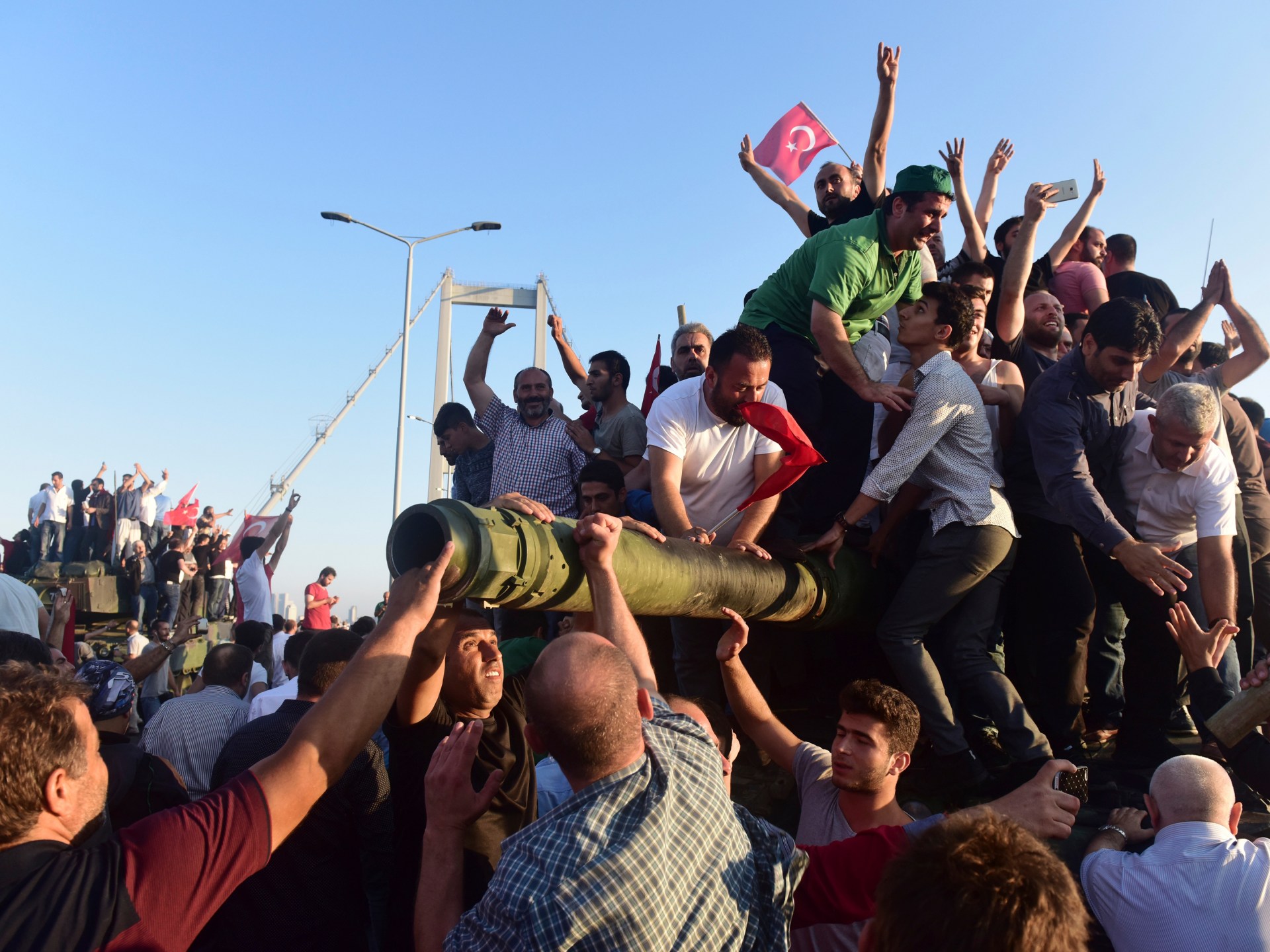
A decade after a military faction tried to oust President Recep Tayyip Erdogan, Turkiye’s armed forces operate under a far tighter civilian framework, Al Jazeera reported. The failed July 15, 2016 coup remains central to national security policy, political debate and the state’s treatment of alleged Gulen-linked networks.
According to Al Jazeera, the attempt began around 19:30 GMT with tanks, aircraft and rebel soldiers moving against Erdogan’s elected government. It collapsed within hours after civilians filled streets in major cities and loyal members of the military, police and command structure resisted the plotters.
Al Jazeera reported that about 250 people were killed and more than 2,200 were injured, making the attempt the deadliest coup effort in modern Turkish history. Retired Colonel Unal Atabay told Al Jazeera that the coup failed because of public resistance, opposition inside the armed forces and the military institution’s own response.
A long history of military intervention
The 2016 events followed decades in which the Turkish military played a powerful role in politics, Al Jazeera reported. The armed forces removed governments in 1960 and 1980, acted through a memorandum in 1971 and pushed an elected government out in the 1997 episode known as the “post-modern coup.”
Political scientist Ali Carkoglu told Al Jazeera that the early republic’s founders saw a separation between military command and civilian politics as a core principle. He said Mustafa Kemal Ataturk and Ismet Inonu entered politics only after leaving uniform, in part to keep the army from becoming a political instrument during the fragile early years of the republic.
Over time, Al Jazeera reported, the armed forces increasingly cast themselves as protectors of the state and used that role to justify interventions. Howard Eissenstat, a Turkiye specialist at St Lawrence University in New York, told Al Jazeera that another traditional military coup now appears unlikely, while cautioning against ruling it out entirely.
Post-coup restructuring
Al Jazeera reported that the governing Justice and Development Party, or AK Party, had already sought to reduce the military’s political weight after taking power in 2002. The failed coup sped up that effort through purges, new command arrangements and broader civilian oversight.
Ankara accused the network of US-based Muslim scholar Fethullah Gulen of organising the coup attempt, Al Jazeera reported. The Turkish government designates the network as the Fethullah Terrorist Organisation, or FETO.
After the coup attempt, tens of thousands of soldiers, judges, police officers, teachers and civil servants were dismissed or arrested, according to Al Jazeera. Military academies were replaced by the National Defence University, and the armed forces’ command structures were changed.
Atabay told Al Jazeera that the military has tightened internal controls to prevent organised infiltration. He said the armed forces and society are more alert to efforts to penetrate state institutions.
Democracy debate persists
Carkoglu told Al Jazeera that stronger civilian authority over the army was a success, though he argued that it does not by itself prove democratic consolidation. He said public trust in institutions depends on competitive politics and free expression.
Al Jazeera reported that arrests and investigations involving opposition figures, including Istanbul mayor and Republican People’s Party presidential candidate Ekrem Imamoglu, have sharpened criticism from political parties and rights groups. They argue that judicial processes are being used against political rivals; the government says cases are independent and based on evidence of criminal wrongdoing.
Human Rights Watch told Al Jazeera that emergency powers adopted after the coup attempt grew into wider restrictions on civil liberties. The group said many dismissed public workers struggled to rebuild careers even after acquittals, while the government says the measures were needed to dismantle clandestine networks inside the state.
Al Jazeera reported that Turkish authorities launched operations across all 81 provinces this week targeting nearly 1,000 suspects over alleged FETO links. For Ankara, the 2016 coup attempt remains an active security issue rather than a closed episode.
This story draws on original reporting from Al Jazeera.