
EU hardens China trade stance as industry worries grow
Brussels is weighing new trade curbs as its goods deficit with China widens and pressure builds on European manufacturers.
By Sofia Marchetti · World Affairs Correspondent
3 min read
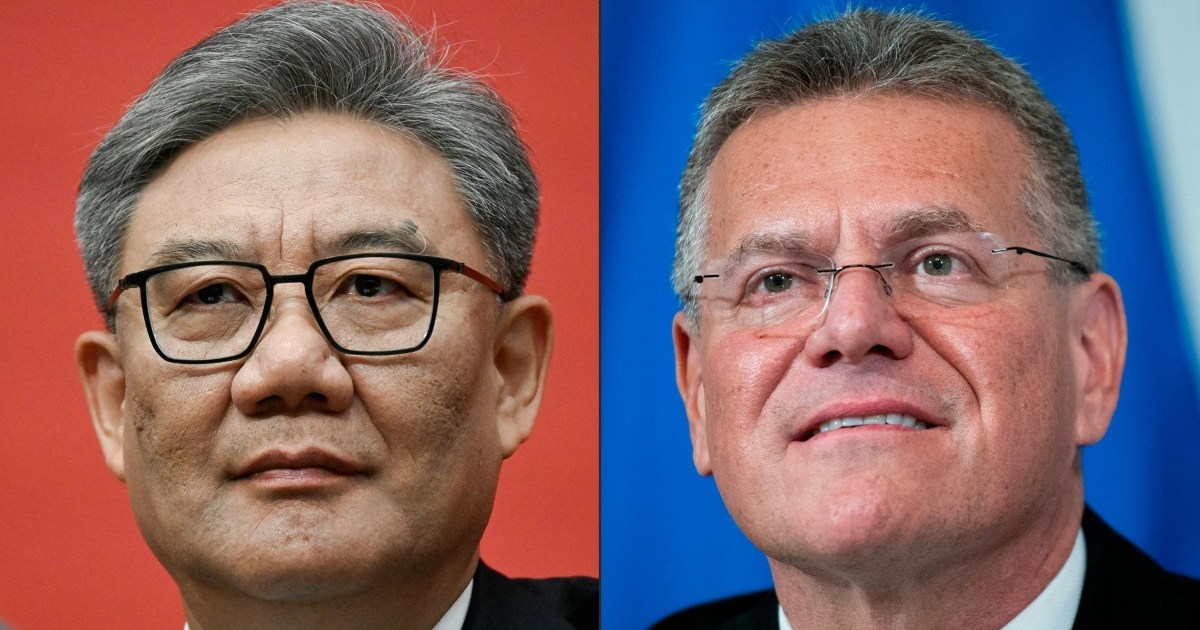
The European Union is taking a firmer line with China over a widening trade gap that officials and analysts say is putting pressure on European industry, Al Jazeera reported. The shift was on display in Brussels, where EU trade commissioner Maros Sefcovic hosted Chinese Commerce Minister Wang Wentao for talks on Monday.
After the meeting, Sefcovic said Chinese sales into the EU continue to climb while European companies are losing ground in China. “This trend is not sustainable. The status quo is not an option,” he told reporters, according to Al Jazeera.
The talks come as European policymakers weigh how far to go in limiting China’s access to EU markets without triggering a broader trade fight. Al Jazeera reported that concern has grown inside the bloc over China’s state-backed industrial expansion, scale advantages and rising share of European markets.
Trade gap sharpens EU concern
China’s goods surplus with the EU reached 360.6 billion euros, or $411 billion, in 2025, Al Jazeera reported. That was equal to about 1 billion euros a day and represented a 15 percent increase from the previous year.
Chinese companies have become major suppliers to Europe in sectors including solar panels, rare earths, chemicals and industrial robots, according to Al Jazeera. The report said Chinese brands are also challenging established European carmakers inside their home market.
The EU has already imposed tariffs of up to 35.3 percent on Chinese electric vehicles, but Al Jazeera reported that brands including BYD, Geely and Chery have continued to gain ground. In May, Chinese models accounted for more than 10 percent of total car sales in the bloc for the first time, according to Dataforce.
The pressure has spread through Europe’s auto industry, Al Jazeera reported. German media said last week that Volkswagen was preparing cuts of as many as 100,000 jobs, while BMW has said it plans to reduce its workforce by about 5 percent by the end of 2026 and Mercedes-Benz has paused employee bonuses while offering voluntary redundancies to thousands of workers.
Brussels weighs new measures
Al Jazeera reported that EU officials are considering several steps aimed at reducing dependence on Chinese firms and supporting domestic producers. Those include changes to the Cyber Security Act that could exclude Chinese companies from critical infrastructure, an Industrial Accelerator Act that would favor EU-made goods in public procurement, and rules requiring European firms in sensitive sectors to use at least three suppliers for components.
Other measures targeting imports are scheduled to begin on July 1, according to Al Jazeera. They include a lower duty-free quota for imported steel and a 3-euro customs charge on small parcels.
China has denied that it promotes industrial overcapacity to push goods into foreign markets, Al Jazeera reported. Yuyuantantian, a social media account linked to Chinese state media, warned before the Brussels talks that China could handle a further deterioration in trade relations with the EU, while saying Beijing did not want relations to reach that point.
Despite the harder tone, both sides signaled they want to keep talks open. Sefcovic described the discussions with Wang as constructive and said Brussels and Beijing were beginning to understand each other better, according to Al Jazeera.
In a joint release cited by Al Jazeera, Sefcovic and Wang said they had agreed on four areas for the next round of talks in October, including export controls and trade and investment balancing. They also agreed to create a joint trade monitoring mechanism intended to increase transparency, build trust and handle trade frictions.
Philippe Le Corre, a professor of international relations and Asian studies at ESSEC Business School in France, told Al Jazeera that European attitudes have changed because companies face a real threat. Alicia Garcia-Herrero, chief economist for Asia Pacific at Natixis in Hong Kong, told Al Jazeera that the scale of job losses makes it unlikely EU leaders would accept cosmetic concessions.
This story draws on original reporting from Al Jazeera.