
England and Argentina renew World Cup rivalry in Atlanta semifinal
The teams meet Wednesday for a World Cup final place, reviving a rivalry shaped by controversial matches from 1966 to 2002.
By Lucas Ferreira · Science & Environment Writer
3 min read
England and Argentina will meet Wednesday in Atlanta for a place in the World Cup final, reviving one of international football’s most charged rivalries. Al Jazeera reported that it will be the teams’ first meeting in any format since a 2005 friendly in Geneva, when England rallied from 2-1 down to win 3-2.
The match also puts Lionel Messi back at the center of the story. According to Al Jazeera, Messi was 18 and suspended for the 2005 game; this time, the World Cup’s record scorer is trying to take defending champion Argentina into another final.
The football ties between the countries go far beyond the World Cup. Al Jazeera reported that British railway workers played Argentina’s first recorded match in 1867, while clubs including Newell’s Old Boys and Rosario Central were founded by expatriates. England hosted Argentina at Wembley in 1951, winning 2-1 in what Al Jazeera described as Argentina’s place as the second country after Scotland to face England there in a full international.
1966: Rattin sent off at Wembley
Al Jazeera noted that the teams’ first World Cup meeting came in 1962, when England beat Argentina 3-1 in Chile and advanced from the group on goal difference. The match that hardened the rivalry arrived four years later in a World Cup quarterfinal at Wembley.
England won 1-0 in 1966 after Argentina captain Antonio Rattin was sent off by West German referee Rudolf Kreitlein. Al Jazeera reported that Rattin was cautioned for a foul on Bobby Charlton and then for dissent, with Argentine players saying the dispute was worsened by translation problems.
The delay lasted eight minutes, according to Al Jazeera, and Rattin eventually left with police help. Geoff Hurst scored the only goal from a Martin Peters cross, while Argentina disputed the decision and later viewed the match as “El Robo Del Siglo,” or “The Robbery of the Century.” Al Jazeera also reported that England manager Alf Ramsay stopped shirt swaps after the final whistle and described Argentina’s players as “animals” in a news conference.
1986: Maradona defines the rivalry
The countries met again in a World Cup quarterfinal in Mexico City in 1986, four years after the Falklands War, known in Argentina as the conflict over Las Malvinas. Al Jazeera reported that more than 900 people died on both sides during the 74-day war.
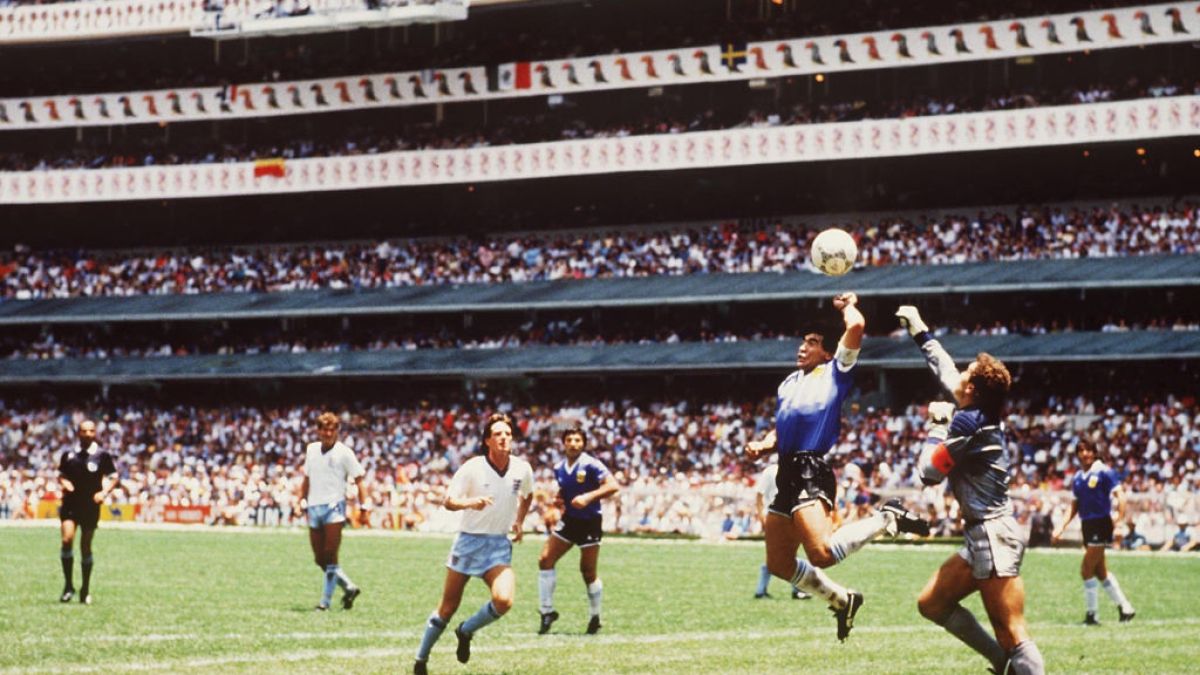
Diego Maradona put Argentina ahead six minutes into the second half by punching the ball past England goalkeeper Peter Shilton, a goal the referee allowed despite England’s protests. Al Jazeera reported that Maradona later credited it to the “Hand of God.”
Four minutes later, Maradona scored after carrying the ball from his own half, beating five England players before finishing past Shilton. Gary Lineker scored late, but Argentina won 2-1 and later lifted the World Cup, according to Al Jazeera.
1998 and 2002: Beckham at the center
In the 1998 World Cup last 16 in St Etienne, Al Jazeera reported that Argentina beat England 4-3 on penalties after a 2-2 draw. Gabriel Batistuta and Alan Shearer traded penalties, Michael Owen scored a solo goal, and Javier Zanetti equalized before halftime.
David Beckham was sent off soon after the restart for kicking out at Diego Simeone after the Argentine had brought him down. Al Jazeera reported that Sol Campbell later had a header ruled out before Carlos Roa saved penalties from Paul Ince and David Batty.
Beckham’s response came in the 2002 World Cup group stage in Sapporo. Al Jazeera reported that Michael Owen won a penalty after Mauricio Pochettino fouled him, and Beckham scored the only goal in a 1-0 England win. England advanced, while Argentina went out in the group stage for the first time since 1962.
This story draws on original reporting from Al Jazeera.