
China forms 29-nation AI alliance as Xi urges shared rules
Beijing announced WAICO in Shanghai, positioning itself to influence global AI governance as competition with Washington intensifies.
By Lucas Ferreira · Science & Environment Writer
3 min read
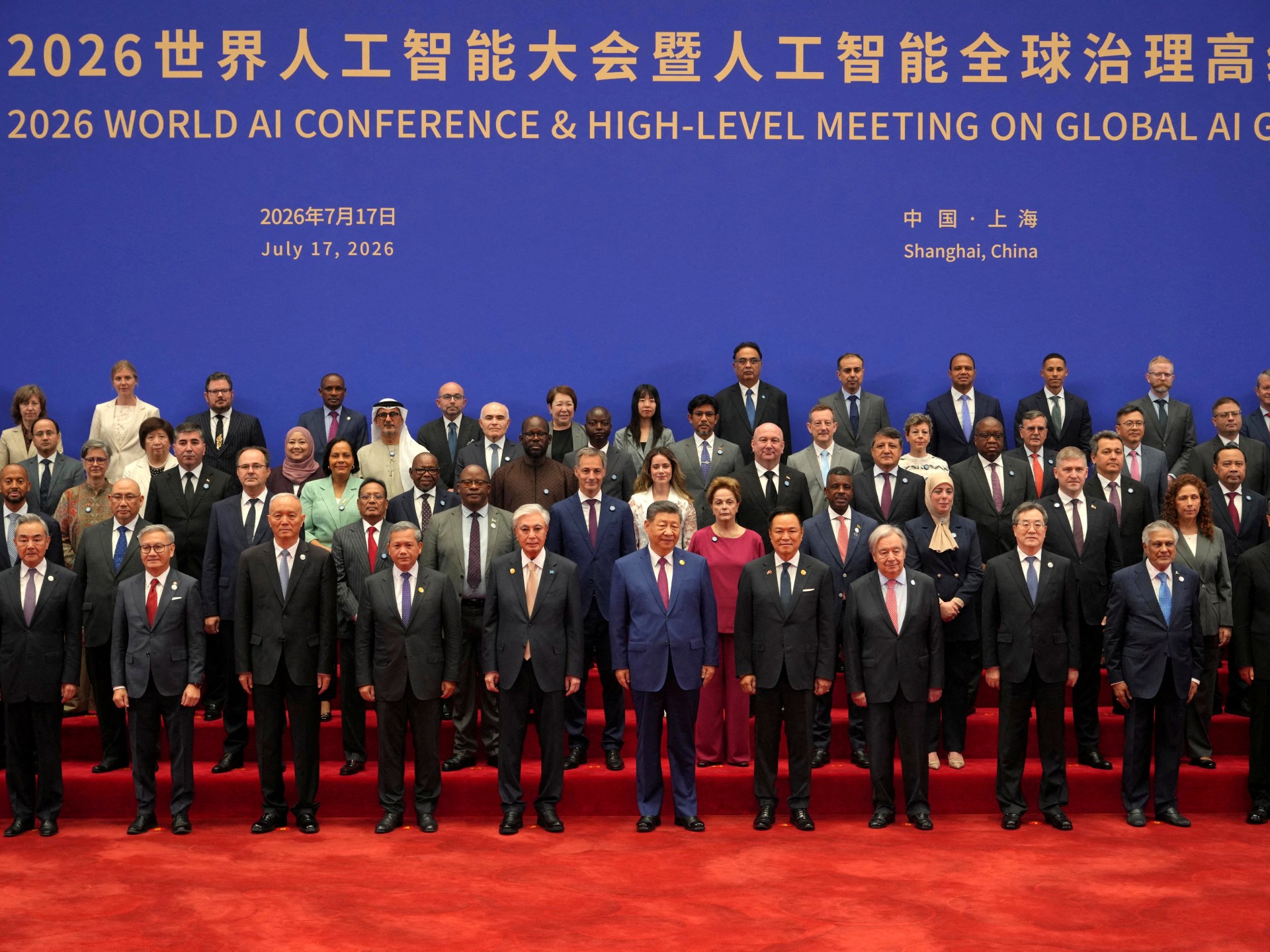
China has created a 29-country artificial intelligence alliance aimed at coordinating AI development and rules, according to Al Jazeera. President Xi Jinping used a Shanghai technology conference on Friday to call for international cooperation on AI and to warn against any single country dominating the field.
The message came as China and the United States compete for influence over advanced technology, chips and AI systems. Al Jazeera described Xi’s remarks as an apparent criticism of Washington, which has restricted some technology exports to Chinese companies on national security grounds.
What Xi said in Shanghai
Xi spoke at the World Artificial Intelligence Conference, where China displayed advanced technology intended to rival US capabilities, Al Jazeera reported. He urged countries to seize what he called the “historic opportunity” of open-source AI and said China would keep working with nations in Africa, Latin America and Asia.
Xi said AI development “should not be a solo performance by a single country, but a symphony of international cooperation.” He also said countries should oppose expanding national security arguments in AI in ways that put one country’s security above others.
Xi called for a “people-centred” approach and said AI should remain under human control. He cited rules, technological monitoring, early-warning systems and emergency responses as safeguards, according to Al Jazeera.
What WAICO is
The World Artificial Intelligence Cooperation Organisation, or WAICO, was formally established on July 16, according to Al Jazeera. China had promoted the idea of a global AI alliance since last year, and Chinese Premier Li Qiang first announced plans for the body in July 2025.
WAICO is based in Shanghai and includes 29 founding member countries. Al Jazeera identified members including Indonesia, Brazil, Malaysia, South Africa, Senegal, Russia and Pakistan.
The organization’s stated aims are to encourage international cooperation and develop AI regulations across countries so the technology remains beneficial and safe for people, Al Jazeera reported. Analysts cited by Al Jazeera said Beijing is likely to use the alliance to influence how AI policy is discussed at the United Nations.
Why the alliance matters
AI is a major part of China’s industrial strategy, with Beijing investing in a domestic system that spans chips, data infrastructure and consumer applications, according to Al Jazeera. The country trails the US in access to the most advanced semiconductors, but Al Jazeera reported that China has advantages in powering large data centers used to train and run AI models.
Al Jazeera also reported that China dominates production of critical rare earth minerals needed for chipmaking and generates more than twice as much electricity as the US. Its electricity advantage is expected to grow because of state-led investment in the national power grid.
The rivalry has produced restrictions and retaliation. In May, the US Department of Commerce reaffirmed limits on shipments of critical semiconductors to subsidiaries of Chinese firms headquartered in China or owned by Chinese parent companies, according to Al Jazeera. Beijing has responded by barring exports of dual-use technology and critical minerals to US firms.
AI regulation has lagged behind the technology’s development, with military uses among the areas drawing intense debate, Al Jazeera reported. By hosting the conference and establishing WAICO, Beijing has placed itself in a stronger position to shape global AI discussions.
Arindrajit Basu, a governance expert writing for the Carnegie Endowment for International Peace, said Beijing wants to show global leadership as Washington pulls back from cyber and AI norms-setting processes and reduces financial support for cyber diplomacy. Basu wrote that China is seeking support from the Global South for a state-centered approach to technology governance.
This story draws on original reporting from Al Jazeera.