
USS Constitution spike may be oldest Americana flown in space
A copper spike from Old Ironsides, flown on shuttle Atlantis in 1995, appears to predate other U.S. historical artifacts sent into orbit.
By Maya Lindqvist · Senior Technology Correspondent
3 min read
A copper spike from the USS Constitution may be the oldest known piece of Americana launched into space, according to space historian Robert Pearlman writing for Ars Technica and collectSPACE. The artifact matters as the United States marks 250 years since 1776 and spaceflight has increasingly carried historic objects into orbit as symbols of national memory.
Pearlman reported that the spike was an original part of the hull of the USS Constitution, the Navy frigate known as “Old Ironsides.” According to a plaque cited by Pearlman, the spike flew on a U.S. space shuttle mission to honor the 200th anniversary of the ship’s commissioning.
The spike was removed from the ship in 1992 and dates to 1797, Pearlman reported. NASA carried it aboard space shuttle Atlantis on STS-71 from June 27 to July 7, 1995, the mission that made the first shuttle docking with Russia’s Mir space station.
Other historic objects have flown
Pearlman framed the search around Americana tied to the Revolutionary era and the early United States. He noted that older objects have reached space, including a 1611 Jamestown artifact flown on Atlantis in 2007, but placed that outside the category he was examining.
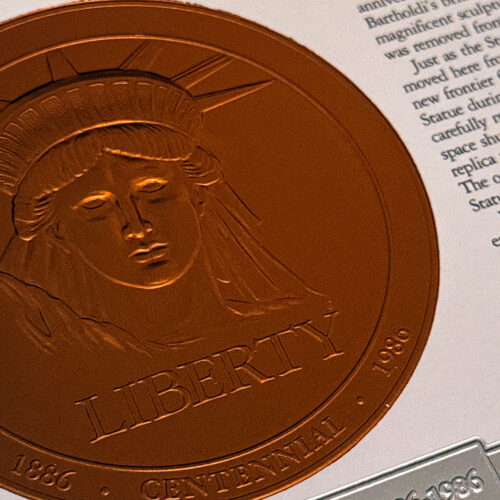
One early example came from the Statue of Liberty restoration. Pearlman reported that two 15-inch Statue of Liberty figures made from copper removed from the full-size statue flew on space shuttle Discovery in April 1985 during STS-51D.
After that weeklong flight, one of the small statues went on display, while the other was melted and made into copper seals sold by the Statue of Liberty Ellis Island Centennial Commission, according to Pearlman. The copper came from the statue’s original 1875-to-1884 construction; France gave the statue to the United States in connection with the nation’s 1876 centennial.
Replicas complicate the record
Some objects linked to early American history have gone to space, but as reproductions rather than original artifacts. Pearlman reported that John Glenn carried two such items on space shuttle Discovery in 1998, when he became the oldest person to fly in space at age 77.
The U.S. Senate Curator’s Office said Glenn selected a 1993 reprint of Thomas Jefferson’s 1801 “Manual of Parliamentary Practice” for the STS-95 Official Flight Kit after consulting Senate historical staff. The office described the book as small enough to fly and meaningful to Senate history because Jefferson wrote the manual while serving as vice president and presiding over the Senate.
Glenn also flew a replica of George Washington’s Headquarters Flag, according to the Museum of the American Revolution and Pearlman. The original 13-star flag is associated with Washington’s battlefield headquarters and is believed to have been inspired by elements of his 1777 uniform.
NASA astronaut Terry Virts later carried another historic flag reproduction aboard the International Space Station from November 2014 to June 2015, Pearlman reported. Fort McHenry provided the 15-star flag after it had flown over the Maryland site during the bicentennial year of the Battle of Baltimore; the original flag inspired Francis Scott Key’s words that became “The Star-Spangled Banner.”
Pearlman also cited a replica of the 1869 Golden Spike, the ceremonial marker of the First Transcontinental Railroad’s completion, flown on Atlantis with the STS-38 crew. A separate USS Constitution fragment of similar age, a piece of wood, flew with the Hubble Space Telescope on STS-31 and was on loan at the U.S. Naval Academy Museum, according to Pearlman.
This story draws on original reporting from Ars Technica.