
Tiny nuclear battery reaches orbit on commercial CubeSat
City Labs says its BOHR CubeSat is the first commercial nuclear-powered satellite, using a tritium battery to run a payload in orbit.
By Hana Yoshida · Markets Reporter
3 min read
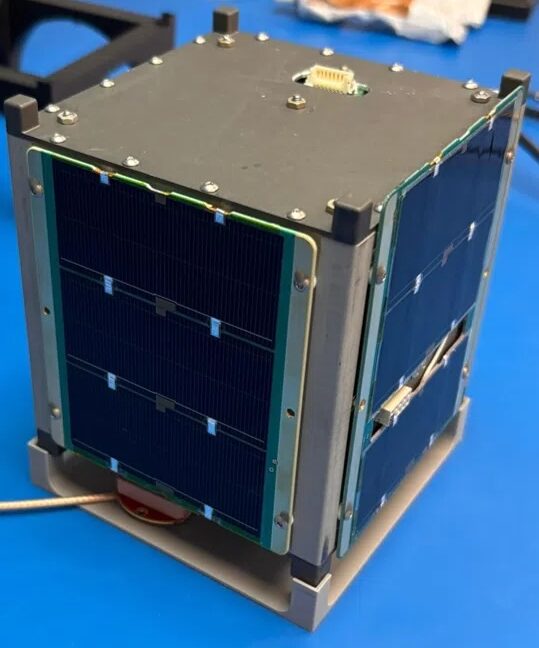
A Miami company has launched a small satellite carrying a nuclear battery, marking an early commercial test of nuclear power in orbit. City Labs said its BOHR spacecraft is the first commercial nuclear-powered satellite and the first nuclear CubeSat, though the mission is far smaller than reactor systems envisioned for Moon bases or deep-space propulsion.
The satellite rode to orbit Tuesday on a SpaceX rideshare mission with 80 other payloads. SpaceX’s Falcon 9 rocket deployed BOHR into an orbit between 350 and 400 miles above Earth, according to mission details reported by City Labs and SpaceX.
A small test of nuclear power
BOHR stands for Betavoltaic Orbital High-Reliability. City Labs said the spacecraft carries its NanoTritium power generator, a betavoltaic battery that makes electricity from the decay of tritium, a radioactive form of hydrogen.
The nuclear device is being used in demonstration mode to power a payload on BOHR, City Labs said. The spacecraft’s routine operations still rely on conventional solar power, a distinction that keeps the mission well short of the larger nuclear systems space agencies have studied for sustained operations away from sunlight.
Images released by City Labs indicate BOHR uses a 1U CubeSat design, a cube-shaped satellite platform roughly comparable in size to a softball. City Labs Chief Executive Peter Cabauy called the launch a historic step for commercial nuclear power in space and said the mission shows compact, approved nuclear systems can support payloads that are not limited by sunlight or battery life.
Power levels are tiny
City Labs’ betavoltaic systems produce power in the nanowatt-to-microwatt range, according to the company. That is far below what would be needed for consumer electronics, large satellites or a lunar outpost, but it can be useful for small devices that need steady power over long periods.
The company has pointed to remote sensors, undersea and polar instruments, secure communications hardware and implantable medical devices as possible uses for its NanoTritium technology. City Labs also says the systems could run heaters for microelectronics exposed to harsh environments.
NASA has worked with City Labs on possible tritium-powered sensor networks for the Moon, including small devices that could be placed in permanently shadowed craters to search for resources such as water ice. The US Air Force and Space Force have also awarded City Labs research contracts tied to an experimental tritium AA battery for cryptographic devices and a self-powered wireless imaging sensor, according to the company.
Regulators cleared the launch
The Federal Aviation Administration authorized the BOHR launch last September. City Labs said the mission was the first commercial nuclear space mission to clear the FAA’s newer nuclear launch approval process.
The mission carried only a small amount of radioactive material. The Nuclear Regulatory Commission says tritium releases low-energy beta radiation that does not travel far in air and cannot penetrate skin.
Past nuclear-powered spacecraft have been owned by government agencies such as NASA and the US military. City Labs described BOHR as a pathfinder for future nuclear-powered spacecraft serving civil and national security missions, while larger nuclear space systems would require far more radioactive material than this CubeSat carried.
This story draws on original reporting from Ars Technica.