
Taiwan seeks drone surge for defense and exports
Taiwan’s defense ministry wants a six-year drone-buying plan as local firms pursue US and European military markets.
By Maya Lindqvist · Senior Technology Correspondent
3 min read
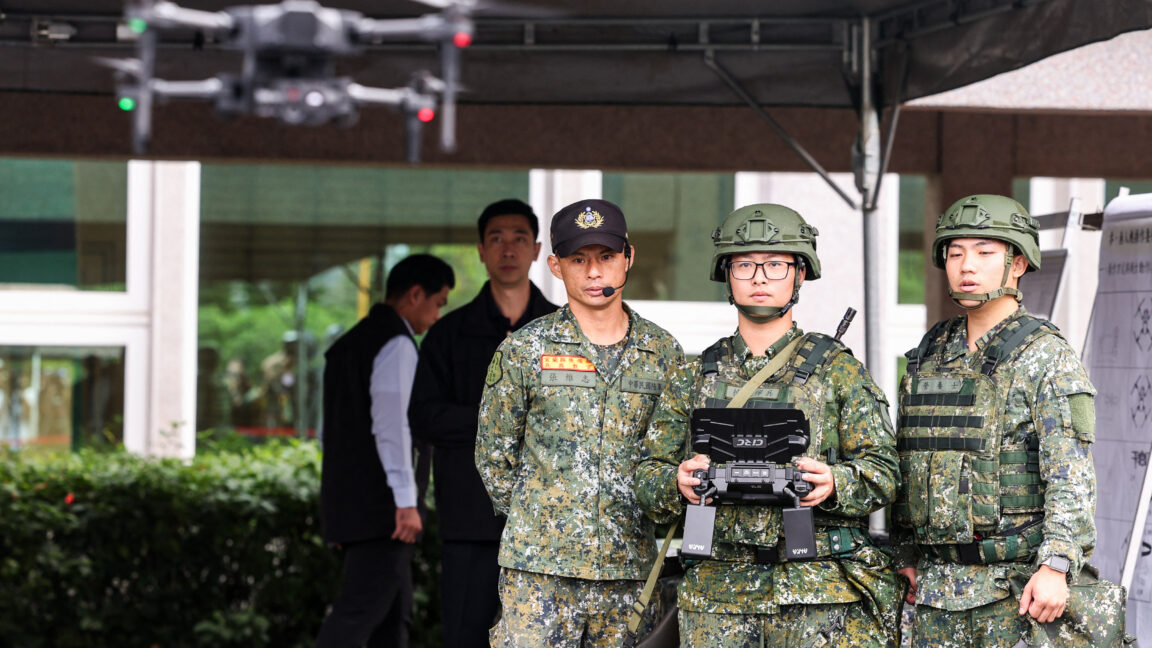
Taiwan’s defense ministry is pressing for a large expansion of domestically built drones, a move aimed at strengthening the island’s defenses while giving local manufacturers a larger base of military orders. The plan also comes as Taiwanese companies seek more business with the US military and other overseas buyers, according to government statements and defense industry reports.
Taiwan’s Ministry of National Defense proposed a special budget worth $6.6 billion over six years to buy drones made in Taiwan, the Central News Agency reported. The proposal, presented June 18, would fund purchases between 2026 and 2031 of more than 208,000 coastal attack drones, more than 1,400 coastal reconnaissance drones and 1,320 uncrewed surface vessels, CNA reported.
The proposed order would sharply increase Taiwan’s drone inventory. Resilience Media reported that Taiwan’s military now has about 5,000 attack drones, including US-made systems and locally produced models.
Domestic orders and overseas sales
Taiwan has already shown some of these systems in military drills. USNI News reported that Taiwanese soldiers fired Altius-600 loitering munitions, made by an Anduril Industries subsidiary, from towed flatbed launchers at offshore targets during exercises in early June. In a separate exercise earlier this year, Taiwanese Marines used domestically made drones in strikes on maritime targets, according to reporting cited by Resilience Media.
The government push could also support Taiwan’s drone makers. Taiwanese Premier Cho Jung-tai said on April 30 that Taiwan exported $115 million in fully assembled drones from January through March 2026, exceeding the $93 million exported in all of 2025.
Thunder Tiger has emerged as one of the companies seeking foreign defense customers. Taiwan News reported that its Overkill drones became the first from an Asian company to qualify for the Pentagon’s Blue Uncrewed Aircraft Systems Cleared List, which certifies commercial drones for US military use. Rest of World reported that the small first-person-view drones cost between $3,000 and $5,000 each and resemble FPV drones used in Ukraine.
Rest of World also reported that Thunder Tiger has begun making larger one-way attack drones, starting at $30,000, based on the US LUCAS design. DSET, a Taiwanese think tank, said the state-owned National Chung-Shan Institute of Science and Technology developed another one-way attack drone modeled on Israel’s Harpy system.
Taiwanese firms are also supplying parts. DSET reported that Thunder Tiger provides drone components to three companies in the US Department of Defense’s $1 billion Drone Dominance Program, and that Taiwanese suppliers are selling flight controllers, batteries, motors and other electronics to Ukrainian companies. DSET also said Czechia and Poland import tens of thousands of Taiwanese drones that may in some cases be sent to Ukraine.
Production hurdles remain
Taiwan’s drone plans face political and industrial limits. The special budget proposal follows a dispute in Taiwan’s Legislature, where opposition parties Kuomintang and the Taiwan People’s Party hold a majority; Reuters reported that lawmakers passed a reduced defense budget bill in May after vetoing funding for domestically produced drones.
China’s drone industry remains a formidable competitor. The Drone Girl reported that Shenzhen-based DJI holds about 70% to 80% of the global commercial drone market, and DSET fellow Ting-Wei Lin told Resilience Media that Taiwanese makers must persuade foreign governments to pay prices two or three times higher than DJI’s.
Taiwan is also trying to remove Chinese-made components from its supply chain. Taiwan News reported that Thunder Tiger defended supplying Taiwan’s military with drones containing STMicroelectronics chips that were packaged in China.
The Ministry of Economic Affairs said Taiwan can now produce about 15,000 drones a month and projects that the industry could exceed 100,000 drones a month by 2030. The Guardian reported that Taiwanese civil defense groups are also expanding drone flight training, taking lessons from Ukraine, where human operators still play a major role in drone warfare.
This story draws on original reporting from Ars Technica.