
Blue Origin rebuilds New Glenn pad as Relativity sets Mars orbiter plan
Blue Origin is repairing its Florida pad after a New Glenn explosion, while Relativity Space says it plans a private Mars orbiter in 2028.
By Maya Lindqvist · Senior Technology Correspondent
3 min read
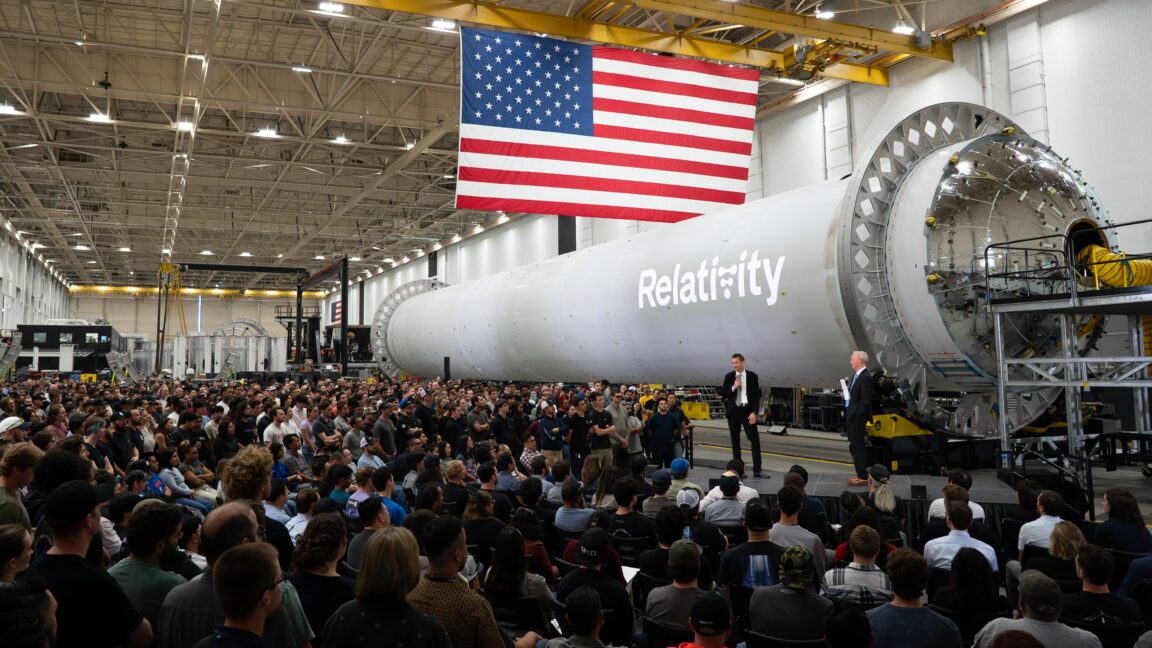
Blue Origin has begun rebuilding its New Glenn launch pad in Florida after an explosion severely damaged the site less than three weeks ago, Space News reported. The work matters for NASA because the rocket is tied to the agency’s Artemis lunar plans.
Relativity Space also outlined a new role beyond launch services, telling Space News it plans to send a privately developed Mars orbiter in 2028. The announcements came during a busy week for launch companies, with delays, debris concerns and new missions across the sector.
Blue Origin works to return New Glenn
Blue Origin Chief Executive Dave Limp said at the VivaTech conference in Paris that Launch Complex 36 had been cleared of debris and that crews started reconstruction this week, according to Space News. Limp and Blue Origin owner Jeff Bezos repeated that the company aims to fly New Glenn again before the end of the year.
NASA is watching the recovery closely because New Glenn is expected to launch Blue Origin’s Blue Moon Mark 1 lunar lander prototype, Space News reported. After the pad explosion, NASA Administrator Jared Isaacman suggested Blue Origin consider another rocket for Mark 1, but Limp said that would not be needed and that the lander is now targeted for early next year.
Florida Today reported that Space Launch Delta 45 is also studying a new launch site at Cape Canaveral Space Force Station. The proposed Launch Complex 51 would support Naval Ordnance Test Unit and US Army missions and would replace Launch Complex 46, which sits inside the explosive clear zone of Blue Origin’s Launch Complex 36.
Relativity sets sights on Mars
Relativity Space said June 17 that its new Interplanetary Sciences Program will support science missions with NASA, industry, universities and philanthropic groups, according to Space News. The company’s first mission under that effort is a Mars science and telecommunications orbiter planned for late 2028.
The planned payload includes an atmospheric profiling instrument suite from NASA’s Ames Research Center, a radar instrument for mapping subsurface ice and geology, and a communications relay package, Space News reported. Relativity said the orbiter would launch on its reusable Terran R rocket, which is still in development and could make its first flight as soon as next year.
Space News reported that Relativity did not release key details such as the spacecraft’s size, mass, power needs or cost. The company previously announced a Mars lander plan with Impulse Space in 2022, but neither company has provided recent updates on that mission.
Launch market strains show up elsewhere
Amazon has hundreds of finished satellites waiting in Florida for rides to orbit, Ars Technica reported, citing Steve Metayer, vice president of Amazon Leo Production Operations. Ars reported that Arianespace’s Ariane 64 launched 36 Amazon Leo satellites from French Guiana this week, the heaviest payload flown by a European rocket.
Ars Technica also reported that Isar Aerospace scrubbed another attempt to launch its Spectrum rocket from Andøya Spaceport in Norway after the company detected off-nominal behavior in the vehicle’s fluid systems. The latest delay was the fourth time in five months that Isar reached a target date for Spectrum’s second test flight without launching.
A Chinese Zhuque-2E upper stage broke apart in low-Earth orbit after a June 9 launch, and the US Space Force said it was tracking at least 51 related objects, Ars Technica reported. Darren McKnight of LeoLabs told Ars the event likely produced 100 to 150 pieces of debris near altitudes used by the International Space Station and some SpaceX Starlink direct-to-cell satellites.
In Japan, an H3 rocket launched successfully June 12 from Tanegashima Space Center, Kyodo News reported. The flight marked the H3 program’s return after a December failure and used a booster-free H3-30S version with three liquid-fueled core-stage engines.
This story draws on original reporting from Ars Technica.