
Study extends timeline for complex life on a warming Earth
A new 3D climate model puts land plants’ possible survival window at nearly 1.9 billion more years, longer than many earlier estimates.
By Hana Yoshida · Markets Reporter
4 min read
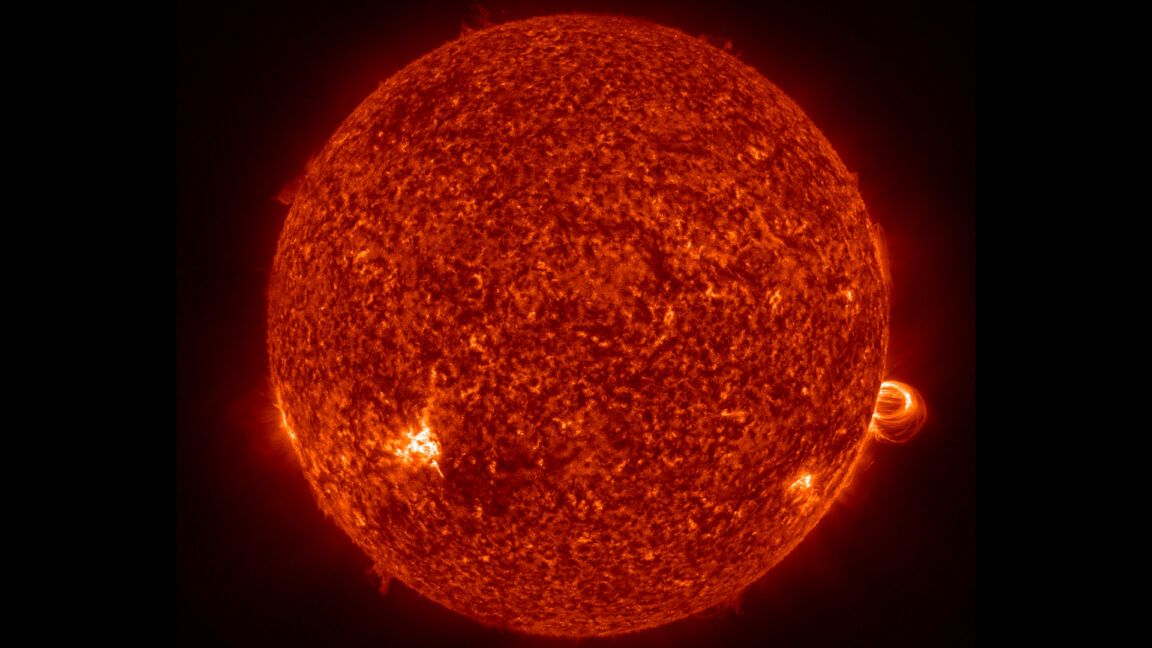
A new climate-modeling study estimates that complex life on Earth could persist longer than many previous projections suggested. The work, published in JGR Atmospheres, examines how a brighter future Sun could end the era of land plants by overheating the planet or starving photosynthesis of carbon dioxide.
Jacob Haqq-Misra of Blue Marble Space and Eric Wolf of the University of Colorado Boulder used a three-dimensional climate model to test far-future conditions as solar output rises. Their question was how long Earth remains habitable for plants before the Sun’s gradual brightening overwhelms the systems that help regulate the climate.
The Sun is expected to grow brighter on its path toward becoming a red giant, according to the study. Earth faces a much later fate when the aging Sun expands, but Haqq-Misra and Wolf focused on the earlier threshold at which complex life loses the conditions it needs.
Carbon dioxide is central to the timeline
The study centers on the long-term carbon cycle, especially the weathering of silicate rocks. As described by the researchers, warmer conditions can speed rock weathering, which draws carbon dioxide from the air and stores it in carbonate minerals that can later be carried into the mantle by plate tectonics.
That process can act as a climate brake because lower carbon dioxide reduces greenhouse warming, the paper says. Over very long periods, however, the same mechanism could push atmospheric carbon dioxide too low for photosynthesis, cutting off the base of much of Earth’s food web.
Haqq-Misra and Wolf tested two end-member cases. In one, a strong weathering response keeps global temperature near today’s level while carbon dioxide falls as the Sun brightens. In the other, carbon dioxide stays near a modern level of 400 parts per million while temperatures rise, representing a weak weathering response.
Two paths to plant collapse
In the weak-weathering case, the model finds Earth about 21 degrees Celsius warmer 1.5 billion years from now. Between 1.5 billion and 2 billion years from now, the study reports an additional warming of about 40 degrees Celsius.
Those conditions would exceed the heat tolerance of land plants even with carbon dioxide still available, according to the paper. The researchers estimate that most land plants would pass their physiological limits by 1.68 billion years from now, while the remaining land plants would be lost by 1.87 billion years.
In the strong-weathering case, the problem is carbon dioxide scarcity. The model keeps temperature steady, but carbon dioxide falls to about 34 parts per million after 1 billion years and below 1 part per million after 2 billion years, the study says.
Most land plants need roughly 150 parts per million of carbon dioxide, according to the paper. The researchers say C4 plants, a less common group with a different photosynthetic pathway, could survive down to about 3 to 10 parts per million, reaching that limit between 1.35 billion and 1.64 billion years from now.
Some organisms could last longer. The paper says plants such as cacti and some marine life can use bicarbonate in water when dissolved carbon dioxide is scarce, potentially surviving down to about 1 part per million and extending the timeline to roughly 1.84 billion years.
A longer window than many earlier estimates
The study’s estimates are more favorable for complex life than many earlier projections, which often placed the end of plant viability less than 1 billion years from now. Haqq-Misra and Wolf attribute the longer window to their 3D model producing less warming under a brighter Sun, a slower modeled decline in carbon dioxide and a broader assumed survival range for plants.
The researchers also note uncertainties. Long-lived civilization could attempt climate interventions such as stratospheric aerosols, while more speculative ideas include shifting Earth’s orbit or reducing the Sun’s mass. The paper also says evolution could change plant tolerances over time.
The study frames the question as broader than Earth’s future. Haqq-Misra and Wolf say the duration of Earth’s habitable period can help scientists think about where life might endure on planets around other stars.
Land plants have existed for nearly 500 million years, according to the paper. Under the more favorable estimates in the new model, they could persist for almost 1.9 billion more years before microbial life again becomes the main surviving form of life on Earth.
This story draws on original reporting from Ars Technica.