
Slate raises electric pickup specs as $24,950 model nears orders
The bare-bones electric pickup now targets 205 miles of range, higher towing and more payload as Slate asks deposit holders to commit.
By Maya Lindqvist · Senior Technology Correspondent
3 min read
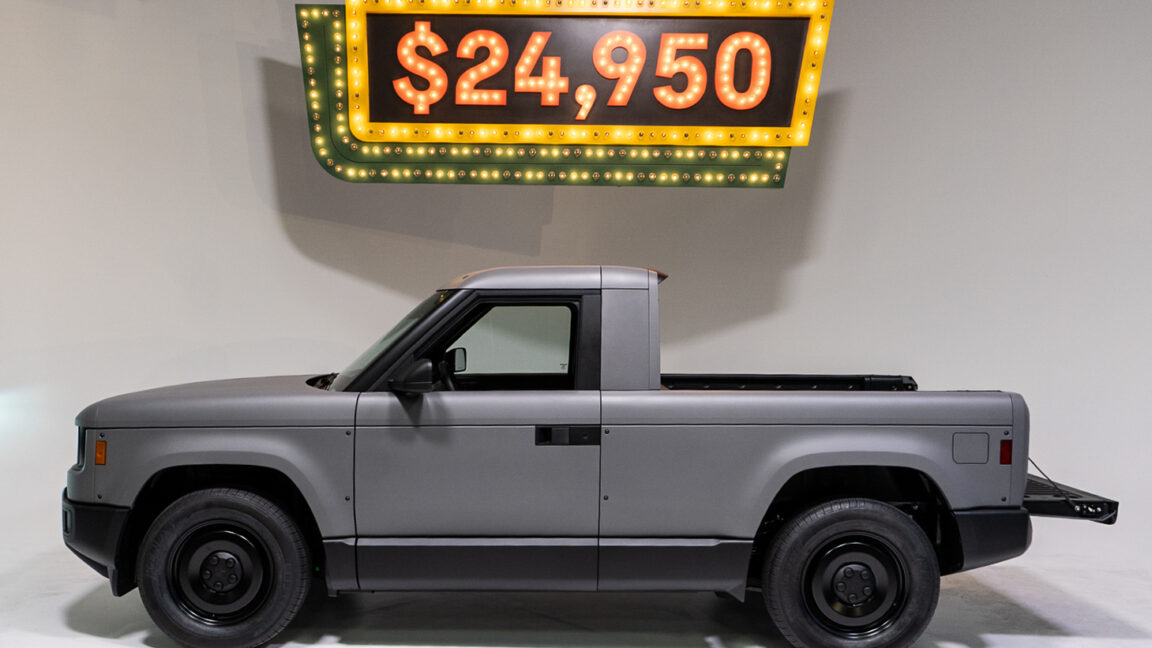
Slate Auto has raised several key specifications for its low-cost electric pickup, strengthening the case for a stripped-down truck priced from $24,950. The changes matter because Slate is trying to prove there is demand for a small, affordable EV built around hardware add-ons rather than standard tech features.
According to Ars Technica, Slate now says the base battery targets 205 miles of range, up from the 180 miles previously announced. Slate also raised the truck’s towing rating to 2,000 pounds from 1,000 pounds and increased payload capacity to 1,550 pounds from 1,400 pounds.
At a launch event in Gardena, California, CEO Peter Faricy told reporters that “Slate is so much more than an affordable truck,” Ars Technica reported. The company has pitched the vehicle as a modular platform that owners can change after delivery with factory and third-party parts.
Ride impressions and core specs
Ars Technica reported from a passenger-seat ride in a pre-production truck that the vehicle felt more polished than its price might suggest. The publication said acceleration was smooth, the cabin avoided obvious rattles during a short drive, and the truck handled bumps and cornering without the roughness sometimes found in unfinished test vehicles.
Slate lists the rear-wheel-drive truck with a single motor producing 181 horsepower and 195 pound-feet of torque, according to Ars Technica. The company says the truck reaches 60 mph in about eight seconds and has a 90 mph top speed.
The battery is a 65 kWh gross, 63 kWh usable LFP pack, Ars Technica reported. Slate’s 205-mile target works out to about 3.3 miles per kWh.
Charging specs are modest by current EV standards, according to Ars Technica. Slate says the NACS-equipped truck can DC fast-charge at up to 120 kW and move from 20% to 80% in about 30 minutes, while 11 kW AC charging can take the battery from 20% to 100% in four hours.
Options, kits and missing features
The truck rides on front MacPherson struts and a rear De Dion axle with coil springs, Ars Technica reported. Ground clearance is 7.8 inches in standard form and 7.6 inches with the SUV package installed, while Slate also plans a lift kit.
Slate’s SUV conversion, called Squareback, raises the starting price to about $29,950, according to Ars Technica. The package cuts payload capacity to 1,263 pounds and lowers towing capacity to 1,824 pounds.
Slate says about 80% of more than 200 marketplace items will cost under $500, Ars Technica reported. The catalog includes roof racks, stereos and wraps; Slate says standard wraps cost under $500, while custom wraps cost $1,299 and take two people 12 to 16 hours to install.
The low price also reflects what Slate leaves out. According to Ars Technica, the base truck has no central screen beyond the instrument cluster, no advanced driver-assistance system and no built-in modem; Slate will sell a modem for $275 with one year of service, followed by monthly fees.
Slate told Ars Technica the vehicle will not need its companion app to run and that it will not sell collected data to third parties. The company also told the publication that it is sticking with crank windows for now after a power-window option disappeared from its marketplace.
Deposits and production
Slate said in April 2026 that 160,000 people had placed $50 refundable deposits, and Ars Technica reported that the figure has since risen to 180,000. Existing deposit holders must add $250 to make the deposit nonrefundable if they want to lock in their delivery window by July 24, 2026, while new customers must place a $300 nonrefundable deposit.
Ars Technica reported that first deliveries are planned for the fourth quarter of 2026. Faricy said annual production capacity is 150,000 vehicles, and Slate said more than 10,000 preorders had been placed as of 9 a.m. PT, according to the publication.
This story draws on original reporting from Ars Technica.