
Nature critique disputes Microsoft’s Majorana qubit claims
A peer-reviewed paper says Microsoft has not proved its Majorana chips use working topological qubits; Microsoft says the challenge falls short.
By Hana Yoshida · Markets Reporter
3 min read
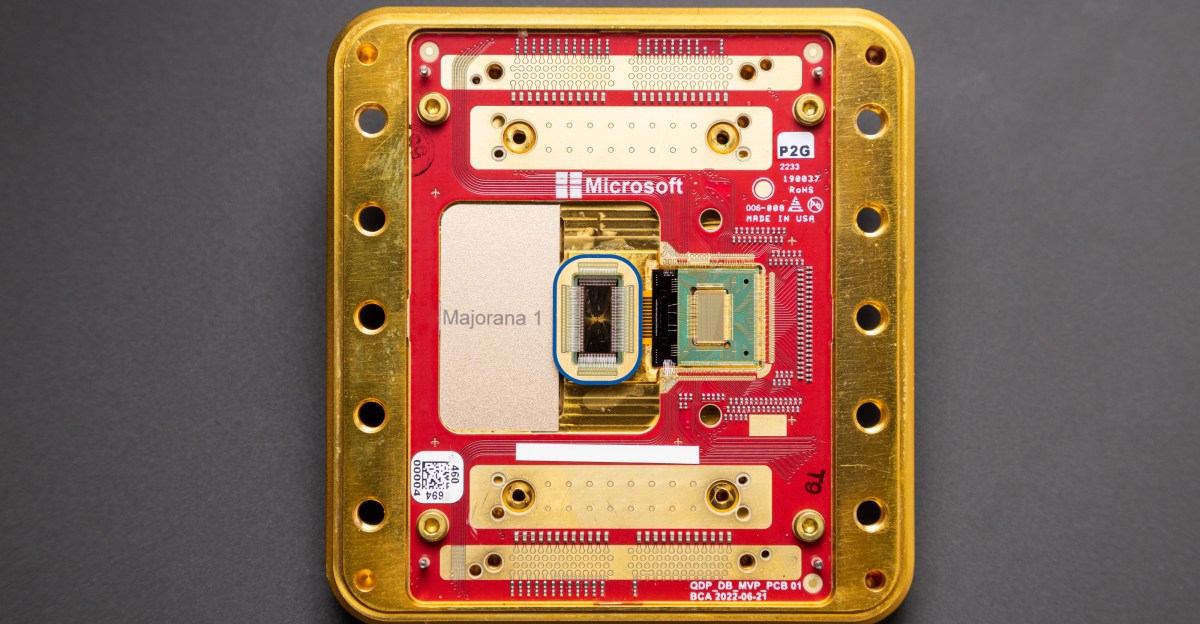
A peer-reviewed critique published Wednesday in Nature challenges Microsoft’s central claim about its Majorana quantum chips. The dispute matters because Microsoft has presented topological qubits as the basis for a path toward a practical quantum computer.
Henry Legg, a physicist at the University of St. Andrews, re-examined Microsoft’s data on the Majorana 1 device and argued that the company had not proved it had built a working topological qubit, according to Nature and The Verge. Microsoft rejected the criticism in a rebuttal published by Nature and said it stands by its results.
Microsoft introduced Majorana 1 in February 2025 and said the chip used a new topological qubit design. The company announced Majorana 2, a follow-up chip, at Build earlier this month and has said it can build a “scalable quantum computer” by 2029.
Microsoft’s approach differs from the designs pursued by other quantum computing companies, according to The Verge. Its device uses a very small wire made from indium arsenide, a semiconductor, attached to a superconductor. Theory predicts that electrons in that wire can form a collective state known as a Majorana particle, the phenomenon behind the chip’s name.
Microsoft’s plan is to store information using properties of the Majorana particle, according to The Verge. Supporters of this route say topological qubits based on Majoranas could be less error-prone than rival qubit technologies, including the superconducting circuits used by IBM, which could reduce the number of qubits needed for a useful system.
Legg’s paper argues that Microsoft’s evidence does not rule out another explanation. He wrote that signals Microsoft identified as a mark of Majorana particles could instead come from quantum dots, structures containing electrons inside the device. Legg also accused Microsoft of selecting data in a way that favored its claim, according to The Verge.
Legg told The Verge that Microsoft had not shown convincing evidence of Majoranas and said a qubit cannot be made without them. He first posted his critique to arXiv on Feb. 26, 2025, less than a week after Microsoft announced Majorana 1; Nature’s peer-review process took about a year before publication.
Microsoft’s Nature rebuttal said Legg’s critique “does not constitute a substantial scientific challenge” to the company’s findings. Chetan Nayak, the physicist leading Microsoft’s quantum team, told The Verge that Legg had not offered an alternate model that explains all of Microsoft’s data.
Nayak also told The Verge that Microsoft “100%” stands behind its results, roadmap and commitment to scientific rigor and dialogue. Legg told The Verge that Microsoft’s non-peer-reviewed paper on Majorana 2 does not address what he views as the unresolved problems with the company’s earlier claims.
The debate comes as quantum computing companies continue to promote progress toward machines that could eventually aid drug discovery, encryption and machine learning. The Verge reported that Google and IBM have shown more advanced machines than Microsoft’s Majorana 1 or Majorana 2, while no quantum computer has yet been shown conclusively to perform a useful task.
This story draws on original reporting from The Verge.