
NASA weighs lunar mission for Mars rover test vehicle
NASA is studying whether to send Promise, a Perseverance rover engineering model, to the Moon’s south pole with nuclear power.
By Maya Lindqvist · Senior Technology Correspondent
3 min read
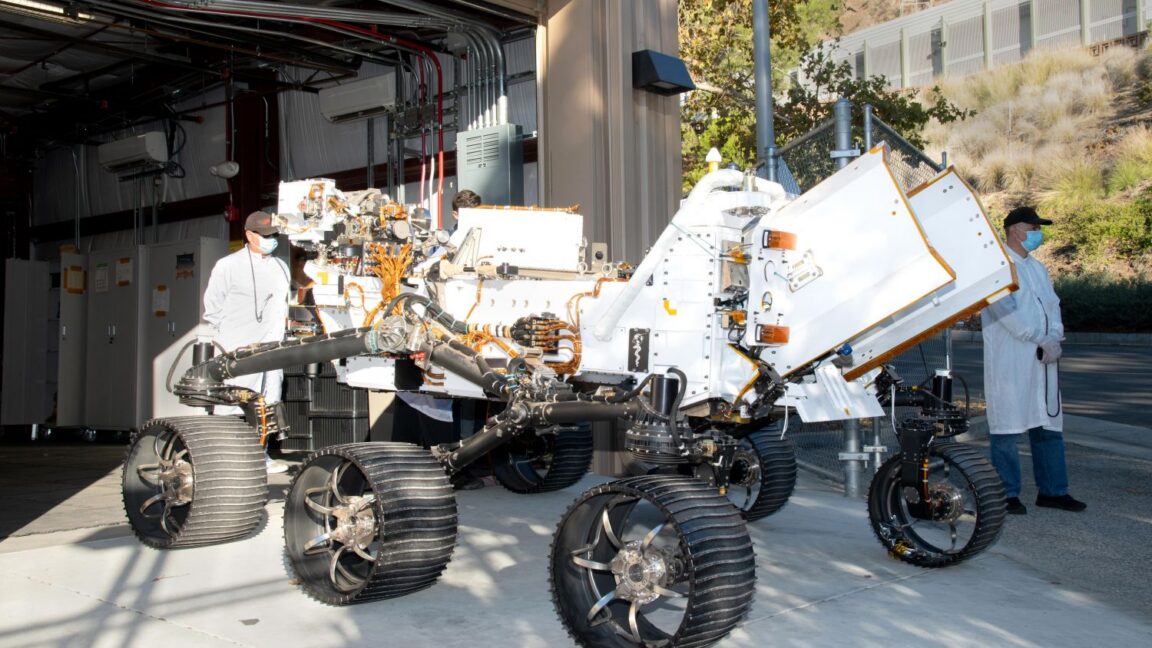
NASA is considering turning a full-scale Perseverance rover engineering model into a lunar explorer, a move that could give the agency a rugged vehicle for the Moon’s south pole. NASA officials said Tuesday the rover, known as Promise, could help speed work tied to a planned lunar base.
NASA Administrator Jared Isaacman said during a monthly update on the agency’s Moon base plans that officials are “thinking very hard” about sending Promise to the Moon. The rover is housed at NASA’s Jet Propulsion Laboratory in California and has not been assigned to a launch, according to NASA officials.
Promise is a car-sized test vehicle built to support Perseverance, the rover operating on Mars. NASA officials said the lunar version would use a multi-mission radioisotope thermoelectric generator, or MMRTG, giving it a power source that does not depend on sunlight.
That matters for the Moon’s south pole, where rough terrain and long periods of darkness create problems for solar-powered machines. Carlos García-Galán, a NASA official working on the Moon base effort, said an RTG-powered rover could travel without relying on illumination and could survive the lunar night.
García-Galán said such a vehicle could reach hard-to-access areas and make long drives, much as Curiosity and Perseverance have done on Mars. NASA’s other rovers have mostly relied on solar power, according to the agency officials.
Existing hardware could be reused
NASA has an MMRTG available, along with a supply of plutonium-238, according to agency officials. Because Promise has a mass of about 1 ton, NASA officials said it would likely need a large lander such as Blue Origin’s Blue Moon or SpaceX’s Starship to reach the lunar surface.
Promise has spent years at JPL supporting Perseverance operations. NASA officials said engineers have used it in the laboratory’s Mars yard to test commands and assess driving plans before sending similar instructions to the rover on Mars.
Isaacman said that approach made sense early in Perseverance’s mission, when teams wanted a way to test possible fixes before uploading commands to Mars. He said years of experience with Perseverance and Curiosity have raised a new question inside NASA: whether hardware already paid for by taxpayers could be put to work on the Moon.
Perseverance launched in July 2020, while Curiosity launched in November 2011. Both rovers were built for Mars, but JPL engineers told NASA that Promise could be altered for lunar operations, according to Isaacman.
NASA would also need to adjust some of the rover’s scientific instruments, Isaacman said. He described the idea as a way to get a useful capability onto the Moon while supporting the agency’s goal of learning more about the environment where it wants a sustained human presence.
Decision remains under review
NASA officials said no final decision has been made. The agency is still studying whether Promise can serve as part of its lunar fleet.
A nuclear-powered rover could support scientific work at the south pole and other difficult regions. NASA previously studied a separate Endurance rover concept that would have crossed nearly 2,000 kilometers of the South Pole-Aitken basin on the Moon’s far side, but that rover was not built, according to NASA materials cited in the discussion.
The proposal also reflects NASA’s push to focus near-term resources on the Moon. The agency is trying to land astronauts near the lunar south pole before China and examine priority terrain there first, while Mars is not a near-term target in that effort, according to the Tuesday update.
Casey Dreier, chief of space policy at The Planetary Society, said the idea carries symbolic weight. He described it as “harvesting up what’s left of the Mars program and shipping it to the Moon.”
This story draws on original reporting from Ars Technica.