
NASA tests X-59 jet built to soften supersonic booms
The experimental X-59 has begun supersonic flights as NASA gathers data that could shape future rules for faster-than-sound travel over land.
By Maya Lindqvist · Senior Technology Correspondent
4 min read
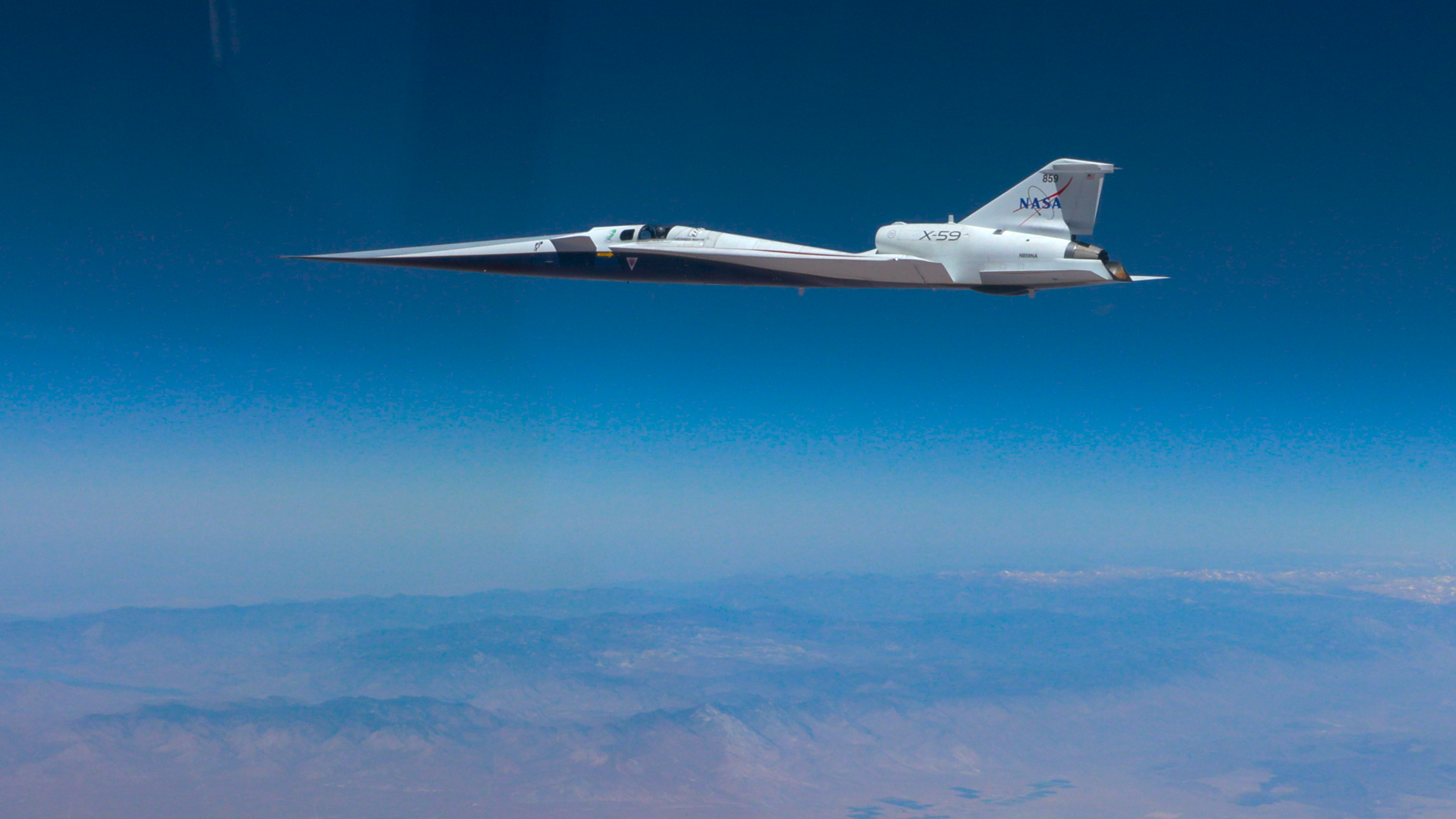
NASA’s X-59 quiet supersonic aircraft has started flying faster than sound, a step toward testing whether overland supersonic travel can be made far less disruptive. The program could give regulators data needed to reconsider limits that have kept commercial supersonic aircraft off U.S. overland routes for decades.
The Lockheed Martin-built X-59 Quesst, short for Quiet SuperSonic Technology, first flew in late 2025 and reached supersonic speed for the first time on June 5, 2026, according to NASA. NASA said test pilot Jim “Clue” Less flew the 81-minute mission to Mach 1.1, about 713 mph, at 43,400 feet.
A second supersonic flight on June 12 reached Mach 1.4, about 924 mph, and 55,000 feet, NASA said. Those figures match the speed and altitude NASA expects to use in later tests of the aircraft’s sound signature.
Designed to spread out shockwaves
The X-59’s shape is central to the experiment. NASA and Lockheed Martin Skunk Works designed the aircraft with a long, tapered nose that accounts for nearly a third of its almost 100-foot length, along with a top-mounted engine and a tailored wing shape.
Peter Coen, NASA’s Quesst mission integration manager, told Ars Technica that the aircraft’s features were chosen to control shockwave strength. On conventional supersonic aircraft, shockwaves from the nose, canopy, engine inlet, wings and tail can combine into the sharp pressure change heard on the ground as a sonic boom, Coen said.
NASA’s goal is to replace that boom with a softer “thump” or “whoosh.” The agency has said Concorde’s boom was about 105 perceived level decibels, while the Quesst mission is targeting a sound closer to 75 PldB.
The work comes as Congress has advanced legislation that could allow overland supersonic flight, according to the American Institute of Aeronautics and Astronautics. The Federal Aviation Administration barred civil supersonic flight over land in 1973 after public resistance and noise complaints tied to earlier U.S. military tests over American cities.
A cockpit without a forward window
The X-59’s nose leaves no room for a front-facing cockpit window. NASA says the pilot instead uses an eXternal Vision System developed by NASA Langley Research Center, with high-resolution cameras mounted above and below the aircraft feeding a forward view to a 4K cockpit monitor.
The monitor also shows flight information with augmented-reality features for takeoff and landing, while side windows help the pilot see runway edges during ground operations. NASA tested the vision system in 2021 aboard a Beechcraft King Air and said it helped pilots spot nearby aircraft in live scenarios.
Less told Ars Technica that he and lead X-59 test pilot David Nils Larson spent hundreds of hours training in a simulator before flying the aircraft. Less said the no-window cockpit had become routine after extensive practice.
Built from proven aircraft parts
Less described the X-59 to Ars Technica as a “frankenjet” because it uses parts drawn from existing aircraft. Its landing gear comes from an F-16, its throttle from an F/A-18 Super Hornet, and its control stick from an F-117, he said.
NASA says the aircraft uses a customized F414-GE-100 engine, a variant of an engine used in F/A-18 Super Hornets, and a Rockwell Collins Pro Line Fusion avionics system commonly found in Beechcraft King Air aircraft. The cockpit is based on the rear cockpit of a T-38 trainer, allowing reuse of the T-38 canopy and ejection seat.
Flight testing has produced some issues. During the X-59’s second flight on March 20, Less saw a cockpit warning suggesting a possible air leak that could lead to a fire, Ars Technica reported. The aircraft’s pressurization system shut down automatically, but Less returned safely to Edwards Air Force Base; investigators later found the warning came from incorrectly installed instrumentation.
Community tests are planned
NASA plans to move from initial flight-envelope testing to measuring the X-59’s shockwaves near Edwards Air Force Base. Coen told Ars Technica the aircraft will carry an instrumented nose boom to measure shockwave strength and location, while microphones on a motor glider and ground recorders will track how the sound changes before reaching the ground.
The program’s later phase calls for flights over U.S. communities so residents can report what they hear. Coen said communities may experience daily tests for about a month, with sounds ranging from about 70 to 90 PldB.
NASA plans to share the results with the FAA and the International Civil Aviation Organization. Coen said the aim is to support standards that permit future supersonic flight while protecting people on the ground.
This story draws on original reporting from Ars Technica.