
NASA’s rush mission to lift Swift nears launch on final Pegasus rocket
Katalyst Space Technologies is preparing a fast-built satellite to grab NASA’s aging Swift observatory and raise its decaying orbit.
By Maya Lindqvist · Senior Technology Correspondent
4 min read
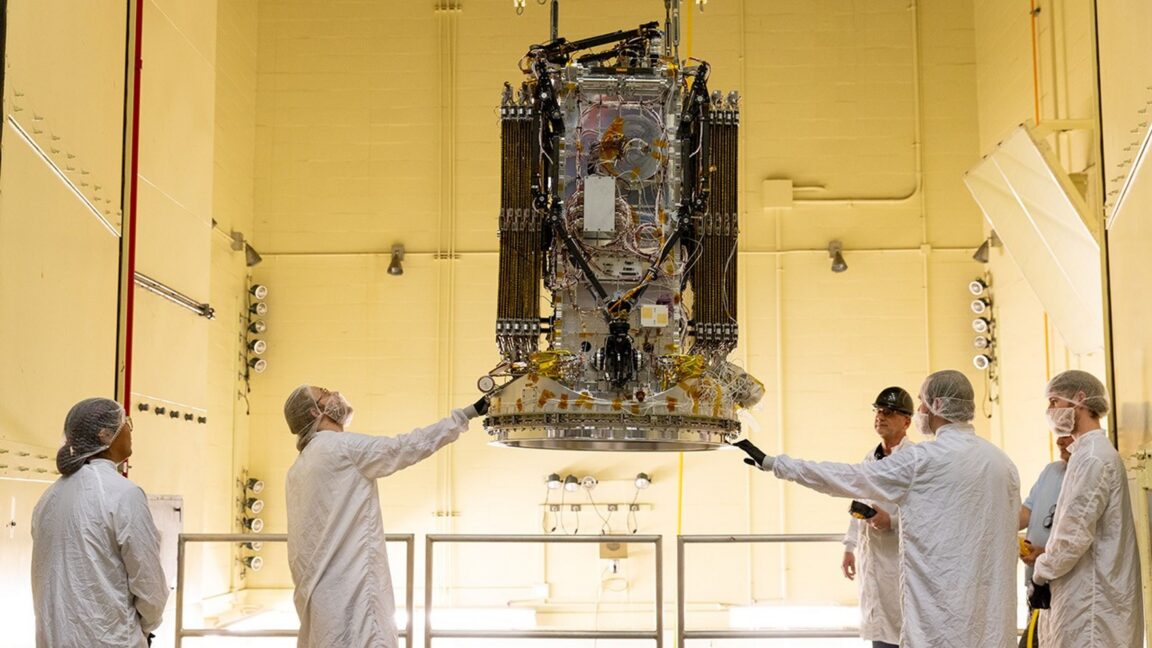
NASA is days from attempting a rapid satellite rescue meant to keep the Swift astronomy observatory from falling out of orbit. Ars Technica reported that Katalyst Space Technologies built the servicing spacecraft under a $30 million NASA contract awarded in September, with launch scheduled for June 27.
The mission targets a $500 million observatory that remains useful to astrophysicists more than two decades after launch, according to NASA officials cited by Ars Technica. Swift studies gamma-ray bursts and can quickly turn its instruments toward explosive events in the universe so other observatories can follow up.
Swift launched in November 2004 into an orbit about 363 miles, or 585 kilometers, above Earth, Ars Technica reported. By Thursday, its altitude had fallen to 225 miles, or 363 kilometers, because the spacecraft has no thrusters to hold its orbit against atmospheric drag.
NASA officials told Ars Technica that recent solar activity has worsened the problem by expanding Earth’s upper atmosphere, increasing drag on satellites in low Earth orbit. Engineers estimate Swift could drop below 186 miles, or 300 kilometers, this fall, possibly around October; below that point, NASA considers an approach by Katalyst’s spacecraft too risky.
A fast build under deadline pressure
NASA asked three companies about possible rescue plans about 10 months ago, according to Shawn Domagal-Goldman, director of NASA’s astrophysics division. He told Ars Technica that Katalyst offered a plan NASA considered technically and programmatically plausible.
Katalyst’s Link spacecraft is designed to chase Swift, attach to it with three robotic arms and raise the observatory to a safer altitude, Ars Technica reported. If the operation works, Swift could continue science operations instead of being left to reenter the atmosphere.
The schedule forced NASA and Katalyst to move far faster than a typical satellite program. Domagal-Goldman told Ars Technica that NASA did not issue its standard solicitation because the agency did not have time, and instead asked companies already under contract for technology work to study options.
Katalyst, a startup founded in 2020, had already been developing a commercial servicing platform, Ars Technica reported. The company redirected that work toward Swift, ordered parts quickly, built some components itself when suppliers could not meet the schedule and shortened parts of the test campaign.
Kieran Wilson, Link’s principal investigator at Katalyst, told Ars Technica that the deadline shaped how much risk the team was willing to accept. He said the main early risk was missing the launch window before Swift fell too low, while remaining risks include reaching orbit and operating the spacecraft successfully.
Final Pegasus launch
After assembly in Colorado, Katalyst sent Link to NASA’s Goddard Space Flight Center in Maryland for thermal vacuum and vibration testing, Ars Technica reported. The spacecraft then moved to NASA’s Wallops Flight Facility in Virginia to be integrated with Northrop Grumman’s Pegasus XL rocket.
Pegasus XL launches from the air after being carried by a modified L-1011 aircraft. Ars Technica reported that Northrop Grumman’s jet departed Wallops on Thursday for a multi-day trip toward a launch zone over the equatorial Pacific near Kwajalein Atoll in the Marshall Islands.
The air-launched rocket helps reach Swift’s unusual low-inclination orbit, which carries the observatory between 20 degrees north and south latitude, according to Ars Technica. A launch from Cape Canaveral would have required a dedicated mission on a larger and more expensive rocket.
Ars Technica reported that this Pegasus XL is the final one scheduled to fly, after 45 missions since 1990. Northrop Grumman had the rocket hardware in storage after Stratolaunch gave up two Pegasus rockets following the 2018 death of company founder Paul Allen; one later went to the Space Force, and the other to Katalyst.
NASA and Katalyst officials described the mission to Ars Technica as both an operational rescue and a test of faster commercial-government space work. Robert Lamontagne, Katalyst’s vice president for strategic partnerships, said the effort is an attempt to capture an unprepared satellite as a commercial service rather than as a demonstration alone.
This story draws on original reporting from Ars Technica.