
Six June studies span soccer feints, ancient scrolls and spider traps
Recent research reports new findings on sports physics, ancient texts, nanomaterials, animal behavior, excrement shapes and Renaissance medical history.
By James Whitfield · Staff Writer
3 min read
June brought a varied set of science findings, from the mechanics of soccer deception to the first full reading of a carbonized Herculaneum scroll. The work matters because it shows how tools such as high-speed imaging, wind tunnels, spectroscopy and machine learning are changing fields far beyond their usual lanes.
In sports science, Japanese researchers writing in the Japan Journal of Physical Education, Health and Sport Sciences studied the scissors feint, a dribbling move in which a player signals one direction before cutting the other way. Using high-speed cameras on university and junior high school players, the team reported that strong dribbling depends on more than sprint speed: skilled players managed spacing from defenders, kept high body speed, coordinated knee motion for rapid acceleration and used low foot lift with a forward-leaning trunk to make the feint faster and harder to read.
Another soccer paper, published in Fluids, examined the Adidas Trionda ball used at this year’s FIFA World Cup. The Guardian reported that goalkeepers have had difficulty judging the ball, and the Fluids authors found in wind-tunnel tests that the ball can speed up after reaching a certain velocity because of a “drag crisis,” when airflow shifts from smooth to turbulent; they also reported lower drag when the ball is struck on a seam and less likelihood of the effect at higher altitude.
Ancient text and new materials
The Vesuvius Challenge reported a full virtual unrolling and reading of PHerc. 1667, one of the fragile Herculaneum scrolls buried by volcanic mud and later recovered from what archaeologists believe was the library of the Epicurean philosopher Philodemus. In an arXiv preprint, the project team described the text as an ethical treatise on human moral progress and said a final-column reference to Aristocreon, nephew and student of the Stoic philosopher Chrysippus, suggests a likely second-century BCE date.
Researchers at Brown University reported in Chemical Science experimental evidence for a boron version of a buckyball, a molecule related in form to the 60-carbon buckminsterfullerene discovered in 1985. Lai-Sheng Wang’s team said laser vaporization of a boron target produced clusters that included a stable, highly symmetrical 80-atom structure, despite theoretical expectations that such a boron cage should not be stable.
Animals, physics and art history
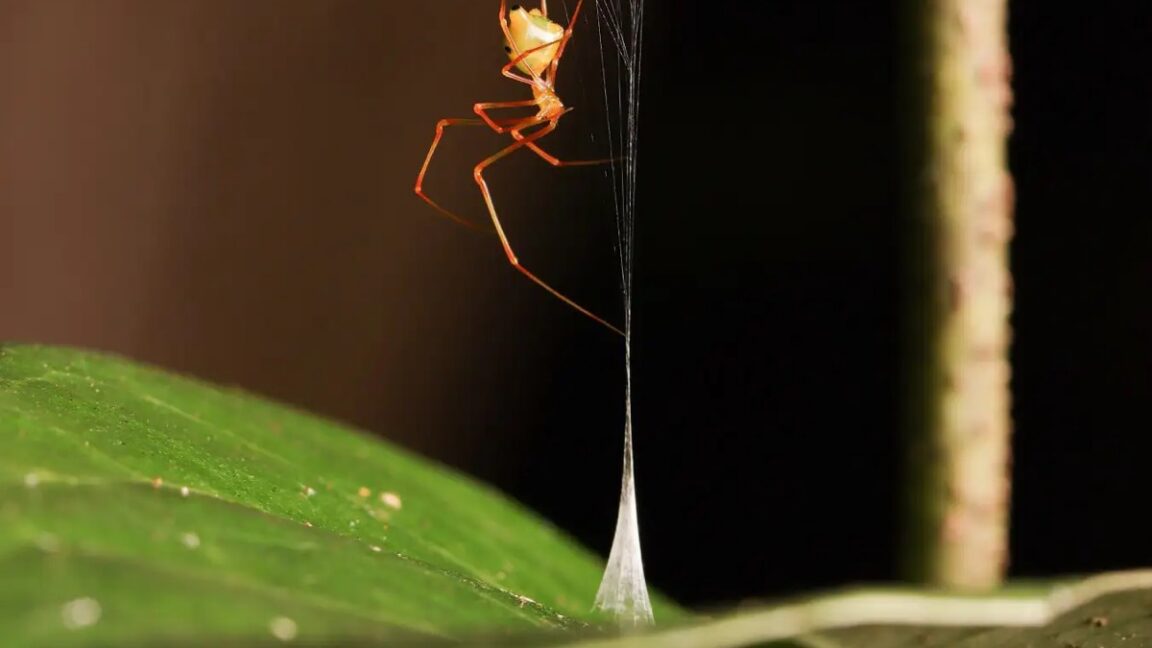
A Current Biology paper described a newly found Australian spider in the genus Propostira that the authors call a “ballista spider.” According to Greg Anderson of QIMR Berghofer Medical Research Institute and colleagues, the nocturnal spiders build conical silk snares under their main webs, attract green tree ants with a chemical signal, and launch trapped ants upward at accelerations as high as 1,367 meters per second squared.
In Nature Communications, researchers explained the familiar coiled shapes of feces using elastic rope-coiling theory. The team said ordinary downward extrusion produces tapering coils like the poop emoji, while lugworms in U-shaped burrows push feces upward, producing uniform “anti-gravitational” spirals; the authors said stiffness and gravity mattered more than muscular control or extrusion rate, and they plan to propose a second poop emoji to the Unicode Consortium.
A medical-history study in Endocrinology, Diabetes & Metabolism revisited the death of Simonetta Vespucci, long linked by some accounts to Botticelli’s Birth of Venus and traditionally thought to have died of tuberculosis. Paolo Pozzilli of Queen Mary University of London and co-authors argued that letters describing her collapse, headache, hallucinations, vomiting and high fever fit a rapidly expanding pituitary tumor, and they said irregular eye positioning in the painting may support further study of that hypothesis.
This story draws on original reporting from Ars Technica.