
Hybrid Corvette breaks Pikes Peak production record
JR Hildebrand drove Chevrolet’s 1,250 hp Corvette ZR1X up Pikes Peak in about nine and a half minutes, while an electric Ford took the overall win.
By Maya Lindqvist · Senior Technology Correspondent
3 min read
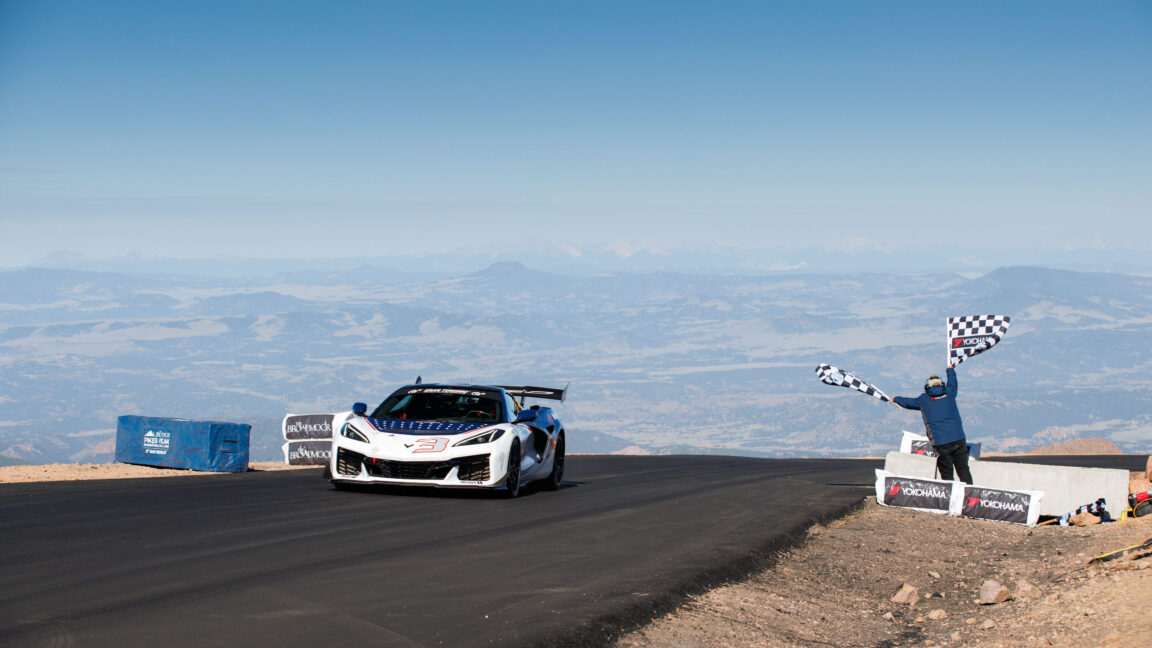
Chevrolet’s hybrid Corvette ZR1X set a new production-class mark at the 2026 Pikes Peak International Hill Climb, with JR Hildebrand completing the 12.4-mile course in about nine and a half minutes, according to Ars Technica. The result put a 1,250 hp production-based hybrid ahead of Porsche’s combustion-powered entries on one of racing’s most demanding climbs.
The 104th running of the event again tested cars across 156 corners on the way to the 14,115-foot summit, Ars Technica reported. The outlet noted that thin air near the top can cut the output of combustion engines, a disadvantage that has helped make electric and hybrid powertrains more attractive at Pikes Peak.
A hybrid takes production honors
Ars Technica reported that the previous production record belonged to a 2022 Porsche 911 Turbo S driven by David Donner, which had been prepared with required safety equipment including a roll cage and fuel cell. Donner returned this year in the same car, while Jeff Zwart competed in a 700 hp Porsche 911 GT2 RS Clubsport.
Hildebrand’s Corvette ZR1X used a 5.5-liter twin-turbo V8 at the rear and an electric motor at the front, according to Ars Technica. The site reported that the car is expected to cost about $210,000 and that the Pikes Peak entry began as a development vehicle before Chevrolet fitted the required safety gear.
Stefan Frick, an energy performance engineer on the ZR1X team, told Ars Technica that the Corvette’s gasoline engine was down by a few hundred horsepower at the summit but still produced power in the 700 hp range. Frick said the car used stock software, while Hildebrand selected the “Race 1” traction setting to limit wheelspin.
GM Executive Chief Engineer Tony Roma told Ars Technica that the team added safety equipment to the car and described it as representative of the production model. Hildebrand also told the outlet that he used racing simulators to learn the rhythm of the course’s 156 turns and tested the car at GM’s Milford, Michigan, proving grounds.
Electric power wins overall
The Corvette beat Zwart’s Porsche GT2 RS by 14 seconds and finished 23 seconds ahead of Donner’s Turbo S, according to Ars Technica. Donner’s 9:53.740 run was just two-tenths slower than his 2022 record time, the outlet reported.
Ars Technica reported that the Corvette’s electric front axle gave it advantages in traction and response, especially in slow corners where immediate torque can help the car accelerate out of hairpins. Matt Foley, crew chief for the 000 Porsche team, told the outlet that a hybrid setup can manage wheelspin by reducing front-motor output rather than relying only on engine cuts or brake intervention.
The overall victory still went to an electric vehicle. Romain Dumas drove Ford’s upgraded three-motor Super Mustang Mach-E to the fastest time of the day at 8:18.202, according to Ars Technica.
Dumas, who set the all-time Pikes Peak record in Volkswagen’s electric I.D. R in 2018 with a 7:57 run, did not match that benchmark this year, Ars Technica reported. His Ford finished 11 seconds ahead of Robin Shute’s Sendycar V1, which the outlet said set a record for rear-wheel-drive cars.
The results gave manufacturers using hybrid, electric and traditional combustion power something to claim from the mountain, according to Ars Technica. At Pikes Peak, where altitude, grip and weather all complicate raw speed, electrified drivetrains again played a central role at the front of the field.
This story draws on original reporting from Ars Technica.