
GM robot rollout draws union anger at Detroit EV plant
GM has added about 50 robot arms at Factory Zero while more than 1,000 union workers remain laid off, according to Detroit business reports.
By Maya Lindqvist · Senior Technology Correspondent
3 min read
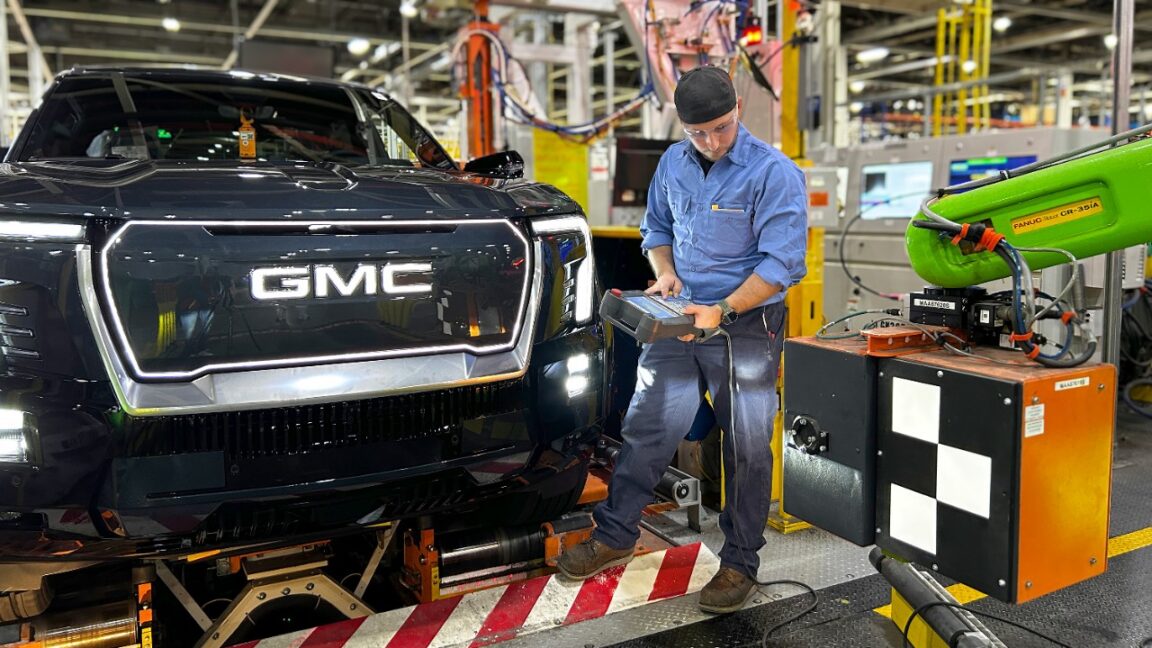
General Motors has added about 50 robotic arms to its Factory Zero electric vehicle plant in Detroit while more than 1,000 union workers there remain off the job after temporary layoffs, according to Crain’s Detroit Business and The Detroit News. The move has sharpened a dispute between automakers and the United Auto Workers over whether factory automation will support employees or displace them.
Crain’s Detroit Business reported that the robots were supplied by FANUC, the Japanese robotics company, and are intended to help fasten parts to vehicles on the assembly line. UAW leaders objected because GM has not recalled workers affected by layoffs announced as temporary in March, according to the reports.
James Cotton, president of UAW Local 22, told The Detroit News that more than 1,000 union members remain “laid off indefinitely.” Cotton said GM could bring some of those workers back instead of installing the 50 robots, according to the newspaper.
The March layoffs followed a separate round of permanent job cuts at Factory Zero in October 2025, when another 1,200 workers were affected, according to Fox 2 Detroit. Factory Zero is GM’s flagship EV plant, and the staffing cuts have landed as U.S. automakers reassess electric vehicle production plans.
Andrew Bergman, a Local 22 member and union organizer who was among the GM workers laid off, told The Detroit News that automation could improve conditions if workers shared in the benefits. “Technological development has the capability of making work safer for the working class and enabling workers to have a shorter work week without losing pay,” Bergman said. “But in the bosses’ and billionaires’ hands it’s used to pad profits and lay off workers.”
The Detroit News reported that the same week in Detroit, company leaders and labor leaders described sharply different futures for robotics and artificial intelligence. At the Reindustrialize Summit, startup founders promoted robots as a way to strengthen manufacturing, while UAW President Shawn Fain warned at the union’s constitutional convention about “the threat of humanoid robotics and mass automation” to jobs and wages.
GM is not alone in adding robots to vehicle production. Stellantis and Ford have also used assembly-line robots, including FANUC systems, and Hyundai plans to put Atlas humanoid robots from Boston Dynamics into work at its Georgia EV facility by 2028, according to company and industry materials cited in the reports.
Automation is further advanced in parts of East Asia, where some companies operate so-called dark factories with few workers on site. FANUC says it has run a lights-out factory since 2001, and Chinese automakers including Jetour and Zeekr have built highly automated plants, according to company materials and The Wall Street Journal.
Xiaomi uses more than 700 robots at its EV Hyperfactory in Beijing, where The EV Report said the company can produce a new electric vehicle every 76 seconds. The Institution of Mechanical Engineers has warned that heavy automation can create problems of its own, including missed production-line issues and greater cybersecurity risks.
The International Federation of Robotics said China had 2 million industrial robots in factories by 2024 and added 295,000 that year. The group said Japan installed 44,500 industrial robots in 2024, while the United States installed 34,200.
This story draws on original reporting from Ars Technica.