
China catches reusable Long March booster at sea for the first time
The Long March 10B flight marks China's first controlled first-stage recovery and tests a net-based method for reusable rockets.
By James Whitfield · Staff Writer
3 min read
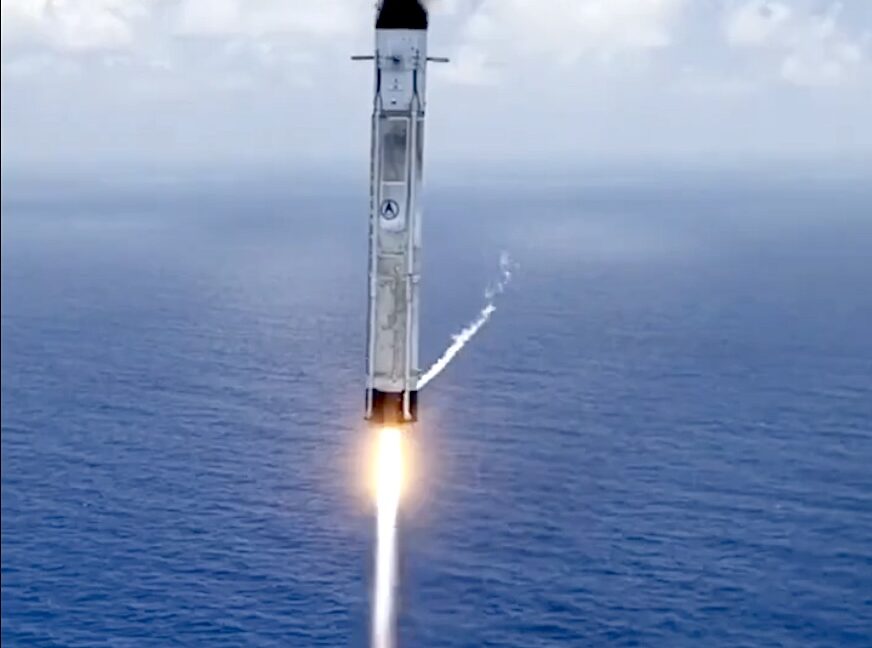
China recovered an orbital-class rocket booster for the first time Friday, a step toward reusable launch systems that could raise the country’s flight rate. The Long March 10B first stage was caught above a ship in the South China Sea after launching from Hainan Island, according to China Aerospace Science and Technology Corporation.
The mission began at the Wenchang Commercial Space Launch Site, where the Long March 10B lifted off at 12:15 p.m. local time, CASC said. The rocket’s upper stage reached orbit and released a payload identified by Chinese officials as CX-26.
About 10 minutes after liftoff, the booster returned from space and lowered itself toward an offshore recovery vessel. Video distributed by Chinese state media showed the rocket settling into a four-legged structure fitted with tensioned cables, which held the booster suspended after its engines shut down.
Chinese officials described the mission as successful. Mao Ning, a spokesperson for China’s Foreign Ministry, wrote on X that the launch was the Long March 10B’s first flight and that the sea-based net catch marked China’s first controlled rocket recovery.
A different recovery method
CASC said the flight tested technologies needed for reusable launch vehicles, including engine restarts at altitude, precision guidance and control, and capture by a net system mounted on a sea platform.
The approach differs from the methods used by SpaceX and Blue Origin. SpaceX lands Falcon 9 boosters vertically on pads or drone ships, and Blue Origin has landed its New Glenn booster on an offshore platform. SpaceX also catches its Starship Super Heavy booster with arms on its launch tower.
The Long March 10B method combines a downrange ship with a catch system. Ars Technica reported that avoiding landing legs can preserve payload capacity, while recovering the booster at sea reduces the propellant needed to return toward the launch site.
The Long March 10B is a two-stage, medium-lift launcher about 63.6 meters tall. Ars Technica reported that it can carry about 16 metric tons to low Earth orbit, slightly less than SpaceX’s Falcon 9. Its first stage uses seven kerosene-and-liquid-oxygen YF-100K engines, while the second stage uses a methane-fueled YF-219 engine.
Part of a broader rocket push
CASC said the Long March 10B team plans to keep improving the vehicle and expects to complete a first-stage reuse flight test by the end of the year.
The rocket is related to the Long March 10A, which is designed for future crew launches to China’s Tiangong space station using the Mengzhou spacecraft. A heavier Long March 10 configuration, using three first-stage boosters, is planned for China’s lunar program. The Chinese government has said it wants to land astronauts on the Moon by 2030.
China has tested other reusable rocket concepts, with mixed results. Ars Technica reported that LandSpace reached orbit with its Zhuque-3 rocket in December but lost the booster near its landing zone, while a Long March 12A flight later failed to recover its descending first stage.
U.S. officials have tied reusable launch systems to military and commercial competition in orbit. Maj. Gen. Brian Sidari of the U.S. Space Force said last year that he was concerned about China using reusable lift to put more capability into orbit faster, according to Ars Technica.
Retired Space Force Col. Charles Galbreath, now at the Mitchell Institute, told Ars Technica that China’s launch rate could rise if reusable rockets are paired with its multiple launch sites. He said peaceful competition can spur innovation, but added that U.S. officials will watch how China’s military uses space capabilities.
This story draws on original reporting from Ars Technica.