
BepiColombo Mercury arrival enters final phase after transfer module separation
ESA’s BepiColombo has shed its cruise propulsion module and is scheduled to enter Mercury orbit on 21 November.
By Hana Yoshida · Markets Reporter
2 min read
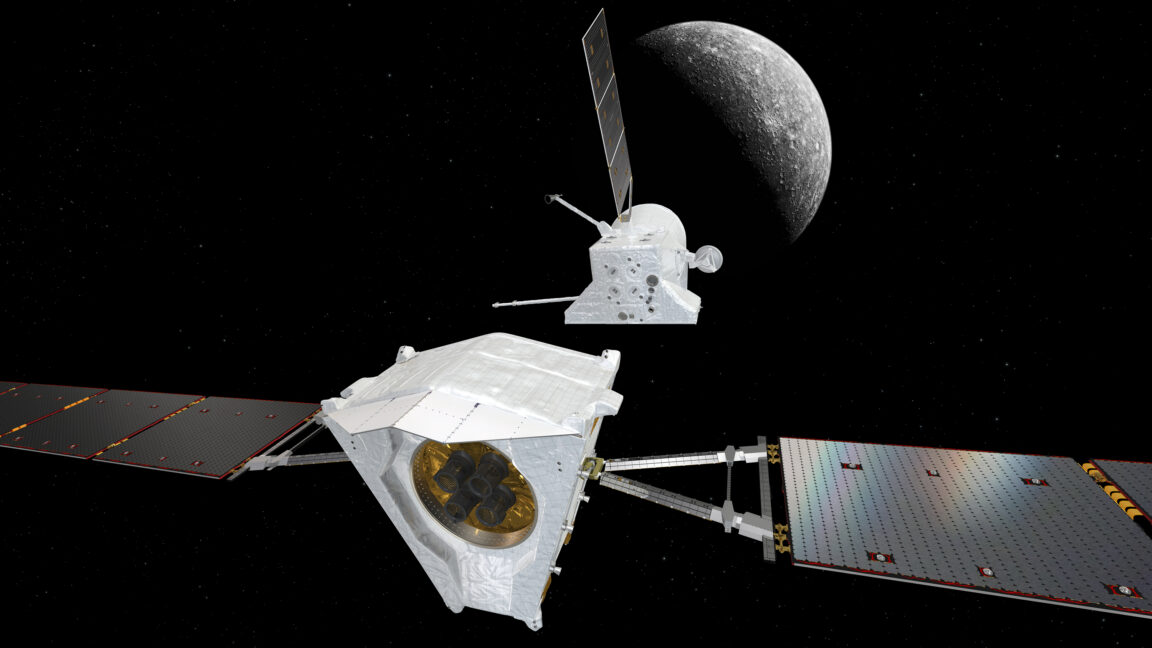
BepiColombo’s Mercury arrival has entered its final phase after the joint European-Japanese spacecraft released the module that powered and propelled it during its nearly eight-year journey. The European Space Agency reported on 3 September that the Mercury Transfer Module had separated and that the remaining spacecraft was healthy, clearing a key step before a planned orbit insertion on 21 November.
The discarded module supplied power and solar-electric propulsion during the cruise from Earth, according to Ars Technica. With that work complete, the spacecraft now relies on the European Mercury Planetary Orbiter, or MPO, while it remains attached to Japan’s Mio Mercury Magnetospheric Orbiter.
Why did BepiColombo take eight years to reach Mercury?
Getting to Mercury is difficult because a spacecraft must reduce enough speed to be captured by the planet’s gravity while traveling deep in the Sun’s gravitational field. BepiColombo, launched in October 2018, used nine planetary flybys and ion propulsion to reshape its path around the Sun, according to ESA and Ars Technica.
The journey was extended by a year after the ion thrusters lost some power in 2024, Ars Technica reported. The transfer module’s release was also an operationally demanding maneuver because the spacecraft is operating near the Sun, where intense radiation and high temperatures complicate power, thermal control and pointing.
Early telemetry showed MPO’s solar arrays were generating power and its batteries were recharging after the separation, ESA personnel said in comments reported by Ars Technica. Aerospace Global News, citing an ESA post, also reported that a signal received through ESA’s Cebreros deep-space antenna indicated the spacecraft was healthy.
What happens next for BepiColombo?
- 21 November 2026: The combined spacecraft is scheduled to enter orbit around Mercury, according to Ars Technica and Aerospace Global News.
- December 2026: MPO and Mio are planned to separate into their respective orbits, Ars Technica reported.
- April 2027: Both orbiters are expected to begin science observations of Mercury and its surrounding environment, ESA said in a mission video description.
The two orbiters were built for complementary work. ESA’s MPO is designed to operate closer to Mercury and examine the planet’s surface, while Japan’s Mio will fly higher to study its magnetic environment, according to Ars Technica. Together, the mission will investigate the innermost planet and the space around it.
The mission is led by ESA in partnership with the Japan Aerospace Exploration Agency, with U.S. contributions also reported by Ars Technica. Its planned arrival would follow NASA’s MESSENGER, which became the first spacecraft to orbit Mercury in 2011 and ended its mission in 2015, according to Ars Technica.
This story draws on original reporting from Ars Technica.